
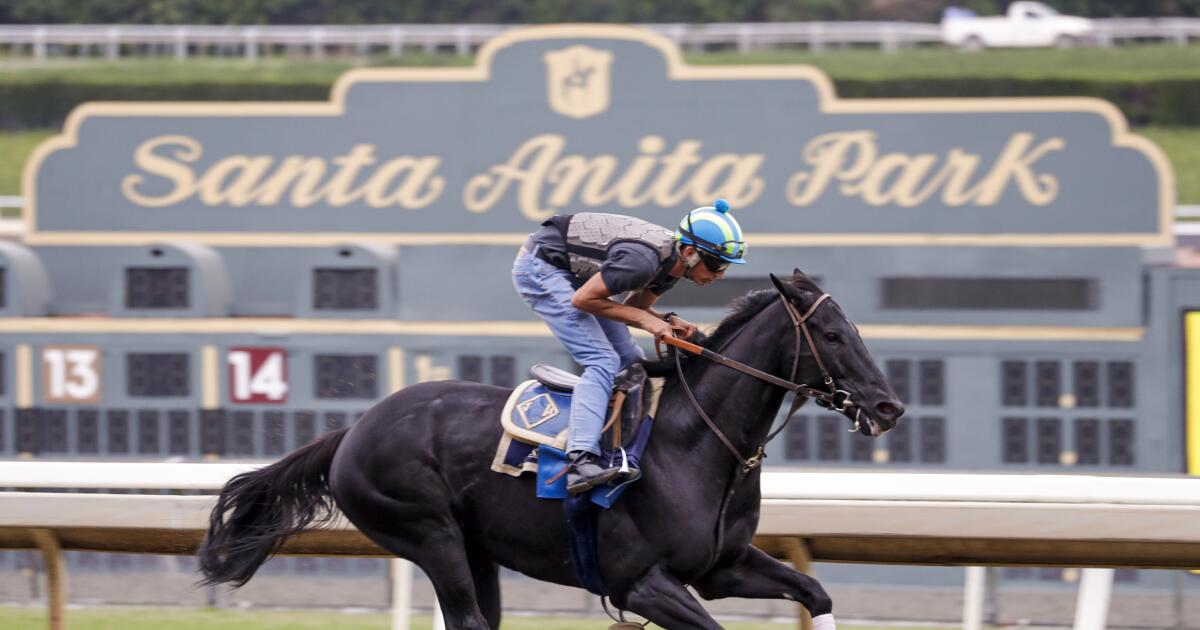
The fight over whether Santa Anita Park can legally have Racing on Demand machines at its facility moved to its next step of litigation on Tuesday when the track filed a writ of mandate against the California Department of Justice.
The 52-page complaint, filed in Los Angeles Superior Court, offered new details on the confiscation of 26 betting machines on Saturday. It also attempts to bring the California Horse Racing Board into the fray by detailing meetings that racing officials had with the regulatory agency.
A writ of mandate is a court order that attempts to correct alleged overreach or abuse of discretion by a government official or agency.
The petitioner, listed as the Los Angeles Turf Club, seeks that the 3X3 wager be deemed legal for concluded races as it is with live races. It also seeks the return of the machines and money that was in the machines. The state says it will destroy the machines in 30 days barring legal remedies to return them to the track.
A major point the track is trying to make is that the state and CHRB each had ample time to tell the track about the legality of the machines. Both state agencies were provided a legal analysis earlier but did not offer any guidance.
“Neither the Attorney General’s office, nor the CHRB, ever disputed [the track’s] written legal analysis or stated that the [track] did not have the legal right to offer the 3X3 wager on concluded races,” the suit said.
The track also said the confiscation was done without a warrant or warning. The DOJ said a warrant wasn’t needed because Santa Anita Park is an “open business with ongoing criminal activity.” The suit says the state could have used other methods to warn the track of the alleged impropriety of the machines rather than sending 21 DOJ personnel, along with two uniformed officers from the Arcadia Police Department, to the track with a U-Haul truck.
According to the Santa Anita incident report, the DOJ did provide Nate Newby, Santa Anita general manager, with a receipt for the 26 machines. But it later denied a request for an itemized receipt for the money that was confiscated.
The 3X3 wager consists of picking horses finishing first, second and third in three different races. The bet was deemed legal by the CHRB on April 18, 2024, and has been in use since then, although with very little usage. At question is if the authorization was only for live races or also concluded races. There was no specific language in the regulation with the track and state viewing the legality of wagering on concluded races differently.
The major opponent to the machines is the Tribal Nation, which has jurisdiction over most non-pari-mutuel wagering in the state. The tribes contend that the machines are little more than slot machines, because they have the look and feel of slots. The tracks say it is pari-mutuel wagering because the payoffs come from a co-mingled pool of machines from many locations and you are not playing against the house, like casino table games.
The track says it never received a statement of the state’s seizure of the machines “other than a form notice provided to Santa Anita Park employees at the conclusion of DOJ’s seizure.”
The suit alleges that the CHRB and attorney general’s office was well aware of the track’s plan to install the Racing on Demand machines. The CHRB has asked its employees and commissioners not to talk about Historical Horse Racing, which are machines similar to Racing on Demand as it allows betting on concluded races, and has had a public hands-off stance of this political hot-button issue.
The California tribes are major contributors to politicians and their PACs.
According to the suit, the CHRB first met with track representatives on Jan. 17, 2024, in the regulator’s Sacramento office to discuss the legality of the machines. They also met “multiple times throughout 2024 and 2025 to discuss [the track] offering its customers the opportunity to place 3X3 wagers on concluded races,” according to the suit.
As late as Nov. 25, 2025, the track met with CHRB personnel to discuss the legality of Racing on Demand. At the meeting were Scott Chaney, executive director of the CHRB; Cynthia Alameda, deputy executive director; Amanda Brown, general counsel; and Jacquelyn Lloyd, staff counsel. The tracks were represented by Eric Sindler, Santa Anita general counsel; Scott Daruty, executive vice president of The Stronach Group — owner of Santa Anita; Josh Rosenstein, president of the Del Mar Thoroughbred Club; and Bill Nader, chief executive of the Thoroughbred Owners of California.
On Dec. 12, 2025, the tracks met with two unnamed CHRB commissioners and Chaney to discuss Racing on Demand. (California public meeting laws do not allow meetings of more than three without public notice.) On Dec. 22, 2025, the tracks talked again with Chaney to discuss a plan to “launch Racing on Demand within the next several weeks.”
On Thursday, the day the machines were operational, the CHRB issued a statement that said: “Like everyone else, we had heard rumors, but the CHRB was unaware of this actual move.”
Also on Thursday, Daruty sent Chaney a letter letting him know that the machines would be in operation that day. In the letter, Daruty referenced “several recent informational meetings and calls we hosted with you, certain [members] of your staff, and certain CHRB commissioners.”
The Racing on Demand machines are considered vital to the preservation of horse racing in California. Most racing states receive supplemental income from casinos or casino-like machines that generally go to raise purses. California racing receives no supplemental income and has lower purses than tracks in other big racing states.
Without supplemental purse income, California racing is in trouble because of the low purses, which leads to small field sizes and causes low mutuel handle, the financial engine that drives the sport.