
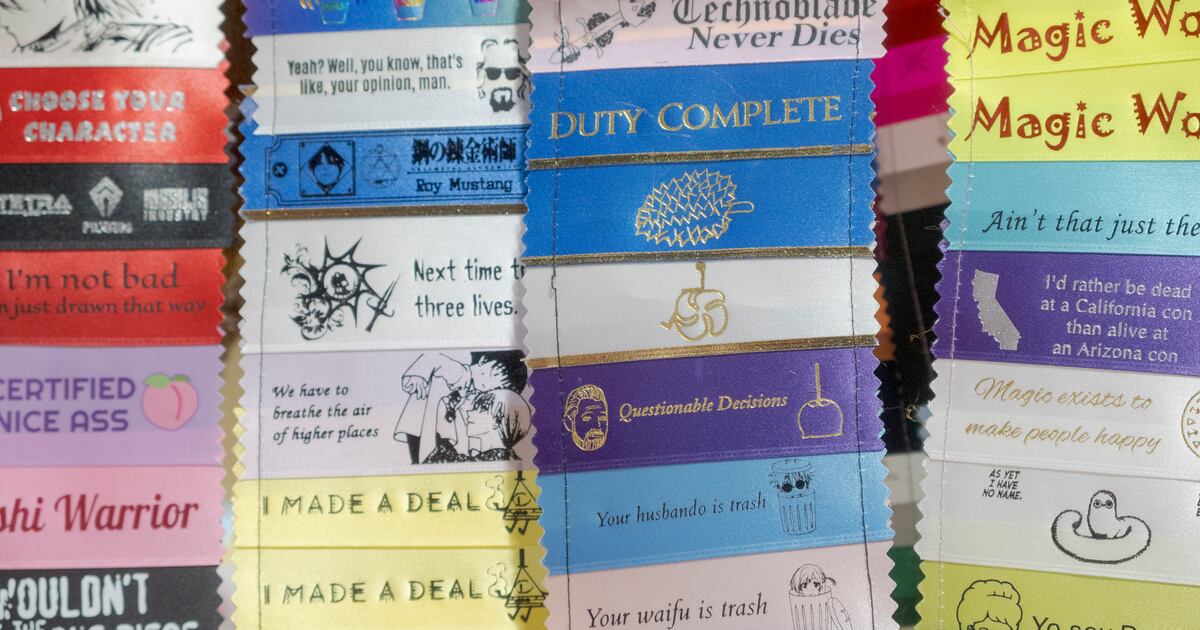
The anime community began 2026 with a bang as Anime Los Angeles opened its doors from Jan. 8-11. Offering events such as meet-and-greets, artist alley, dance parties, cosplay contests and game areas, ALAs was not short of the typical convention activities. However, ALA is home to one special cultural tradition. It starts with a small piece of fabric, a ribbon.
Attendees, vendors, and staff hand out ribbons with adhesives from interactions, little challenges and purchases. The ribbon can then be attached to the person’s badge, and every additional ribbon can be attached to the previous ribbon, making one long chain.
Danni Michelle, the ALA’s department head of Ribbon Services spoke to elevASIAN about the significance of the convention’s ribbon culture.
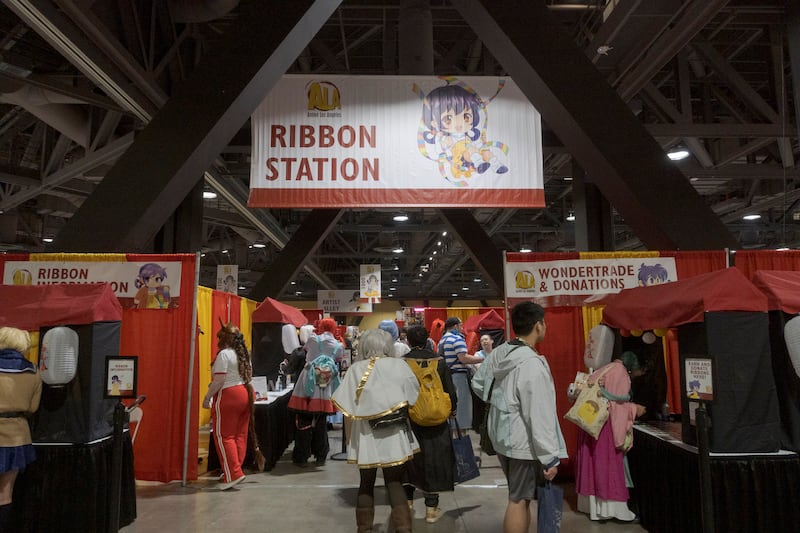 Attendees check out the Ribbon Station, where they can trade, repair and obtain new ribbons. (Photo by Aaron Ogawa)
elevASIAN: I’ve been attending ALA for a few years now. I love the culture here, but I also notice that many people are unaware of the ribbon culture. How did the ribbon culture start at ALA?
Michelle: So originally, ALA was a small hotel lobby convention, and staff had different ribbons that they would give out for fun, little games, when attendees were just polite, or you could just go up to them and ask them politely for a ribbon, and they’d be more than happy to give you one. ALA also had their own first-time ribbons that you could earn as an attendee, and just let them know ‘it’s my first time’, and they give you that first-time ribbon.
Eventually, attendees started figuring out that they could make their own (ribbons) and also bring them to the public, and that’s what kind of started this culture. It started very small, and then kept going. Now it’s very common for almost everyone who comes here to have some form of ribbon to really just engage in that culture that’s been built, and it’s nice because it’s a culture that was really built on being nice and being polite. So that’s the forefront rule: you get rewarded for being nice.
elevASIAN: I never knew if the event was the one who started the ribbon collecting, or if attendees just started handing out ribbons on their own. That’s kind of amazing to hear that fans kind of caught on, and we’re like, ‘Yeah, let’s make this a thing.’
Michelle: Yeah. You can see staff doing it, they’re having a great time giving it out, and you can go make them too. They’re not terribly expensive to order, so the barrier to entry is relatively low, and I think that’s what made it really accessible. That’s also what we tried to do here, was make it accessible to people who maybe don’t know that ribbon culture is a thing, or don’t know where to start. We get to introduce them to something really fun.
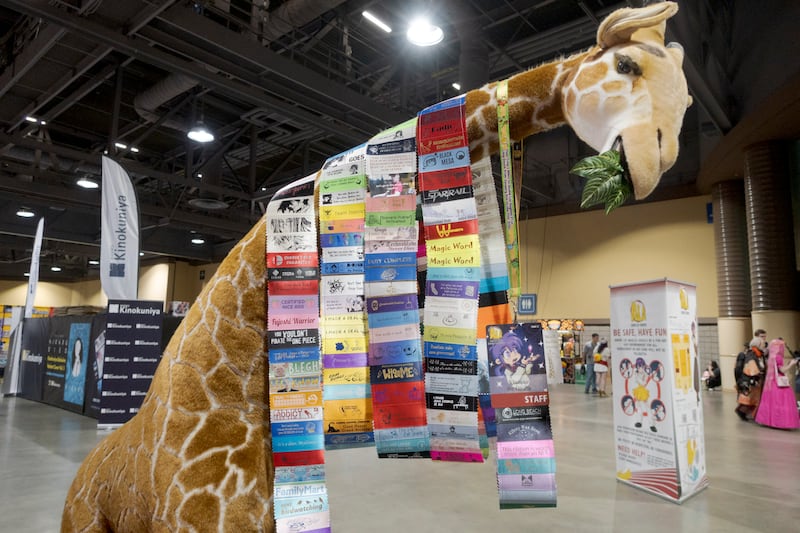 Giraffe model displaying various ribbons at the Ribbon Station. (Photo by Aaron Ogawa)
elevASIAN: Then, when did you guys start to advertise the ribbons? Obviously, I’m sure when people found out about the ribbons, they started talking about it, but when did ALA start pushing for the ribbon agenda? I feel like, out of all the conventions that I know, even in LA, and I’m sure even other conventions outside of California, not many conventions have such a strong ribbon culture as ALA.
Michelle: So I’m gonna backtrack, and then I’ll kind of lead you to where we are. So attendees just kicked off with the ribbon thing. They absolutely just loved it and took off and ran, and the convention said, ‘Go for it.’ They definitely encouraged it, and it was very common to see people throwing their ribbon chains off the third-story Radisson, Ontario, back when we were located there, or just trying to get really tall ribbons. You would see people stretching out their ribbon chains all over the con.
When we started the Ribbon Station eight or nine years ago, it was because we decided that, since there were so many attendees who were new and weren’t quite sure of what the ribbon thing was, we wanted to make a table where staff could answer questions and help just make ribbons a little bit more accessible. At that time, there was one gatcha machine, one sewing machine, and, I believe, two staff, and that’s all it was. And we made it work. We love ribbons and we want other attendees to be able to experience that if this is something that they’re interested in, and we don’t want it to feel like just because they didn’t know about it, or they haven’t done it before that they can’t participate in it’s something that clearly, as you can see by how many people have massive ribbon chains, it brings a lot of joy to people.
elevASIAN: I love how accessible it is, how welcoming the culture is. It’s so much fun. How do you think the culture evolved?
Michelle: Yeah, it’s definitely evolved in ways that now you see a lot more like ribbon games and people engaging in it. Generally, it hasn’t changed too much. There’s still definitely that ‘be nice,’ culture, and it’s so wonderful that something that has just caught on and kind of taken off is rooted in this ‘be nice and polite,’ and that is rule number one. It is such a core part of this that I think is what also makes it really enjoyable, because you’re not coming across any really nasty people. It’s people who understand they don’t owe me a ribbon.
There’s a certain level of just politeness that needs to happen for this interaction to work. Now you see people with massive bins of ribbons. We didn’t see that maybe 10 or 15 years ago. One person can have hundreds of designs, and that was unheard of. The mass amount of ribbons there is now absolutely crazy. Multiply that by how much bigger the con gets every year, and you just get this extreme amount of ribbons, which is beautiful, and in a way, it’s not as easy to get the ones you want because it is harder to find people there, and it’s harder to find that one ribbon. So I think it’s more evolved in the sense of quantity, of course, but generally, at the core, it’s still the same.
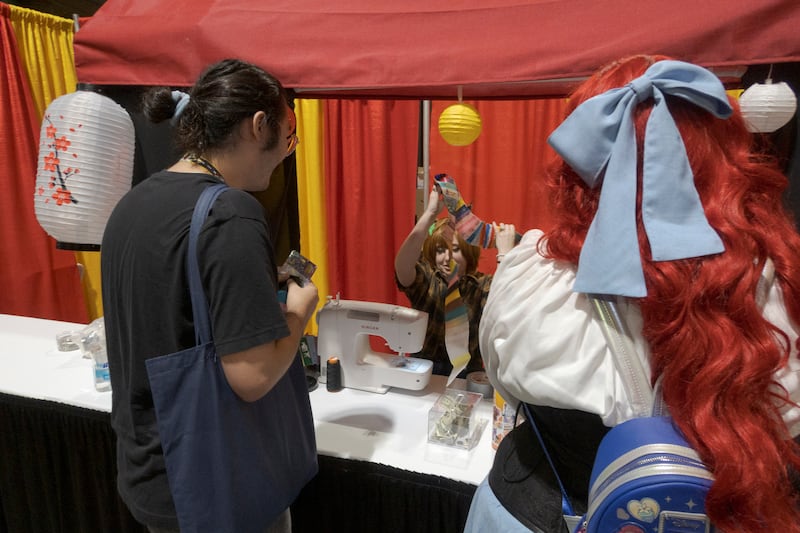 Attendees repairing their ribbon collections at the Ribbon Station. (Photo by Aaron Ogawa)
elevASIAN: That sounds like so much fun. Finally, is there anything else you’d like to add, whether it’s about the ribbon culture or the convention?
Michelle: Part of the reason I have been on the Ribbon Station team since year two was because of the people. It is so exciting to see someone get the ribbon they want, playing a game, earning it through ribbon station because they’ve met a certain criteria. Every year, I have to post a public thank you on how nice everyone is, because they make my life easier and they make me have a good time, even though I’m technically working.
It is amazing to see how many people come through the Ribbon Station because there really is something for everyone. It’s nice to see how many people really enjoy what we do here, and make it so that there is a reason we’re here. Of course, I know we’re not doing something crazy like logistics or anything, no one will die, but it adds something to the convention experience, and it just brings us, as staff, so much joy to see that other people are enjoying the things that we come up with.