
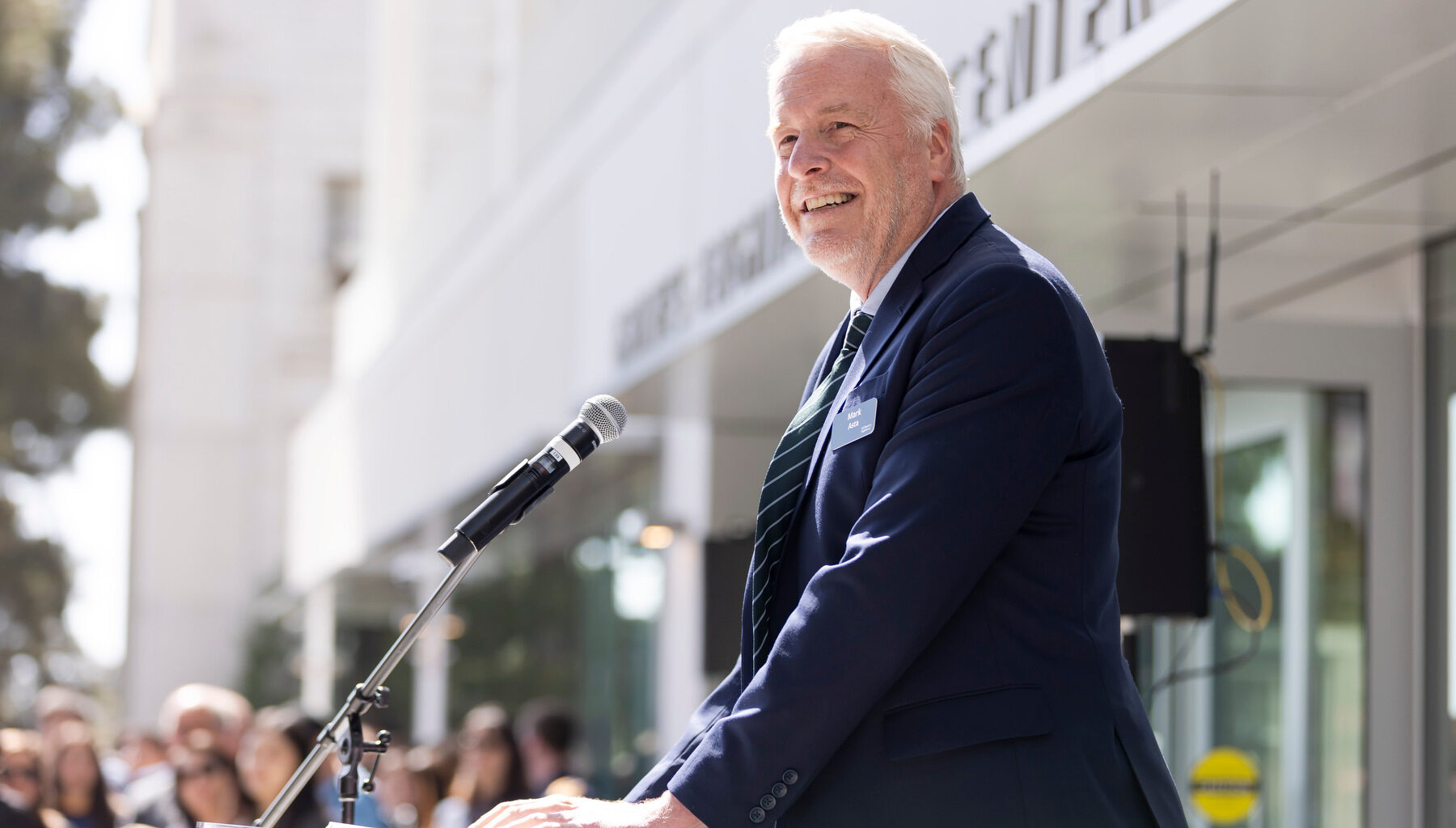
January 21, 2026 by Sarah Yang
Mark Asta, a distinguished materials scientist and a UC Berkeley faculty member for more than 15 years, has been named the new dean of UC Berkeley’s College of Engineering after a competitive national search.
The appointment, announced today by Chancellor Rich Lyons and Executive Vice Chancellor and Provost Ben Hermalin, makes Asta the 14th dean of Berkeley Engineering. Asta’s term as dean will officially begin on July 1, 2026, one year after his appointment as the college’s interim dean.
“During his tenure as the College of Engineering’s executive associate dean, and more recently as interim dean, Mark clearly demonstrated extraordinary leadership and a comprehensive commitment to excellence and innovation,” said Chancellor Rich Lyons. “His vision for the college’s future, and his dedication to Berkeley’s mission and values instill confidence and excitement for what the future holds. I’m excited to work closely with him in the years ahead.”
In 2010, Asta joined UC Berkeley’s Department of Materials Science and Engineering and Lawrence Berkeley National Laboratory’s Materials Sciences Division, where he holds appointments as Arthur C. and Phyllis G. Oppenheimer Distinguished Professor in Advanced Materials Analysis, and senior faculty scientist, respectively. His connection to UC Berkeley began decades earlier as a student. He earned his B.S. degree in engineering physics, master’s in physics and Ph.D. in materials physics, an interdisciplinary program combining physics and materials science and engineering.
“As a proud Berkeley alum, I have personally experienced the unparalleled excellence of the academic programs and breadth of opportunities available here” said Asta. “I’ve witnessed firsthand how Berkeley Engineering ignites a passion among its community members to advance societal progress. Serving as dean is both exciting and humbling, and a tremendous honor.”
Asta earned his doctorate in 1993 and promptly started work at Sandia National Laboratories, first as a postdoctoral associate and then as a senior technical staff member. He returned to academia in 2000 when he joined Northwestern University’s Department of Materials Science and Engineering as an associate professor. He spent five years at Northwestern before returning west to UC Davis as a full professor and then as vice chair in the Department of Chemical Engineering and Materials Science.
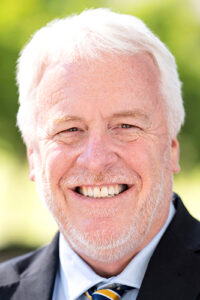
Mark Asta (Adam Lau photo)
After joining UC Berkeley in 2010, Asta soon took on leadership roles for his department and the college. From 2012–18 he served as department chair of materials science and engineering, overseeing the hiring of six faculty and an increase in the rankings and research impact of the department.
In 2018, Asta became director of Berkeley Lab’s Materials Sciences Division. There, he oversaw expansion of the portfolio of materials research programs funded by the Department of Energy’s Office of Basic Energy Sciences, spanning programs in data-driven materials discovery and materials for microelectronics, quantum information and renewable energy.
Five years later, he took on the position of executive associate dean of Berkeley Engineering, and in 2025, he began his one-year term as the college’s interim dean. As interim dean, Asta holds the Roy W. Carlson Chair of Engineering, an endowed chair that he will retain as he transitions to the dean position in July.
Among the many initiatives and responsibilities Asta has taken on at the college is co-leading the development and advancement of its strategic plans for the Berkeley Space Center and the Resilient and Sustainable Engineering initiative.
“We are living through a period of unparalleled technological acceleration, where groundbreaking innovations like artificial intelligence (AI) are profoundly influencing every facet of our society,” said Asta. “This dynamic landscape presents extraordinary opportunities for Berkeley Engineering to confront our most pressing societal challenges, while also fulfilling a responsibility to ensure inclusive access, champion sustainable practices and safeguard against unintended consequences for already marginalized communities.”
Asta sees vast potential for physical AI to transform engineering practice. As dean, he plans to foster multidisciplinary collaborations in emerging technology areas that hold the promise of addressing pressing societal issues in human health, advancing resilient communities and realizing sustainable approaches to intelligent technologies.
Among his priorities is the support and elevation of the student experience, ensuring that the engineering education at Berkeley prepares them to lead in an era of rapid change.
Last semester, the college launched the Student Organization Applied Research (SOAR) labs at the Richmond Field Station, an effort that Asta began and co-led as the college’s executive associate dean. The upgraded workspace supports co-curricular activities that provide opportunities for hands-on and collaborative experiences vital to an engineering education.
“It’s worth noting that the graduation rate of Berkeley Engineering students far outpaces the national average,” said Asta. “This success stems from a comprehensive array of programs supported by the college that not only enable academic success, but support the more ambitious college goal of training future engineering leaders.”
Asta emphasized the importance of Berkeley Engineering’s community values of inclusivity and collaboration, which remain essential to the success of these educational and research efforts.
A distinguished researcher, Asta’s expertise is in the field of computational materials science and data-driven accelerated discovery and design. His work leverages computational simulation techniques and AI methods to advance structural alloys and critical materials for applications in extreme environments, including those encountered in nuclear fission and fusion, as well as aerospace applications.
Among Asta’s numerous honors is election as fellow of The Minerals, Metals & Materials Society (TMS) and of the American Physical Society. He earned the William Hume-Rothery Award from TMS and the David Turnbull Lectureship Award from the Materials Research Society.
See related