
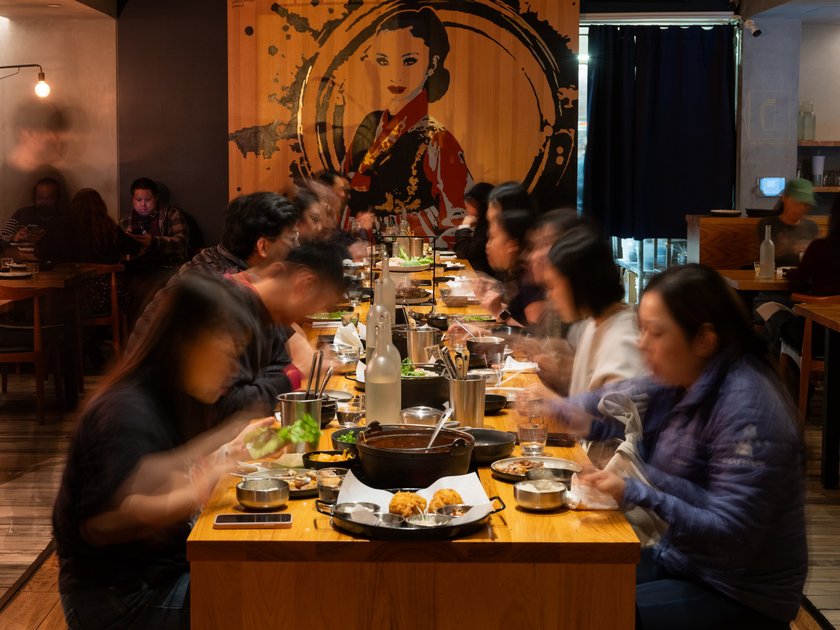
On a busy Friday night, the sound rippling through the dining room at Ilcha, the Korean restaurant and bar in the Marina, isn’t K-pop hits from Blackpink or NewJeans. It’s the clinking of glasses and peals of laughter — the unofficial soundtrack of most Korean pubs, otherwise known as sool-jibs.
Ilcha, which means “first round,” is more than the name of the 4-year-old establishment. It’s also a nod to the owner and chef Kummi Kim’s vision to introduce a unique aspect of Korean drinking culture to the Bay Area. Though San Francisco has seen a Korean restaurant and bar boom in recent years, Ilcha remains one of the only places to enjoy premium sool, a category of beverages that includes soju and makgeolli.
But on Feb. 14, Ilcha will pour its last glasses of soju. In December, Kim and co-owner Hilwin Wong sold their lease for the space on Lombard Street to an unnamed buyer who will convert it to an Indian restaurant.
 Elise Andersen, of San Francisco, films content of budae jjigae.
 A hotpot simmers on a table at Ilcha.
“There’s no one real reason behind selling, other than someone expressed interest, and we had the opportunity,” Kim says. “There has definitely been a downturn in business, but I think that’s the case overall for everybody right now.”
Kim says she feels ready to move on from the restaurant she built. “I think I accomplished what I wanted to, which was to introduce a kind of Korean sool-jib culture that didn’t quite exist here yet.”
Before Ilcha arrived in 2022, late-night spots Toyose and Cocobang were among the only places in San Francisco that offered a glimpse into Korean drinking culture. After 11 p.m. on weekends, rowdy groups stumble into such bars to order kimchi fried rice and crispy seafood pancakes, which they wash down with foamy pitchers of the Korean lager Terra and cheap bottles of soju.

With Ilcha, Kim wanted to add dimensionality to the picture. Rather than open another restaurant designed to be the last stop of the night, she wanted to create a place that made Korean drinking culture the main event.
Instead of offering banchan and familiar dinner entrees like bibimbap and bulgogi, she rolled out a menu of “anju,” snacks intended to be paired with drinks. The selection includes items that she hasn’t seen on many San Francisco menus: kim mari, fried seaweed-wrapped spring rolls; ganjang gaejang, soy sauce marinated raw crab; and ganjang saewoo, soy-cured shrimp served with gyeran bap, rice that’s been doused in sesame oil and crushed seaweed, then topped with an egg yolk. Ilcha’s version of Korean fried chicken — a crunchy, salty, juicy masterpiece — includes the option to order a whole bird instead of just wings or thighs.
But the food, of course, is and has always been secondary to the sool. “It’s about pairing drinks with food,” Kim says — not the other way around. “When we started, people were upset that we didn’t carry wine and sake, but that wasn’t the point.”

Thanks to Korea-focused distributors like KMS Imports and domestic artisanal producers like Hana Makgeolli in Brooklyn and Nasung in Fullerton, Kim curated a wide-ranging list that champions high-quality sool. “My main goal was to introduce traditional sool outside of what most people know, which are those green bottles of soju. We offer that as well, because it’s part of the drinking culture. But we wanted to offer more than that.”
Four years later, it’s undeniable that San Francisco’s understanding of Korean drinking culture has deepened. Jilli SF, another lively sool-jib, opened last year in the Mission, and Buoy (opens in new tab) and The Korner Store Bites & Vibes also serve anju and a wide selection of soju. Even non-Korean bars, including Millay Sake + Wine Bar, pour makgeolli.
Even though Ilcha will say its final “gunbae” — cheers — in a few weeks, Kim believes the Korean dining scene will continue to rise in San Francisco. And she wants to be a part of whatever comes next. “I feel like it only makes sense for me to keep leaning in, right?” she says. “We’ll see. We’ll see where it goes.”