
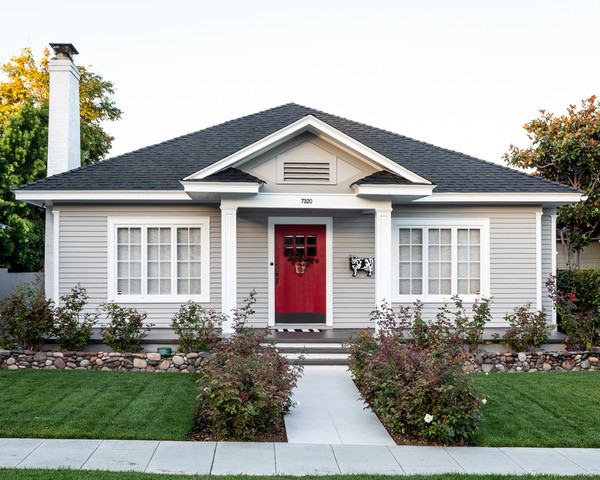
A La Jolla couple and local preservationists claimed victory Jan. 22 as the San Diego Historical Resources Board went against city staff’s recommendation and designated a cottage on Fay Avenue as a historic resource after nearly an hour of debate.
In recent years, Michael and Lisa Maher, owners of the 1928 Colonial Revival cottage at 7320 Fay Ave., sought to have the house designated under HRB Criterion C, indicating the property embodies distinctive characteristics of a style, type, period or method of construction or is a valuable example of the use of natural materials or craftsmanship.
The Mahers live in the house, built and originally owned by Judson and Mary Ferguson, and though there is no current threat to it or plans to develop the property, the Mahers say they want it designated to help preserve it beyond their lifetimes.
“We have watched hundreds of cottages and bungalows destroyed,” Michael Maher said previously. “The house next to us, constructed in 1915, was demolished [in December].”
However, during preliminary review of the Mahers’ application, city staff recommended that the house not be designated under any criteria.
“Staff’s position and recommendation is that the home does not embody sufficient character-defining features of the Colonial Revival style to be eligible for designation under HRB Criterion C as an individually significant historical resource,” said city spokesman Peter Kelly.
When the HRB considered the application during its Jan. 22 meeting, staff argued that while some original features of the house are consistent with the Colonial Revival style, others have been altered, which could affect the integrity of the character-defining elements.
Maher told the board that the house retains many “dominant characteristics associated with Colonial Revival cottages.”
“It is a textbook cottage example consistent with its era and the La Jolla streetscape,” said Maher, who added that it retains “a high level of integrity … and is one of the few remaining examples of La Jolla’s early permanent residential core from the 1910s to 1920s.”
 La Jolla resident Michael Maher, who with his wife, Lisa, owns a 1928 cottage at 7320 Fay Ave., addresses the San Diego Historical Resources Board during its Jan. 22 meeting. (Screenshot by Ashley Mackin-Solomon)
La Jolla resident and local architectural historian Diane Kane said the house reflects the “better homes or smaller homes in America movement” of the late 1800s, which helped usher in a new era of smaller residences that housed military members. She said Colonial Revival houses were instrumental in carrying the movement forward, further signifying the need to preserve and protect examples that still exist.
“The smaller-home program jump-started homebuilding in the United States in a boom during the 1920s that only ended with the Depression,” Kane said. There is a “dwindling supply” of such houses remaining in La Jolla, she added.
Local historian Seonaid McArthur said the cottage “embodies early La Jolla residential development, retains integrity and clearly conveys its period. … This house doesn’t need to be exceptional to be historic, it needs to be authentic, and it is.”
During the board’s deliberations, member Michael Provence raised the question of whether the house should get additional consideration since the number of Colonial Revival-style cottages is declining.
“Is it possible or plausible that as fewer and fewer examples of a particular type of vernacular architecture exists because others are destroyed that something that might not have been significant when there were hundreds or thousands of examples might become significant?” he asked.
City staff member Alvin Lin said rarity is not typically a factor in staff recommendations.
Nevertheless, a motion to designate the property under Criterion C narrowly passed 7-2 (with six votes needed).
Board member David McCullough called the cottage a “good example of Colonial Revival [and] … representative of a dwindling supply of [properties] … characteristic of 1920s La Jolla.”
After the vote, Maher told the La Jolla Light that “we respect the city’s historic preservation staff’s recommendation and are grateful for the care the HRB … members brought to their deliberations. … When the board voted in our favor, it was a profound relief and an immensely heartening moment.”
“Knowing the home mattered — not just to us but to so many others — and seeing the community come together was a powerful reminder of why La Jolla is such a special place,” he said. ♦