
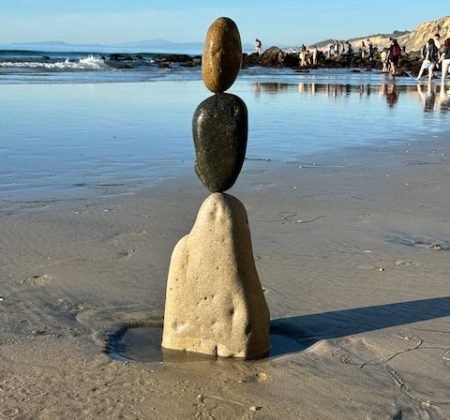
While Alan Ackerberg was taking a walk near the tide pools north of Scripps Pier in La Jolla this week, he came across an impressive sculpture composed of three rocks — one on the bottom and the others perfectly balanced atop it.
Marveling at the creation, Ackerberg approached a man who had made three such structures on the beach to see how they could possibly stay intact.
“The sculptor was still at the beach, so I asked that very question,” Ackerberg recalled. “The answer is gravity. No glue, no adhesive, no pins.”
The sculptor could not be reached for comment for this story. But eye-catching sculptures like his can be seen across the world, and according to a professor at UC San Diego’s Scripps Institution of Oceanography in La Jolla, they are a testament to the wonders of geophysics.
Vashan Wright, an assistant professor of geophysics, studies granular sand and how it influences geohazards and applies pressure on earthquake faults.
Two factors allow the rock sculptures to stay intact, Wright said.
“You have a collection or group of rocks in what we would call mechanical equilibrium,” said Wright, who added that granular physics follow the same rules. “And that means its motion does not change over time.
“To create this mechanical equilibrium, such that it doesn’t move, you need to balance your forces that are exerted on each rock and you also need to balance the torques.”
The key, he said, is finding a contact point to balance the rocks upon one another. Upright rock stacks such as the ones Ackerberg encountered are considered to be in a metastable state, meaning a smaller contact area makes it vulnerable to falling from the smallest of disturbances. Flatter stacks, meanwhile, more easily maintain their center of gravity.
Stacked rock sculptures called cairns often are seen at national parks, according to the National Park Service, and their presence can mark routes for hikers and help ensure they stay on the right path.
The Park Service recommends that people not disturb, knock down or add to cairns, though some parks caution visitors not to rely on them as official pathways. ♦