
Advocates for reparations, who have struggled to enact key pieces of their agenda following a landmark report and recommendations from a state task force in 2023, don’t appear likely to have a strong champion in California’s next governor.
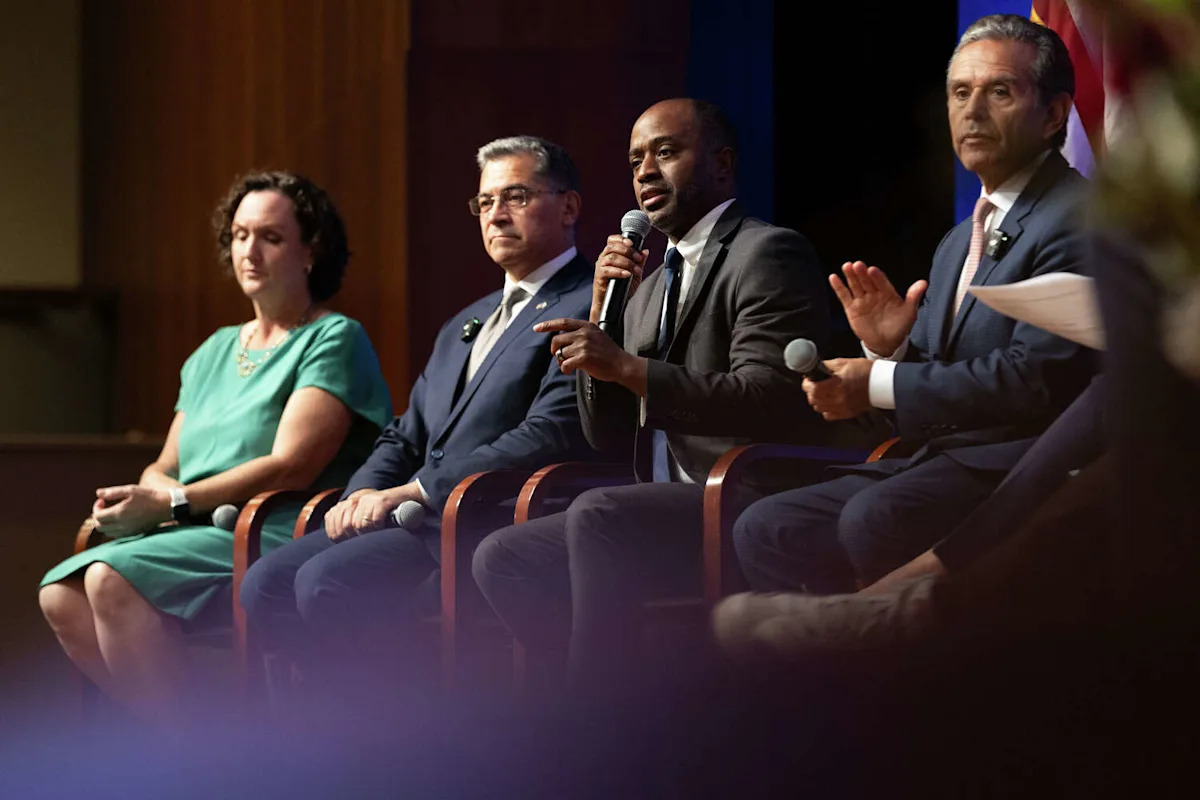
Only one of the Democratic candidates at a forum sponsored by the Urban League of the Bay Area on Monday mentioned reparations when asked what their first act would be to ensure that people of color can thrive economically.
Superintendent of Public Instruction Tony Thurmond, the only Black candidate among the major Democratic hopefuls, was the only one who included reparations in his response. Yet Thurmond notably suggested giving loans to Black residents – not the cash payments that have been the most controversial piece of the reparations discussion.
“I will sign as governor a reparations package that gives loans to black folks who want to start a business to go to college or to pay for a home,” Thurmond said in response to the question by Oakland Mayor Barbara Lee, a former chair of the Congressional Black Caucus.
Afterward, Lee said: “Reparations are a key strategy to achieve racial and economic equity. The only Black candidate (Thurmond) demonstrated a clear understanding of why this is critical.” Lee has endorsed Thurmond for governor.
California made history in 2020 by establishing the nation’s first task force to study harms faced by Black residents and to recommend policies to address and atone for systemic racism. The reparations task force released a final report in May 2023, recommending a wide range of remedies addressing housing discrimination, the criminal justice system and access to state assistance. Lawmakers have implemented some of the proposals, but many have met intense resistance and failed.
Last fall, Gov. Gavin Newsom signed legislation creating the Bureau for Descendants of American Slavery, which will create an infrastructure for reparations measures. He also backed $6 million for the California State University system to research methods for verifying descendants of people enslaved in the U.S. who want to access benefits. But no agency could administer cash payments until and unless California lawmakers, and its governor, approved them – something that has so far been a nonstarter.
Newsom has vetoed five reparations-related bills supported by the Legislative Black Caucus, including one that would have enabled colleges to prioritize descendants of American slavery. He has said that “dealing with the legacy of slavery is about much more than cash payments.”
Other than Thurmond, most of the six Democratic candidates who attended Monday’s forum, sounded closer to Newsom’s position. Most deflected the question or answered by talking about DEI policies or their own race or ethnicity.
The six- former Secretary of Health and Human Services Xavier Becerra, former state Sen. Ian Calderon, former Rep. Katie Porter, billionaire former hedge fund manager Tom Steyer, former Los Angeles Mayor Antonio Villaraigosa and former state Controller Betty Yee – did not specifically mention reparations in what they would do first to help Black and Brown Californians. Organizers said Rep. Eric Swalwell and the top Republicans in the race, former Fox News commentator Steve Hilton and Riverside County Sheriff Chad Bianco, were invited to Monday’s event but did not attend.
Porter promised that diversity, equity and inclusion guidelines that have been systematically targeted by the Trump administration – must be core to every policy decision and the state must do a better job enforcing those guidelines.
Steyer said he would create a cabinet-level “office of DEI” to ensure that “that across the government there is fair representation of people, because the most diverse group makes the best decisions.” When Steyer ran for president in 2020 he supported reparations, saying, “I don’t think we can be the country that we want to be until we acknowledge the past and move to accept the mistakes this country made that are dramatic and obvious, and then repair the damage.” He wasn’t that explicit Monday.
Becerra, the son of Mexican immigrants, said that he would “appoint people who look and sound just like you. That’s the most important thing we can do is to make sure that you are represented, that you have someone that you can look at and say, ‘I know that person. I can trust that person.'”
When pressed after the forum about whether he would support a reparations package, Becerra said that he would “work with the Legislature.” He said he would focus first on making sure that no one would lose their MediCal benefits, which are being threatened by federal cutbacks and disproportionately affect Black residents. Black residents are 21% of Medicaid enrollees nationally, while being only 13% of the population, according to a Pew Research survey.
Becerra said he was generally in favor of reparations, but “the question there is, ‘What (legislation comes) first? And how do you fund it? ‘”
Villaraigosa, the first Latino mayor of Los Angeles in a century, said when he was mayor “70% of my appointments and 70% of my staff was of color. I will stand up for Blacks and Browns. I will stand up against the attacks on DEI and I will stand up for the notion that the government has to look like the people it represents.”
Afterward, when pressed, Villaraigosa said that he wouldn’t support a reparations package and that “I’m in favor of fixing our schools. That’s the best way to address past discrimination, but not a reparations package.”
Yee said after the forum that “reparations can look like a lot of different forms, but obviously it’s going to be about how we invest in the community so that we are dealing with some of the structural inequities that have brought us to this point.”
Yee said she would focus on creating “housing opportunities that are really attainable” and helping to create better access to capital for the Black community.
“I don’t want a one-and-done, where it’s just like a cash payment,” Yee said. “It’s got to be about how we look at systems that are going to help create intergenerational wealth.”
Calderon didn’t mention reparations at all, and instead promised to conduct a “forensic audit of every tax credit, every agency, so that we actually know where the money is going. How many times have you been made promises that you’re going to get funding for your businesses, your communities? And it never happens. It’s because the state doesn’t follow through on its commitments.”
Nearly 3 in 5 Black Bay Area residents (59%) said they have difficulty dealing with the rising cost of living, including paying bills, maintaining stable housing, and having enough food to eat, according to a survey of 401 Black Bay Area residents released Monday by the Urban League of the Bay Area.
The survey found that 46% of the respondents said they were impacted by the rollback of diversity, equity and inclusion programs.
This article originally published at California’s next governor isn’t likely to push reparations effort forward.