
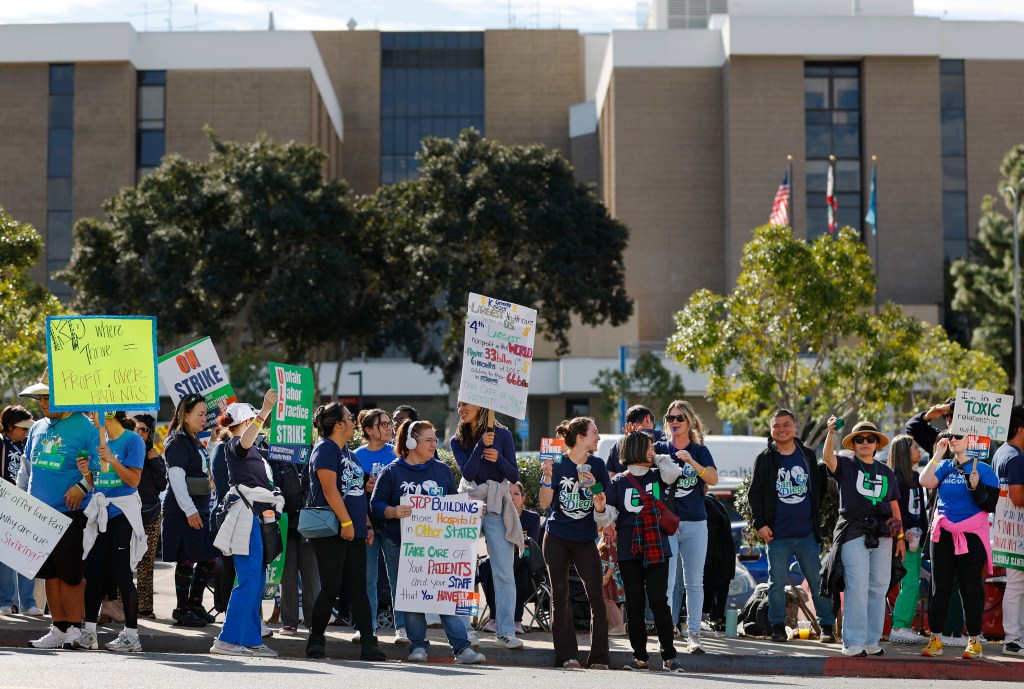
Kaiser nurses statewide began an indefinite strike Monday, restarting picket lines that went idle after a five-day work stoppage in October 2025.
Given that union members do not get paid if they do not work their shifts, such an open-ended walk-off is rare. And it is not like Kaiser Permanente is refusing to pay nurses more. The health care juggernaut has said repeatedly in statements that it has offered raises that would adjust pay upward by a total of 21.5 percentage points over the length of a potential four-year contract, an amount that outstrips the 17 percentage point increase recently ratified by Sharp nurses.
Kaiser has made that proffered pay increase the centerpiece of its messaging campaign to avoid another strike. Though the company has not said how many replacement workers it has brought in to keep its operations running, any such action generates millions in extra labor costs.
The medical provider makes the point that the 31,000 registered nurses now on picket lines in California and Hawaii would fare far better financially if they would just take the deal, especially when “step” wage increases are included. Those increases automatically increase pay as workers amass more years of experience.
Average wages for union-represented nurses in Southern California, Kaiser says, average $77.43 per hour.
“These individuals would see their hourly rate increase to $101.69 by the end of the contract — an increase of 31.5%, which includes across-the-board pay and step increases,” a Kaiser statement said. “This means a full-time nurse would see an (average) increase in wages from $160,861 to $211,513 per year.”
Why not just take the raise?
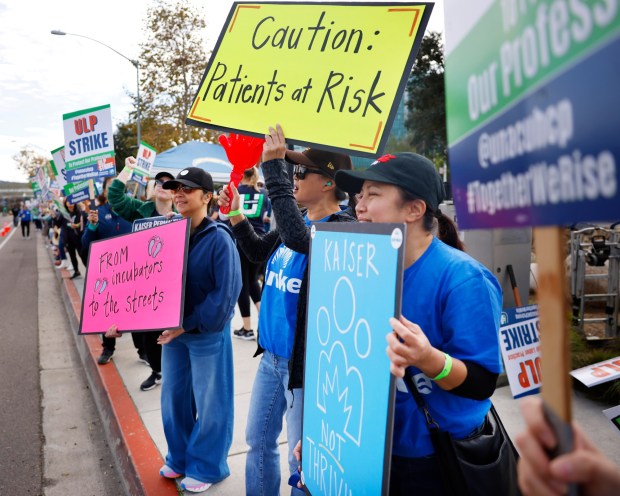 San Diego, CA – January 26: Kaiser Permanente nurses and healthcare workers picket at the Kaiser Permanente San Diego Medical Center as part of an unfair labor practices strike on January 26, 2026 in San Diego, CA. Around 31,000 employees went on strike at facilities in California and Hawaii. (K.C. Alfred / The San Diego Union-Tribune)
Nate Poliakoff, a registered nurse in the emergency department of Kaiser’s San Diego Medical Center in Kearny Mesa, said that the main driver behind a second strike in just three months is unresolved disagreements over staffing. The union, he said, has previously negotiated staffing that is to be one better than the state’s mandated nurse-to-patient ratios.
For example, medical and surgical units in hospitals are to have one nurse for every five patients. Emergency departments are mandated to staff one nurse for every four patients. But Kaiser’s existing contract, Poliakoff said, reduces those examples to 1:4 and 1:3, respectively. He said that part of the union’s staffing concern is that Kaiser has not met these lower ratios.
In general, Poliakoff said, nurses do not believe that the number of resources brought to bear day in and day out is enough to meet the bedrock mandate of providing quality care for patients.
“If a nurse is doing transports and taking a patient off the unit, then who’s watching that nurse’s patient? If a nurse is not working to the top of their scope, and they’re doing work that a CNA, an LVN or an ED tech could be doing, that’s delaying them in doing the actual work that they should be doing,” Poliakoff said. “Things slow down, you begin to rush the quality of care.”
Kaiser flatly rejects the notion that the strike is about anything other than reimbursement.
“Despite the union’s claims, this strike is about wages,” Kaiser said in a statement. “This open-ended strike is unnecessary when such a generous offer is on the table.
“The strike is designed to disrupt the lives of our patients — the very people we are all here to serve.”
The organization tends to do well on independent quality assessments.
All three of Kaiser’s hospitals in San Diego County, located in Kearny Mesa, Grantville and San Marcos, have “A” hospital safety grades from The Leapfrog Group, a nonprofit hospital rating group.
Kaiser said Monday that it is shifting some appointments to its virtual care platform, either phone calls, video chats or electronic chat, and “may need to reschedule certain appointments, elective surgeries, and procedures.”
The medical provider has not stated how many services have had to be rescheduled thus far.