
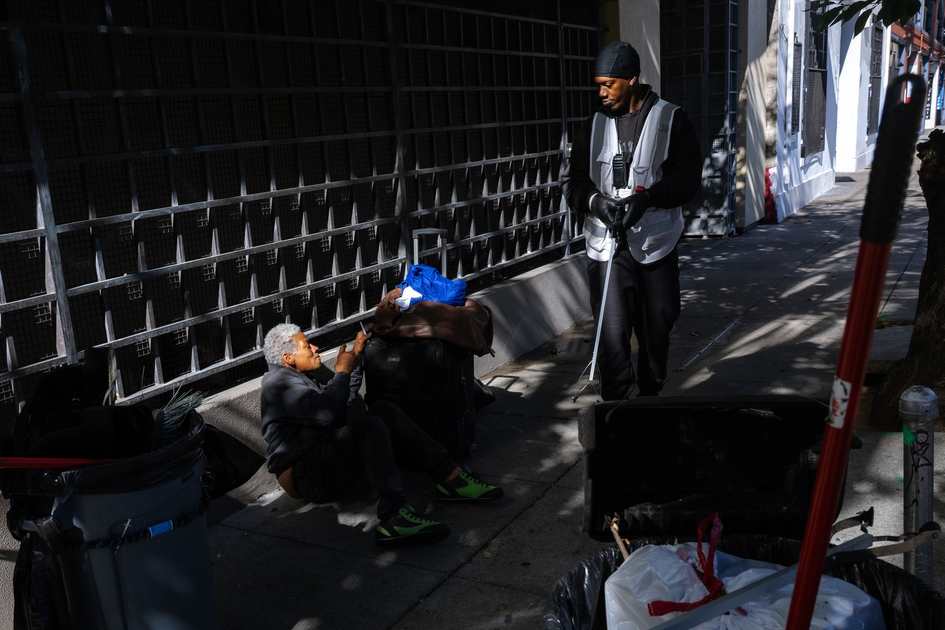
As San Francisco increasingly leans on private contractors to tackle its visible drug and homelessness crises, Supervisor Myrna Melgar is introducing new legislation on Tuesday that aims to ensure higher wages for frontline street workers.
The Department of Emergency Management in December awarded $32 million in contracts to five organizations tasked with responding to homelessness, public drug use, violence, and trash. Some elected officials, including Mayor Daniel Lurie, have credited these for-profit and nonprofit entities with improving street safety. However, union leaders allege that outsourcing this work leads to subpar outcomes as employees are underpaid, undertrained, and under less scrutiny than city staffers.
Melgar’s legislation, the Clean Streets and Fair Pay Act, would require future contracts to pay street ambassadors a wage comparable to what they would make if employed by the city. The requirement, Melgar hopes, would force the city to thoroughly evaluate whether its own employees could be used instead of contractors.
Melgar and union leaders credited recent reports in The Standard for spurring the legislation. In December, The Standard profiled Ahsing Solutions, a nascent for-profit organization tasked with responding to the drug crisis in the Mission, raising questions about the ethics and effectiveness of the growing “street ambassador” industry. Experts in security law say Ahsing and another large city contractor, Urban Alchemy, require ambassadors to do work typically performed by licensed security guards, though the organizations do not possess the required licenses.
 Supervisor Myrna Melgar during a Board of Supervisors meeting. | Source: Michaela Vatcheva for The Standard
“They’re actually doing the work that a police officer should do, or a [Homelessness and Supportive Housing Department] worker, or a [Department of Public Health] worker,” Melgar said of the ambassadors. “Then turning around to pay their workers minimum wage. I just don’t think that’s right.”
Ambassadors employed by the five organizations that signed new city contracts in December make between $52,000 and $62,400 annually. By comparison, a city-employed street inspector can make up to $134,000 annually, plus overtime, benefits, and other compensation that adds tens of thousands of dollars, according to Transparent California.
The proposed law is likely to cause controversy at City Hall as leaders search for creative ways to bolster essential public services despite growing budget constraints. Lurie has made addressing the street crises a priority of his administration. His office did not respond to a request for comment on Melgar’s legislation.
The street ambassador model, which employs formerly incarcerated or homeless people, among others, to monitor problematic street corners, has grown locally and nationally since Urban Alchemy launched in San Francisco in 2021. In 2024, the nonprofit reported annual revenue of nearly $84.9 million.
 Urban Alchemy employees at UN Plaza. | Source: Jason Henry for the Standard
Business owners and residents have praised the programs for clearing visible drug use and homelessness from San Francisco sidewalks. Critics say the initiatives are merely shuffling the crises out of public view and not necessarily resulting in significant financial savings for the city.
Last year, Laborers International Union Local 261, which represents employees of the Department of Public Works, blasted Ahsing Solutions, alleging it did not work collaboratively with city employees. However, the union said this week that it had reached an agreement with Ahsing, under which the company would no longer power wash the sidewalks.
The Department of Emergency management said in a statement that Ahsing doesn’t use a power washer and that the organization is still expected to “maintain a clean environment.”
Representatives of Ahsing Solutions and Urban Alchemy did not respond to requests for comment.
The companies have faced criticism for having low-paid, front-line employees perform work similar to that of security guards without the proper licenses, training, oversight, or insurance, placing them in danger. In September, a man allegedly used a shotgun to kill an Urban Alchemy ambassador who had asked him to move, marking at least the third time one of the nonprofit’s workers was shot.
“A city that tolerates exploitation is a city that abandons its values,” civil rights icon Dolores Huerta said in a statement. “Fair wages are not a luxury — they are the foundation of strong communities.”
Proponents of the contractors argue that Urban Alchemy and others have some of the region’s most effective job programs for formerly incarcerated people. But Melgar contends that these workers would be better served in union jobs that offer better pay and upward mobility.
“If you keep somebody in a role for four years cleaning bathrooms, that’s obviously exploitation,” the supervisor said. “We want to support the upward mobility that comes with a good union job.”