
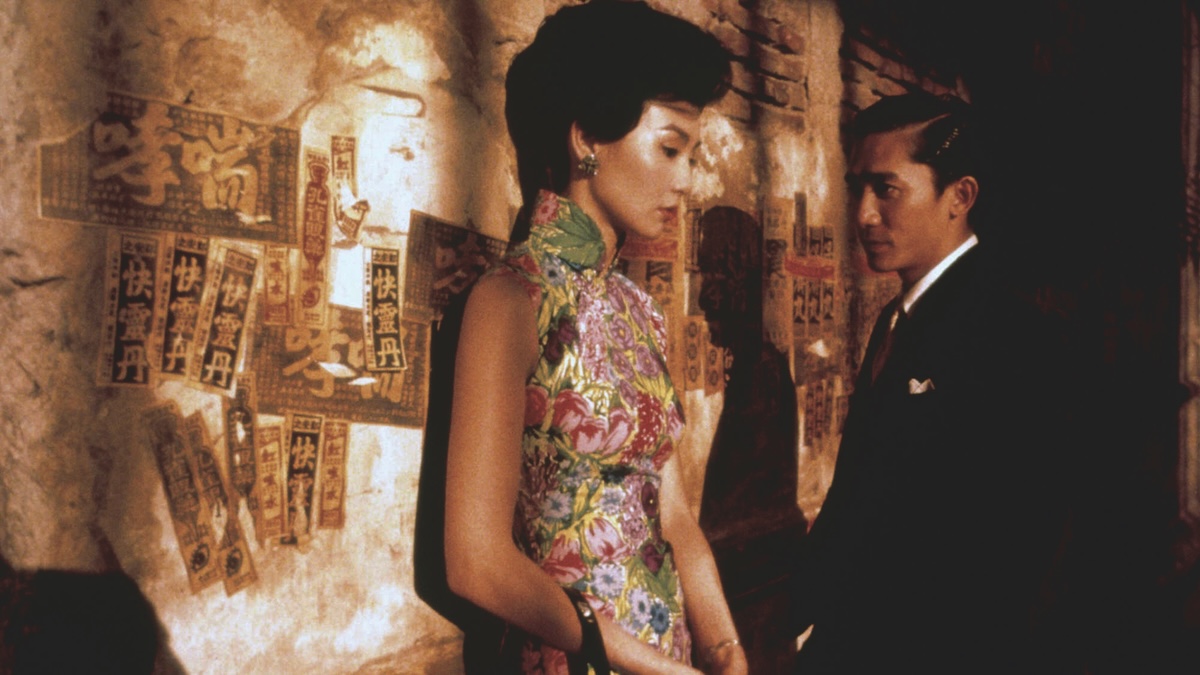
When the name Wong Kar Wai first lit up stateside screens in the early 1990s, it was as if a bolt of lightning had suddenly struck the Hong Kong film scene, and now its energy was radiating across the Pacific. The electricity was intense and immediate.
Wong’s approach was a radical departure from the then-Crown Colony’s typical fare, which relied heavily, up until that time, on swords and gangsters. Wong’s films made room for affairs of the heart, in contrast to the stylized violence that had been Hong Kong’s most popular product for years.
Not very long after that, this reviewer called Wong the world’s most romantic filmmaker. Nothing in the world has happened since then to challenge that reputation.
“In the Mood for Love: The Films of Wong Kar Wai,” a selective retrospective of 13 of Wong’s most provocative works, is now well under way at the Berkeley Art Museum Pacific Film Archive. The most brilliant of the director’s gems—presented by the Hong Kong Economic and Trade Office—are there for pleasurable examination through Feb. 28.
Wong’s biggest all-time critical hit is the 2000 release In the Mood for Love, a lightning rod for doomed romanticism starring the most magnetic actors in Hong Kong, Maggie Cheung and Tony Leung Chiu Wai. It screens Jan. 30 and Feb. 14. As if aroused by an insistent sexual drumbeat coming from deep inside them, cautious-but-curious urbanites Su Li-zhen (Cheung) and Chow Mowan (Leung)—each married to another person—perform an intricate pas de deux in the hallways and stairs of their HK apartment house. Never mind that the film was mostly shot in Bangkok and Angkor Wat, in order to recapture the vanished surface vibe of 1962 HK.
Cinematographer Christopher Doyle’s images never fail to enchant us, likewise the mid-20th-century chic of Cheung’s cheongsams and Leung’s Mad Men suits. But the film’s overpowering rhythm comes from the downward tragic trajectory of the lovers’ lives. Filmmaker Wong is a sucker for sadness, especially when it’s warmed by body heat. The result is one of the most rewarding film dramas of the fledgling 21st century.
The 1997 production Happy Together creates an altogether different shower of sparks, in the story of a pair of on-again, off-again gay male lovers—played by Tony Leung Chiu Wai and Leslie Cheung—bouncing around Buenos Aires and into and out of each others’ arms. Once again the overriding mood is one of lingering melancholy. Try as he might, Leung’s working-class expat can never quite get drunken playboy Cheung off his mind. Expect one or two rough-sex sequences, arranged in contrast to Leung’s patented gloomy wistfulness. DP Doyle’s camera work makes it all seem the height of modern metrosexuality, à la intense bursts of bad-boy horseplay in a succession of flavorful Argentine street scenes. Happy Together shows Feb. 13, with an introduction by critic Iggy Cortez.
Just as his use of the Mamas & the Papas’ “California Dreamin’” threatens to overwhelm the filmmaker’s jazzed-up 1994 policier Chungking Express—screening Feb. 28—Wong is seemingly unafraid to let his obsessions run away with his stories.
The Grandmaster (2013) is a case-in-point, a putative reflection on previous decades’ costumed historical epics told from the point of view of the legendary, real-life martial artist Ip Man, played by then-51-year-old Tony Leung Chiu Wai.
Amid the splendiferous settings and political stresses of 20th-century China, the character of Ip manages to evoke internal power struggles, the Japanese invasion in World War II and his championing of the martial art of Wing Chun into a heroic panorama. Meanwhile, the ongoing love story of Ip and Miss Gong (Zhang Ziyi) is the definition of tough love.
Like their mafia counterparts in Western gangster pics, Ip’s and his fellow martial artists’ speech is flavored with near-poetic metaphor, such as—“If you don’t see something, does it not exist?” The Grandmaster plays Feb. 21. For further info, visit: bampfa.org.
* * *
Through Feb. 28 at BAMPFA