
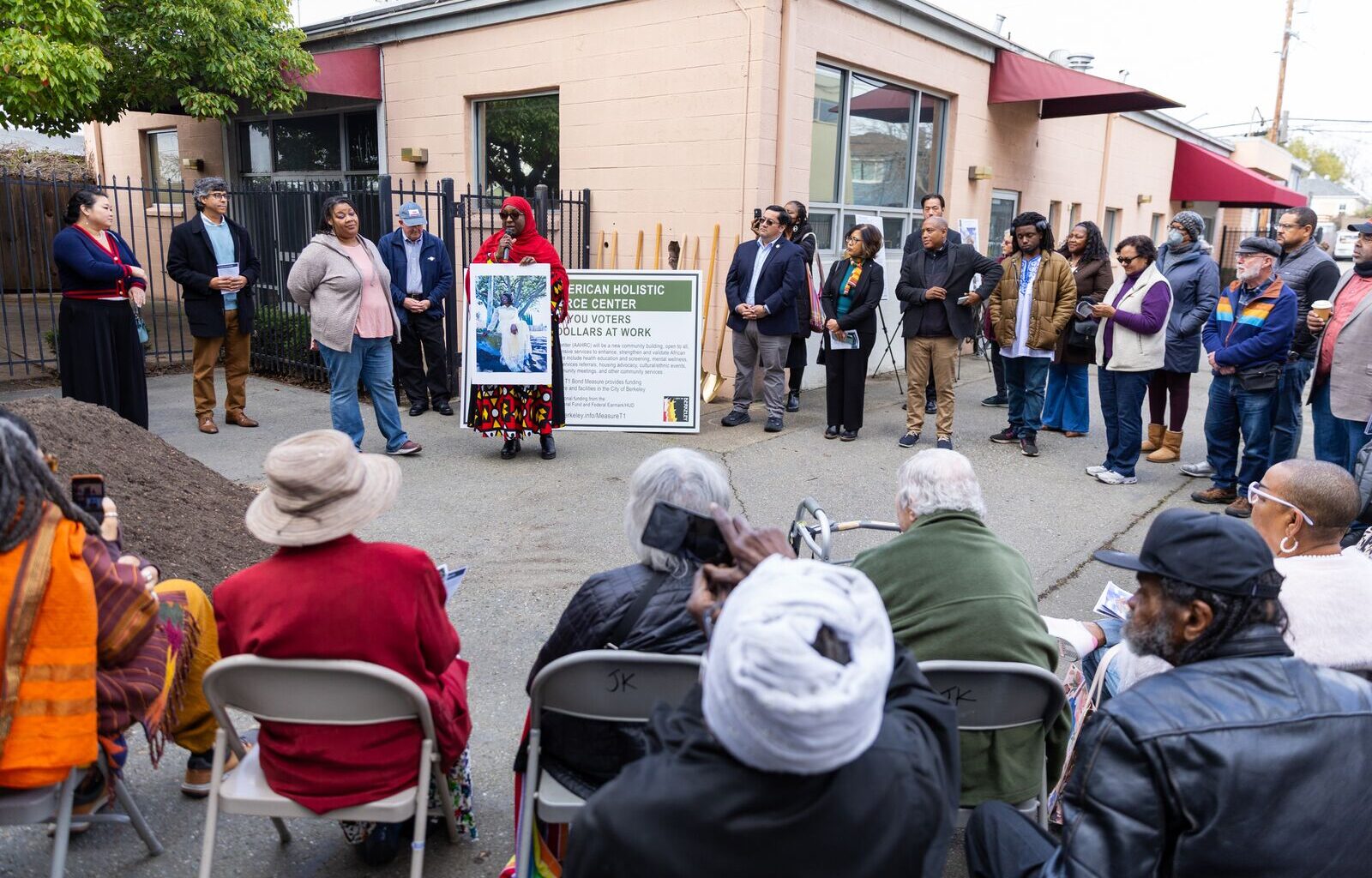
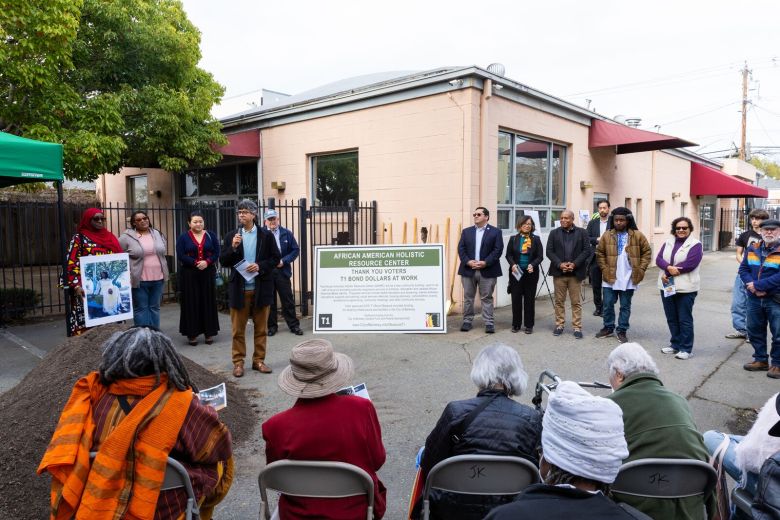
 City Manager Paul Buddenhagen speaks at a groundbreaking event Friday for the African American Holistic Resource Center. Credit: Estefany Gonzalez for Berkeleyside
The city began construction last week on a long-planned South Berkeley resource center designed to serve Black residents and those displaced due to racism, gentrification and skyrocketing housing costs.
Focused on uplifting African American and Black identity, cultural values and traditions, the center is being championed by city leaders as an affirmation of Berkeley’s progressive values at a time when the Trump administration’s crackdown on diversity, equity and inclusion has many corporations, nonprofits, universities and cities backpedaling.
“They’re trying to make equity a bad word, but we won’t let them,” Berkeley City Manager Paul Buddenhagen said at a groundbreaking ceremony Friday.
“They’re trying to disinvest in communities of color so explicitly,” Mayor Adena Ishii said. “We’re saying this project matters.”
Planning for the African American Holistic Resource Center, which will be located on 1890 Alcatraz Ave., has been in the works for at least 15 years. The two-story, roughly 6,000-square-foot building will provide culturally relevant resources — including education, employment assistance, health and mental health services and housing advocacy — to “help eliminate inequities within Berkeley’s African American community,” according to the city.
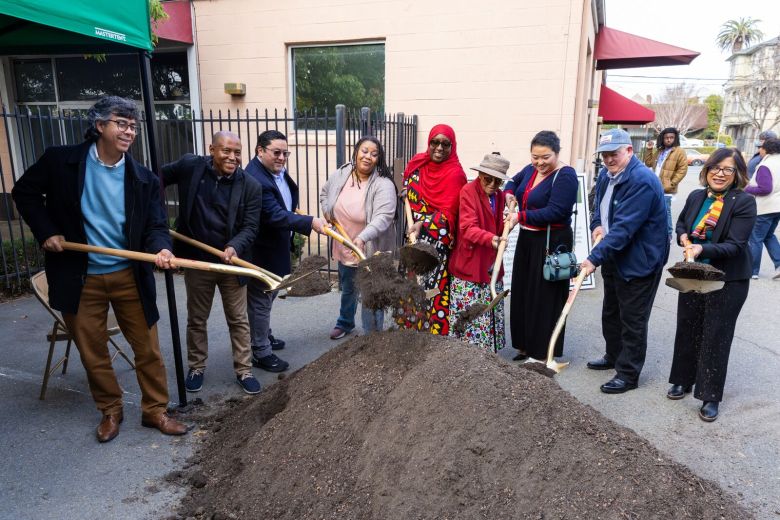 City leaders and community members put shovel into dirt during a the groundbreaking ceremony for the African American Holistic Resource Center on Friday. Credit: Estefany Gonzalez for Berkeleyside
It is expected to open sometime in 2027 and will primarily serve the formerly redlined neighborhoods of South and West Berkeley, where Black residents mostly settled in the first half of the 20th century due to government-supported racist housing restrictions in other parts of the city.
“We plan to develop a building that will work for all children and help them to grow and do great things,” Richie Brook-Cole Smith, who is widely known as “Ms. Richie” or the “Mayor of South Berkeley” because of her long-time involvement with children and the community, said at the groundbreaking.
“We are not waiting for someone else to do something. We know what our children need, and we will see that they get what they need,” she said.
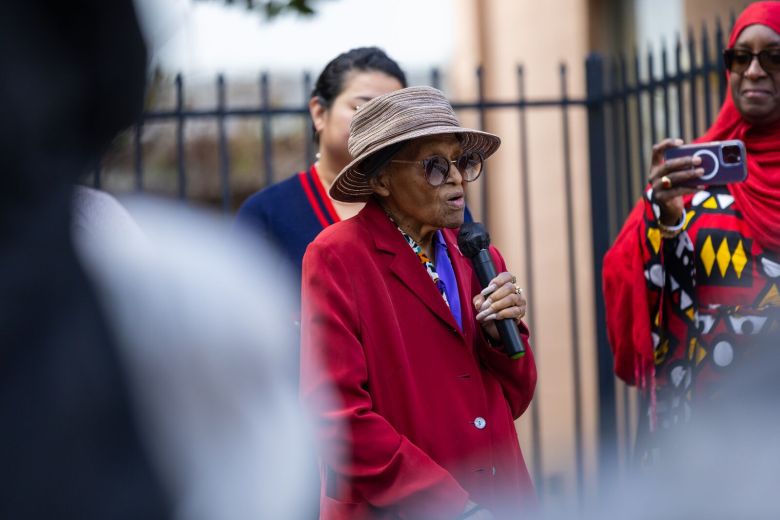 Richie Brook-Cole Smith, often called the “Mayor of South Berkeley,” speaks at the groundbreaking. Credit: Estefany Gonzalez for Berkeleyside
Smith arrived in 1949, in a post-war period when hundreds of thousands of African Americans were coming to the Bay Area, and she has raised her children and grandchildren in Berkeley.
For decades, South Berkeley was the busy center of Black life in the city, with many Black businesses and community organizations. But over the decades, the city’s overall Black population has fallen to just a third of what it was in 1970, in the tail end of the Great Migration. As of 2024, Black residents in Berkeley made up 7.4% of the city population.
It’s a change that’s particularly visceral in historically Black South Berkeley, home to this new resource center, where the Black population shrank by 30% from 2010 to 2020.
Alameda County Supervisor Nikki Fortunato Bas said the new space is intended to be a “place of healing, restoration, and investment.”
Center will include shelter, pantry, garden and event space and be open to all
Services in the resource center will be tailored to the Black community and will include health screenings, scholastic tutoring, recreational programming, community meetings and social services referrals. City officials said the center will be open to everyone.
The project is expected to cost nearly $22 million, with $15 million of funding from Measure T1, the city’s general fund, and federal grants, according to the city. Structural problems derailed the original building’s planned restoration. An additional $6.85 million was allocated to demolish a Berkeley-owned 3,910 square-foot commercial building and build an entirely new building on the parcel. The project is designed by AE3 Partners, Inc.
The space will include a pantry and teaching kitchen, a reservable indoor and outdoor event space, and a meditation garden, according to a project program distributed Friday. The facility will be open during the day as a community center and will also be used as a shelter space during emergencies like excessive heat or earthquakes, Berkeley parks director Scott Ferris said.
“This will be a home to hold all things that are necessary to heal the community, whatever that might be, because that will be determined by the community itself,” community activist and project steering committee member Starla Gay said.
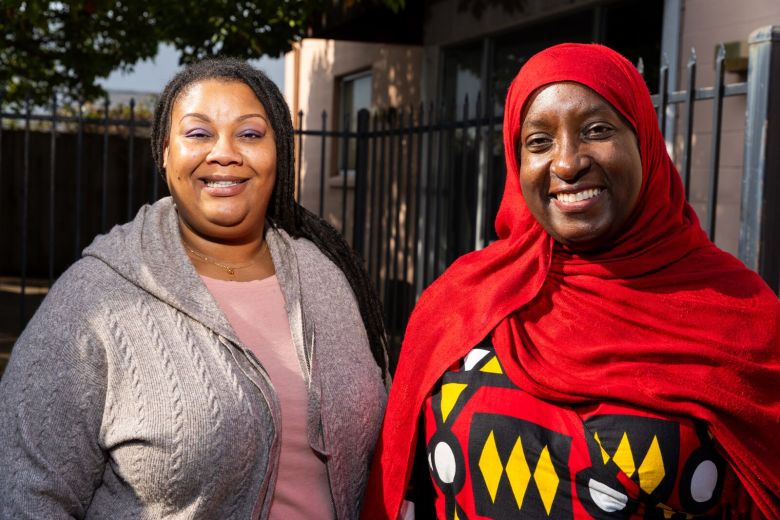 Starla Gay, left, and Babalwa Kwanele of the center’s steering committee pose for a portrait during the AAHRC groundbreaking event on Friday, Jan. 23, 2026. The AAHRC Center aims to provide holistic resources including education, employment assistance, health and mental health services, and housing advocacy.
Gay said work has already started developing programming, such as supporting youth mental health through intergenerational trainings and community events.
“Members of the community were there every single step of the way for years, talking about the design and creating a holistic third space,” Babalwa Kwanele, activist and steering committee member, told Berkeleyside. She said local youth suggested creating a community garden on the resource center’s roof.
Local officials and activists spoke at the Friday ceremony about the project’s 15-year journey, which consisted of years of health data analysis, activism and city planning.
“I was a different person 15 years ago. I actually still lived in Berkeley 15 years ago,” Gay said during the ceremony. “That’s changed. The kind of work that I did, that has changed.”
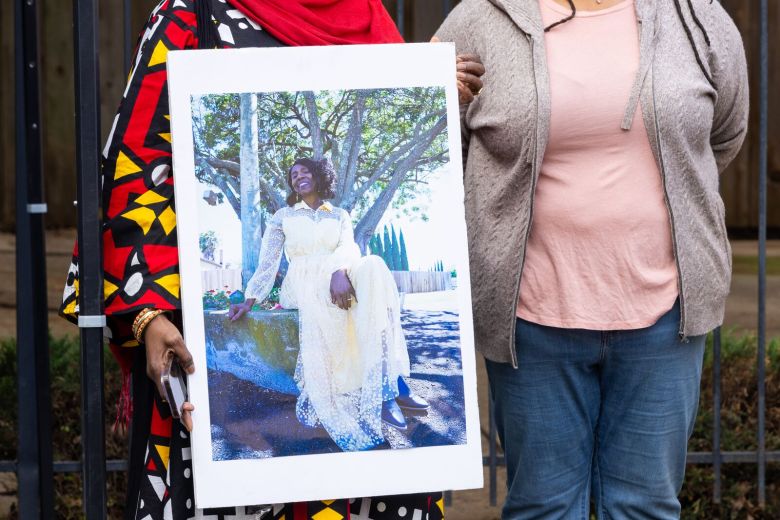 Kwanele and Gay hold a photo in memory of Barbara Ann White, a leader of the original effort to form a holistic resource center for Berkeley’s Black community. Credit: Estefany Gonzalez for Berkeleyside
The ceremony also served as a tribute to community leader Barbara Ann White, an advocate and project co-founder who died before seeing the groundbreaking. She fought for oppressed communities in Berkeley for 45 years and worked in the city’s mental health division for two decades. The city recognized her in 2022 with a day named in her honor.
“She left me with explicit instructions of what to do and how to do it, and I’m doing the best that I can,” Kwanele said Friday.
Cheryl Davila, who previously served as a Berkeley councilmember, said the resource center will support Black people in Alameda County and beyond.
“Hopefully, the Black and African American community and people of color are still going to be here because the numbers are dwindling, and we have to bring them back,” she told Berkeleyside.
“We’re going to have a new model that can be copied everywhere, because the problems we have here are everywhere,” Berkeley Councilmember Ben Bartlett said. “And now they’re getting worse.”
“*” indicates required fields