
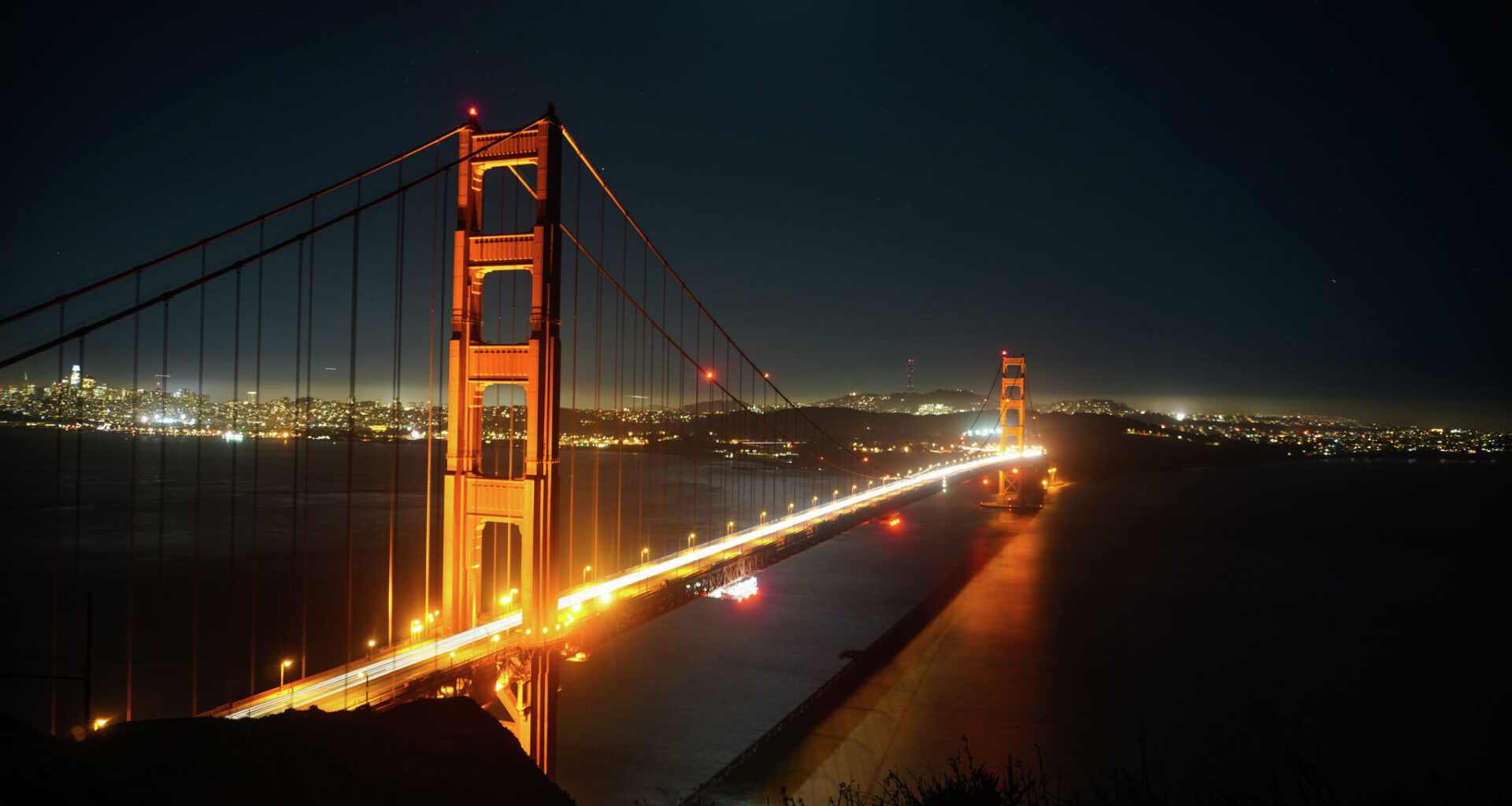
FILE: Overlooking the Golden Gate Bridge at night.
Chung-Wei Huang/Getty Images
PARK CITY, UTAH — San Francisco may be one of the most cinematic cities in the world, but it isn’t necessarily the easiest place to film a movie. Or is it? This year’s Sundance Film Festival saw two breakout hits that filmed in the city: “Josephine,” which was filmed fully in SF, and “The Invite,” which spent two days in the city on location. Along with the recent filming of “Artificial” and 2024’s “Man on the Inside,” there’s a growing mound of evidence that despite popular belief, San Francisco can be a welcome place for filmmakers.

To reiterate that point, on Sunday afternoon, a braintrust of San Francisco film professionals met up in Park City, Utah, to discuss the strengths of the community and the industry misconceptions around filming in the City by the Bay.
Article continues below this ad
Moderated by Film SF Executive Director Manijeh Fata, the five-member panel began with an introduction by each member showcasing their organization, ranging from the Roxie Theater to BAVC Media (formerly the Bay Area Media Coalition). First to speak was Beth de Araujo, a writer-director whose feature film “Josephine” has made waves as one of the buzziest films at the festival. Due to financing, it took years to make it locally.
“The conversation from the get-go was always, ‘Can we shoot this in Toronto? Can we shoot this in Georgia? We can do it this year, but you’ve gotta go to Budapest,’” de Araújo said. “And [San Francisco] was the one hard and fast line that I really stood by, because the whole design of [‘Josephine’] was engineered around my memory and visual language.”
It was only with the help of rebates on city-related costs from San Francisco (filming in parks, road closures, security) and additional credits from the state of California that financiers came on board. Fata said there are a lot of misconceptions regarding tax credits.
Make SFGATE a preferred source so your search results prioritize writing by actual people, not AI.
Add Preferred Source
“One misconception is that it’s a lottery, [or] it’s only for studio projects or TV series,” Fata said.
Article continues below this ad
She went on to explain an updated rebate ordinance that just passed its first bureaucratic hurdle and is expected to be signed by Mayor Daniel Lurie soon. The program makes it such that filmmakers can get fully reimbursed for city fees and can earn up to a million dollars back in rebates (with lots of fine print). That’s in addition to an incentive program from the state of California, which has a tax credit of up to 45%.
Manijeh Fata, Beth de Araújo (“Josephine”), Lexi Leban (Jewish Film Institute), Maya Labban (Arab Film & Media Institute), Paula Smith Arrigoni (BAVC Media) and Lex Sloan (The Roxie) at a Sundance Film Festival panel on Jan. 25, 2026.
Dan Gentile/SFGATE
Maya Labban, managing director of the Arab Film & Media Institute, echoed that most filmmakers feel like the cost makes filmmaking in San Francisco out of reach but that organizations like AFMI and others represented onstage offer programs that help financially and logistically.
“Those who do come, they say it’s expensive,” Labban said. “And I think that’s what everybody’s afraid of — ‘This is expensive. How can I make ends meet? How can I make this happen?’ I’m just learning that there are so many opportunities, especially tax credits, and so many organizations that are helping out.”
Article continues below this ad
For Lexi Leban, executive director of the Jewish Film Institute, “Josephine” is a perfect example of a film breaking down a falsity about documentary filmmaking in the city.
“I feel like for a long time — and I’ve been in the independent film industry in the Bay Area for decades now — we were seen as a documentary town. And a lot of people left the Bay Area to go to LA because they felt like they couldn’t make a living or shoot their [feature] films in SF,” she said.
For de Araújo, another misconception was regarding working with local crews and whether they would be respectful of a female director. “I had the most lovely experience. Especially the teamsters have a very bad rep, and I was shocked — they were so kind, so deferential, so respectful, just every day,” she said.
Article continues below this ad
Paula Smith Arrigoni of BAVC Media stressed that her organization offers training and workforce development programs that pay newcomers to the industry to learn the tools of the trade, helping to build up the next generation of filmmakers. She feels the broader landscape of organizations in the city is misunderstood.
“I think that maybe San Francisco and the Bay Area had a reputation for organization being kind of competitive maybe in years past. And I just want to say I think we are super collaborative,” Smith Arrigoni said.
Lex Sloan, the executive director of the Roxie Theater, repeated some of the earlier sentiments about the costs of filming but believes that the barriers to entry result in stronger projects.
“I think those roadblocks are what makes San Francisco Bay Area films braver and often more inventive,” Sloan said. “So I think the thing that we think might be the problem actually creates films that are so special.”
Article continues below this ad
Fata closed the discussion by reiterating that the filmmaking landscape in San Francisco isn’t static and that the evolution of the industry in the city means the broader industry perception is outdated.
“What is so imperative around the misconceptions is that somebody may have had a bad experience a decade ago or 20 years ago, but that sticks with folks. And they hold on to it, and then they tell somebody else, and tell somebody else,” she said. “You don’t know how many times I’ve encountered people that have said things, and I said, ‘It’s a different time.’”