
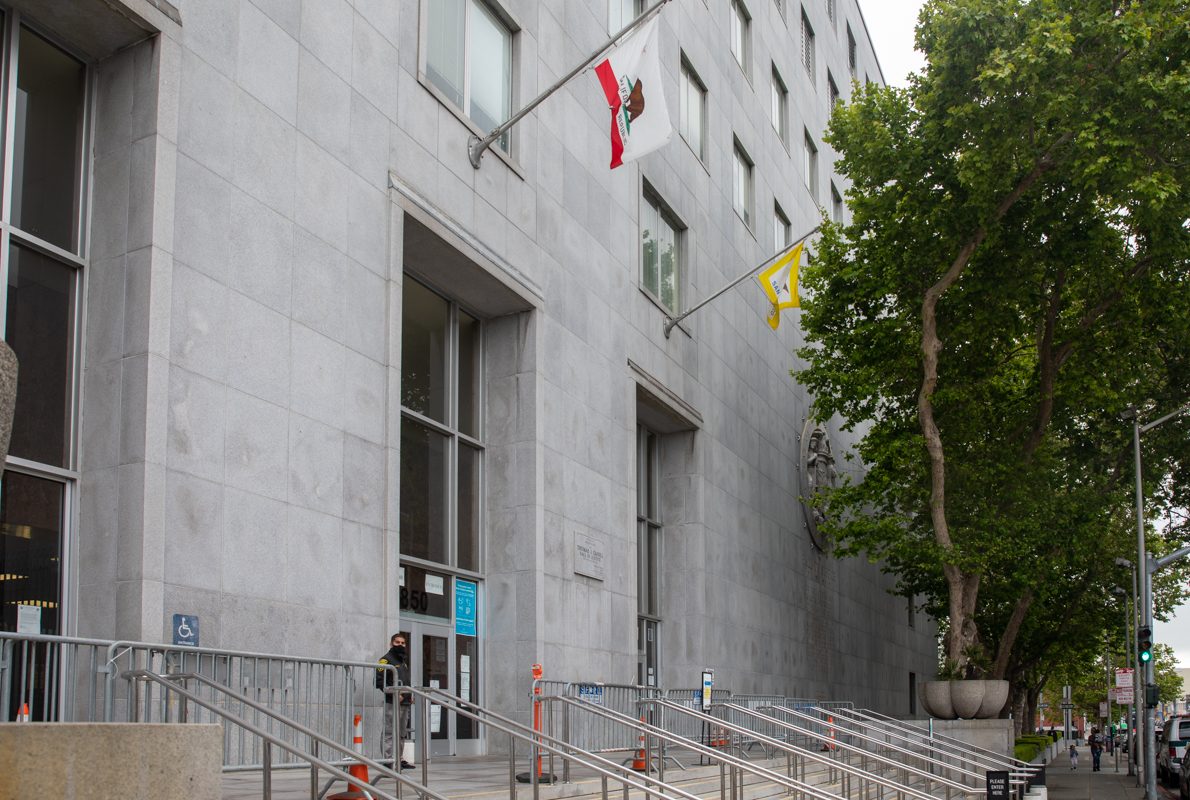
San Francisco Hall of Justice – Photo by David M. Greenwald
By Vanguard Staff
SAN FRANCISCO — A San Francisco jury acquitted Antoine Watson of first- and second-degree murder and elder abuse following a monthlong trial stemming from a January 2021 incident that left 84-year-old Vicha Ratanapakdee dead after a fall.
On Jan. 16, jurors convicted Watson of involuntary manslaughter and assault likely to cause great bodily injury based on evidence that he pushed Ratanapakdee, who later died from his injuries.
Jurors reviewed extensive testimony and video evidence, including full surveillance footage of the encounter presented by the defense, after early public attention focused on a short clip that circulated widely online.
The jury, composed of 12 San Franciscans of varying backgrounds, deliberated for several hours before returning its verdict.
The panel rejected murder charges, finding Watson did not intend to kill and did not understand that his actions could cause death.
Jurors also rejected the elder abuse charge, concluding that Ratanapakdee’s age was not apparent during the brief encounter because his head and face were largely obscured by a hat and mask.
The jury found Watson guilty of involuntary manslaughter and assault likely to cause great bodily injury and found true allegations that the victim was over 70 and became comatose.
After the verdict, prosecutors asked jurors to consider aggravating factors. On Jan. 28, jurors rejected an allegation that Watson posed a serious danger to society, but found that the victim was particularly vulnerable and that the crime involved callousness, cruelty or viciousness.
Prosecutors withdrew a separate allegation of planning or sophistication for lack of evidence.
Watson faces a statutory sentence range of seven to nine years. He has spent nearly five years in San Francisco County Jail and is scheduled for sentencing at a future hearing.
“We thank the jury for listening to the testimony, carefully evaluating the facts in evidence, and rendering a fair verdict in accordance with the law,” Deputy Public Defender Anita Nabha said. “Antoine Watson was a 19-year-old in distress who made a terrible, impulsive decision with devastating consequences. The jury correctly found that he had no intent to kill and no knowledge of Mr. Ratanapakdee’s race or age at the time.”
Although the District Attorney’s Office did not pursue a hate crime allegation for lack of evidence, the case unfolded amid widespread public assumptions about racial bias.
Trial evidence indicated Watson could not see Ratanapakdee’s race because his features were obscured by a brimmed baseball cap and a surgical mask. Two independent witnesses testified that Ratanapakdee’s race was not apparent when they approached him on the ground and that they believed he was white.
The defense also addressed claims circulating after the incident about Watson’s conduct following the push.
Trial evidence showed that cellphone records placed Watson on the phone with his mother when he first returned to check on Ratanapakdee and that he did not take photos. S
urveillance footage showed Watson returned twice to check on him. An independent witness located by police testified that Watson sounded like he was in “agony” afterward, and there was no evidence that he celebrated. Jurors were able to review all available surveillance footage admitted into evidence.
Deputy Public Defender Bao Doan said the defense sought to provide fuller context to the jury.
“It was important for us to show the bigger context to the jury because the prosecution only wanted to show the jury the moment of the push and ignore all other evidence that did not support their pursuit of a murder conviction,” Doan said.
Evidence presented at trial showed Watson was emotionally distressed in the hours before the incident, following a family dispute, a car collision and a police encounter in which an officer pointed a gun at him and briefly handcuffed him before releasing him with a citation.
Video showed Watson visibly upset when he parked in the Anza Vista neighborhood around 3 a.m. and again just before 8 a.m. when his car would not start. Cellphone records confirmed he called his mother for help.
Witnesses testified that shortly after 8 a.m., Watson punched a parked car and ran down the street yelling and crying, which they described as sounding like a distressed person and “like something [was] terribly wrong.”
Watson testified that he was crying and upset and “wasn’t thinking right” when he pushed a man he misperceived as staring at him, and that he did not realize how hard he had pushed until afterward.
He said he noticed Ratanapakdee’s gray hair only when he returned to check on him. The defense called an expert in adolescent brain development to explain impulsivity and limited forethought in late adolescence.
Video showed Watson returned a second time, saw someone already calling for help and left, which he testified was due to “shock and panic.”
He also said he was ashamed of his actions and sorry for the pain caused to Ratanapakdee’s family and his own.
Following the aggravating factors verdict, District Attorney Brooke Jenkins issued a statement expressing condolences to Ratanapakdee’s family and outlining the prosecution’s position.
“Mr. Watson was charged with murder based on the facts and law,” Jenkins said. “We re-reviewed the charges to determine if there was evidence to proceed on a hate crime, and did not find sufficient evidence to proceed on that theory.” She added, “We presented all the evidence we could and the jury returned a guilty verdict of involuntary manslaughter.”
Jenkins said the jury found true two aggravating factors — that the victim was vulnerable and that the crime was vicious and callous — and that her office respects the verdict.
“I know many in our community are disappointed by this verdict and deeply concerned about what this means for AAPI victims of crime,” she said. “Rest assured that my office is committed to fighting for justice for the AAPI community and will always do everything in our power to fight for justice in the courtroom.”
“This tragic incident garnered significant attention at a time when the President of the United States was stoking racism against Asian American communities, and that broader climate understandably shaped public reaction,” San Francisco District Attorney Mano Raju said.
Raju added, “Our legal system exists to examine facts carefully and without assumption. This was a fair and thorough trial, and we appreciate the jurors’ careful review of the evidence. My hope is that our communities can move forward by investing in restorative processes that prioritize healing for individuals harmed.”
Follow the Vanguard on Social Media – X, Instagram and Facebook. Subscribe the Vanguard News letters. To make a tax-deductible donation, please visit davisvanguard.org/donate or give directly through ActBlue. Your support will ensure that the vital work of the Vanguard continues.
Categories: Breaking News San Francisco Court Watch Tags: AAPI community justice Antoine Watson District Attorney Brooke Jenkins District Attorney’s office Involuntary Manslaughter Mano Raju Public Defender San Francisco San Francisco jury verdict Vicha Ratanapakdee