
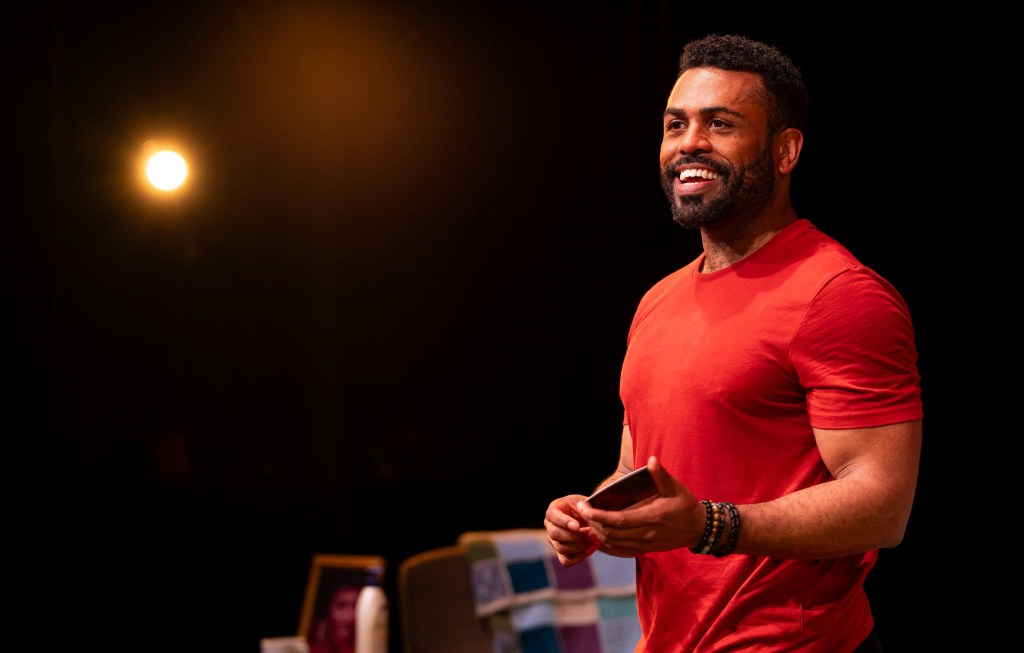
There’s a piercing gaze towards this box that arrived on the doorstep, one that has some heft. That heaviness has nothing to do with what’s inside; the weight of an item cannot compare to the density of a soul.
With incisions that unlock the brown package, secrets and regrets are revealed, and a reckoning of a life inside a shadow haunts. Within this play, when the iconic bassline of “Papa Was a Rolling Stone” reaches the stage, it’s hard not to recall the lyrics that tell the story of a father in name only.
“Papa was a rolling stone,
Wherever he laid his hat was his home
And when he died, all he left us was alone.”
Vincent Terrell Durham’s piercing investigation of a man’s loss of not just one father, but two, dominates in his play “Running After Shadows,” a world premiere at City Lights Theater Company, directed with an infiltrating freshness by Aldo Billingslea. The play is not without its warts, with a few of the many characters tasked to actor James Arthur M., as Morgan, trending towards the thin side. Yet, when the play needs to bear down and drill its point home, namely in a crushing second act where the story’s most beautiful prose lies, the piece delivers like scalding soup on a frigid day.
Morgan (M.) is yet another Instagram food influencer, dropping knowledge on his hungry and very engaged followers. A few key deliveries to the doorstep provide legitimacy to the fledgling chef, such as a bright red apron ready for a bout with the stains of fresh vegetables.
But it’s one particular package, opened for his followers ready to drop emojis galore on the live feed, that careens Morgan into a vicious bout of memories.
The various characters that make up Morgan’s past lead him towards a specific reckoning, one that sees him wrestle greatly with a past that informs his present.
We see the destruction that comes with neglect; first from the father that sired him, then from the abusive stepfather who couldn’t be bothered to engage, a rejection born of the complications that come with raising a child belonging to another man.
M.’s acting instincts are built on the visceral prowling he unleashes upon the stage, fleet of foot with powerful strokes on scenic designer Ron Gasparinetti’s comfy set. It’s a living room with a big screen where the live Instagram feed captures real-time feelings as Morgan processes his thoughts for all.
Morgan runs the gamut of complications that are funny, confounding, and then shattering. Durham’s script carries the strength of balance, a calibrated understanding of when an audience needs a hearty chuckle that breaks up the pain.
While there are plenty of moments that drop some good laughs through M.’s frenetic movement, with the power to pivot on many dimes (check out the hilarity of Morgan trying to change up his walk to something more straight and hip), the play works towards forgiveness through processing trauma. It asks pointed questions about fathers and sons, and in Morgan’s case specifically, about his Black father. The scars of life should be among cousins who tackle each other for fun as little boys, but “our fathers weren’t supposed to be those scars,” Morgan states in some of the play’s most devastating poetry.
That processing comes with discoveries and realizations. As Morgan succinctly states as he comes to terms with his past, his forgiveness towards his father, and any other father that couldn’t get it right, aids his own healing.
So much of the play’s beauty comes from how it articulates longing. The desire for this little boy to meet his father’s mother, the man who should have been there to save both he and his mother from an abusive stepfather, the anger that comes with not knowing what his touch felt like. The emotional demands are massive, and M.’s instincts to stay and fight as Morgan pay massive dividends, especially in the utterly powerful second half of the 80 minute piece.
“I was 38 when I learned that Black fathers don’t always get it right, but you need to find a way to forgive them,” expresses Morgan.
In the never-ending quest to find the perfect components for a meal that transcends the palate, it was that final ingredient of forgiveness that elevated Morgan’s simple, basic dinner, putting him on a rejuvenated journey towards a magnificent feast for the rest of his life.
David John Chávez is a former chair of the American Theatre Critics/Journalists Association and a two-time juror for the Pulitzer Prize for Drama (‘22-‘23); @davidjchavez.bsky.social.
‘RUNNING AFTER SHADOWS’
By Vincent Terrell Durham, presented by City Lights Theater Company
Through: Feb. 8
Where: City Lights Theater, 529 S. Second St., San Jose
Running time: 80 minutes with no intermission
Tickets: $40-$68; cltc.org