
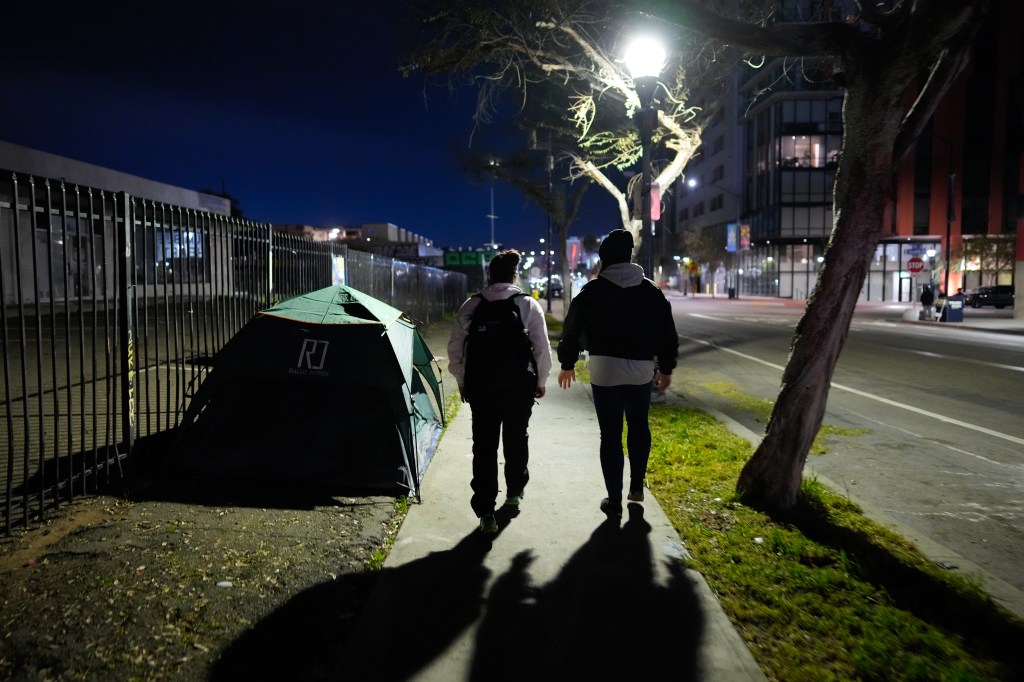
Hundreds of volunteers went tent-to-tent and sidewalk-to-sidewalk throughout San Diego County on Thursday morning for the annual one-day, point-in-time homeless count.
The Regional Task Force on Homelessness spends about six months preparing for the count, which involves 1,700 volunteers and service providers, and then three months analyzing the results, officials said. The statistics collected are a key factor in the allocation of state and federal funding for homelessness prevention programs.
One of the county’s heaviest concentrations of unsheltered residents is in the East Village neighborhood of San Diego, along 16th and 17th streets close to the roar of traffic on Interstate 5. It is a mix of old, small, single-family homes behind bars and fences, with a few warehouses and gated parking lots, all in the shadow of new, high-rise apartment buildings.
“My plan is to get on my feet, be a man and work,” said Gabriel Perez, born in 1977. He’s been living on San Diego’s sidewalks since he got out of jail about a year and a half ago.
He’s an experienced landscaper, he said, but his life was thrown off track by the death of his 16-year-old daughter in a car crash.
A friendly man with a shaved head covered in tattoos, Perez agreed to answer an interviewer’s questions in exchange for a $10 7-Eleven gift card and a pair of new socks.
Not everyone was as cooperative. In a blue nylon tent a block away, two people agreed to participate, but would not unzip their fabric door. They briefly bickered over who should answer questions first. Afterward, they accepted their gift cards through a small hole in the tent wall.
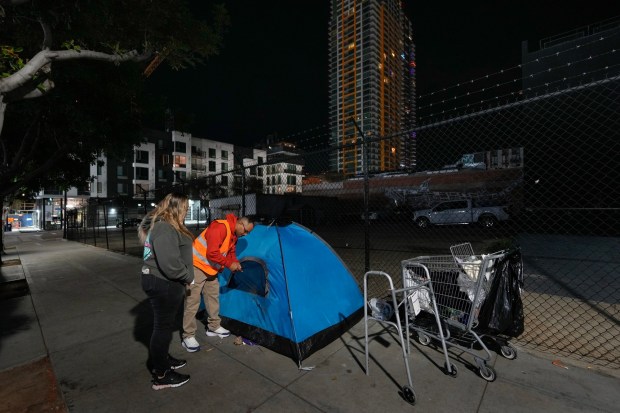 Demian Williams and Brittany Barrett interview the occupants of a tent during Thursday’s point-in-time count of people experiencing homelessness in San Diego County. (Nelvin C. Cepeda / The San Diego Union-Tribune)
Laura Diaz, 52, was sleeping on a sidewalk under blankets covered by a reflective silver plastic sheet.
“It’s cold,” she said. “I need a sleeping bag.”
She grew up in San Diego, she said, but she has a drug problem and she’s been homeless about six years. She knows almost everybody on the street around her, she said, adding, “You get used to them.”
Father Joe’s Villages has its headquarters and service center in East Village. About 50 of its staff members participated in the count, working in teams of five or six in various San Diego neighborhoods.
Carmen Jimenez, a supervisor at the Father Joe’s clean and sober shelter, approached each tent or blanketed individual with, “Good morning, sir or ma’am. Would you like to participate in the point-in-time count 2026?”
Those who refused were still counted, but with a note that they did not participate.
In one of the more crowded spots, family-sized tents, bicycles and loaded shopping carts lined the street. A few people stepped out and asked to participate so they could receive the gifts. Name, first, last, and middle, how old are they, how long have they been homeless, do they abuse drugs or alcohol, and where are they from?
“Here’s a $10 gift card, go get a coffee, a sandwich or something,” Jimenez said, handing one man his freebies.
Kayla Houston, who also works in the Father Joe’s shelter, walked up to a woman camped on a freeway overpass, shouted out the woman’s name and gave her a big hug. It was a friend.
“This is exactly where I used to hang out,” said Houston, who spent several years on San Diego’s streets. “I got arrested … and went to inpatient resident treatment.”
Her experience helps her lead others to recovery, she said.
“Everybody that I know, they were elated for me,” Houston said. “They trust me.”
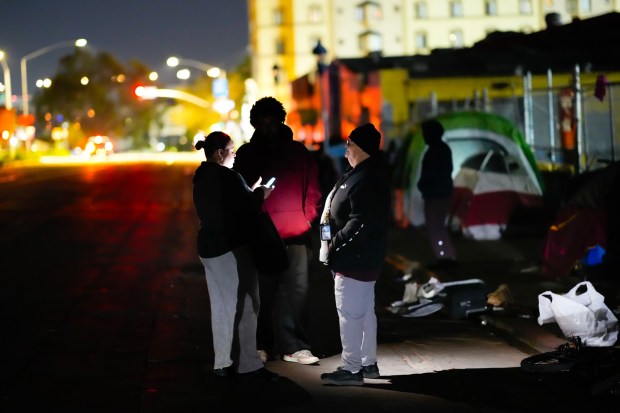 Carmen Jimenez (l) and Ruth Clerico (r) interview people on 17th Street during the annual point-in-time count of people experiencing homelessness in San Diego County. (Nelvin C. Cepeda / The San Diego Union-Tribune)
A few blocks down the street, Houston spotted a woman she’d interviewed earlier in the morning, walking back from a 7-Eleven with hot coffee, a cup of ramen noodles and a small bag of doughnuts purchased with a gift card.
“Thank you, thank you!” the woman shouted to the team.
Teams of volunteers and community leaders also went to cities from Oceanside to National City.
In Lemon Grove, outreach workers and city officials said they hoped the number of individuals living in encampments near state Route 94 had shrunk since last year’s count.
Volunteers found two tents positioned along the eastbound portion of the highway behind local restaurants. A worn staircase made of packed dirt was carved into the slope leading to the encampment, defined by years of steady foot traffic.
There, a woman who lived in a tent adjacent to two others declined resources from an outreach worker but accepted a pair of sweatpants. Another woman living in a tent near the highway said she had just gone to jail because she “didn’t have a place to stay.”
A woman sleeping under a tarp in front of a business said she had been homeless her whole life, and her mental health issues severely affected her ability to hold a job. A man who stood smoking a cigarette in an outdoor plaza said, “I’m not really homeless, I’m just relocating.”
Other areas that were once hot spots for encampments were bare. North Avenue, a road adjacent to the highway and formerly packed with tents, was empty.
“That makes my heart warm,” Stephanie Castaneda, an outreach worker for the county of San Diego, said.
During a sweep of the area around Lauderbach Park in Chula Vista, South Bay Community Services CEO Kathie Lembo and Vice President of Program Operations Mauricio Torre found very few unhoused individuals.
“There used to be several people here in years past,” Torre said, as the group walked around the park at 4 a.m., using flashlights to look for individuals in dark corners. But this year, no one was there.
Lembo said the count of homeless individuals has decreased by roughly 6% since a dramatic spike around 2020.
A few blocks away, sleeping beneath a blue tarp in front of a telecommunications store at Orange and Third avenues, a man named Alex, 39, told the group he’d been living outside for more than 10 years.
“It’s been a while,” Alex said, as he accepted a $10 7-Eleven gift card from Torre.
At Emerson and Third avenues, two men slept in a storefront doorway. One kept sleeping and declined to speak. The other, Carlos, 72, said he used to be a social worker and before that, a professional baseball player for the Los Angeles Angels.
“I was a catcher,” Carlos told the group. He said he’s working with a homeless outreach group to find housing and move into an apartment, “But it takes a while to get that going.”
Last year’s point-in-time count showed a 7% drop in homelessness across the region, according to the task force. Families without shelter were down by 72% from 2024, and homeless veterans decreased by 25%.
Unfortunately, though, one category that increased was homeless seniors.
“I expect that to go up again,” said Joshua Bohannan, a chief strategy officer for Father Joe’s. “That’s a scary trend. That’s the big one on my mind.”
The January 2025 count showed a total 9,905 homeless people in San Diego County. While the accuracy of the federally mandated tally is sometimes criticized, it remains one of the best overall indicators for prevention and assistance programs.
The Regional Task Force also does a separate monthly estimate of homelessness based on information from service providers in the region. The monthly report looks at categories of first-time homelessness, persons who found housing, new entries in assistance programs and more.