
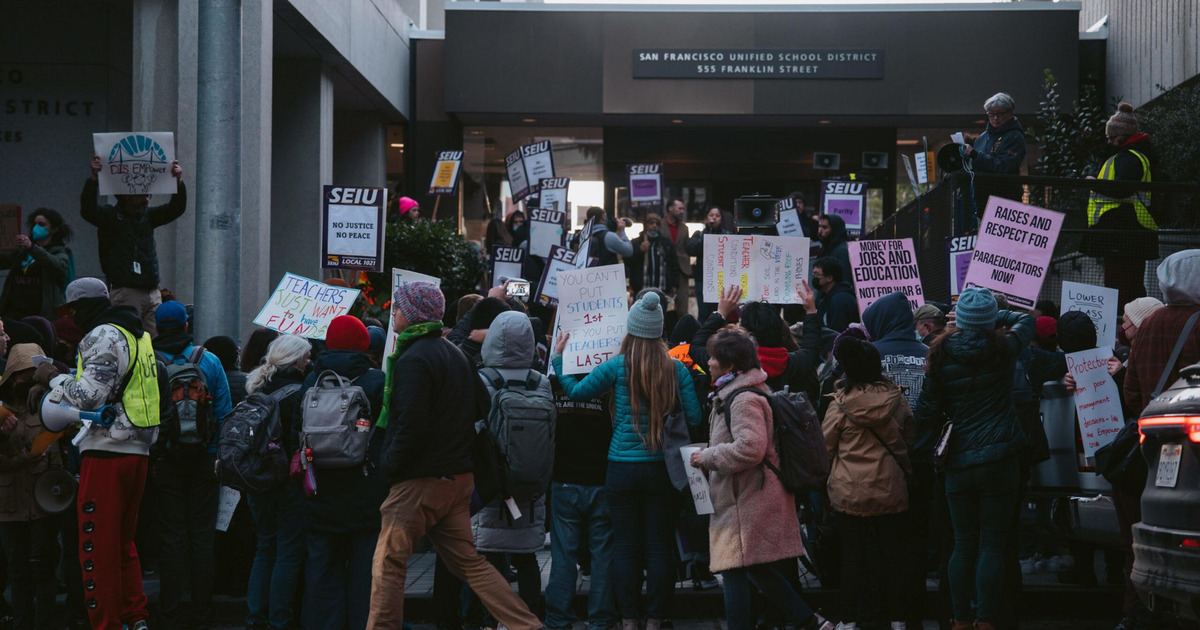
San Francisco educators are on the precipice of a strike.
From Balboa High School in the Excelsior to Sherman Elementary School in the Marina, teachers and paraeducators have cast their votes to authorize a work stoppage, with 97.6% in support. Voting ended Wednesday evening. The United Educators of San Francisco announced its tally Saturday. Principals are now set to take their own vote in solidarity.
Educators will not choose to strike until a neutral fact-finding process is completed and a final report is released by Feb. 4. That report will include recommendations for a settlement — and information on SFUSD’s financial situation — but will not be binding for either party.
“Our community is standing with us in our fight for the consistent classroom teachers, special education supports, and stable programs our students and families need and deserve,” said UESF President Cassondra Curiel. “What comes next is ultimately up to the district and their actions.”
SFUSD and UESF have been butting heads at the negotiating table since March, with the sticking points ranging from better healthcare for dependents, increasing staffing for special education, and enshrining the city’s sanctuary status in the union’s collective bargaining agreement.
Wages are another major point of contention: UESF is pushing for raises of 9% to 14% for educators, far from the district’s offer of 2% annual hikes over the next three years.
This would be the first teacher strike in the city since 1979 — a seismic decision that will send thousands of families scrambling for child care.
That’s what the union is betting on, said John Logan, professor and chair of labor and employment studies at San Francisco State University.
“Parents will be furious. Employers will be furious,” Logan said. “Because parents will be trying to deal with their kids not being at school, even a very short strike will put huge pressure on the school district.”
It remains to be seen which schools might remain open during the strike, and whether any will feature classroom instruction time. The union represents substitute teachers who otherwise could be hired as replacements. But in other districts — including West Contra Costa, where teachers went on strike in December — school support staff have supervised students during work stoppages.
SFUSD Superintendent Maria Su said in a video to parents that the district would “not be able to open schools to students safely” in the event of a strike.
SFUSD faces a growing list of challenges. In the fall, the fumbled rollout of a new payroll system resulted in many teachers not receiving wages on time; the state has taken oversight of the district due to its budget deficit; and the district is exploring closing schools amid dwindling enrollment.
Despite the financial challenges, the school board voted in December (opens in new tab) to create a $111.5 million reserve fund that has become a major point of contention in negotiations. The district has said the reserve fund is to be used only for “urgent” fiscal needs; the union contends that money is needed now for its members.
On Tuesday, moments before joining a labor rally for street cleaners on the steps of City Hall, United Farm Workers cofounder Dolores Huerta called on SFUSD to put its reserves toward educators facing the escalating cost of living.
“The teachers are begging for this: Their healthcare costs have gone up, and we know that if our teachers aren’t healthy, then our kids can’t really be taken care of the way they should,” Huerta told The Standard. “This is what the reserves are for.”