
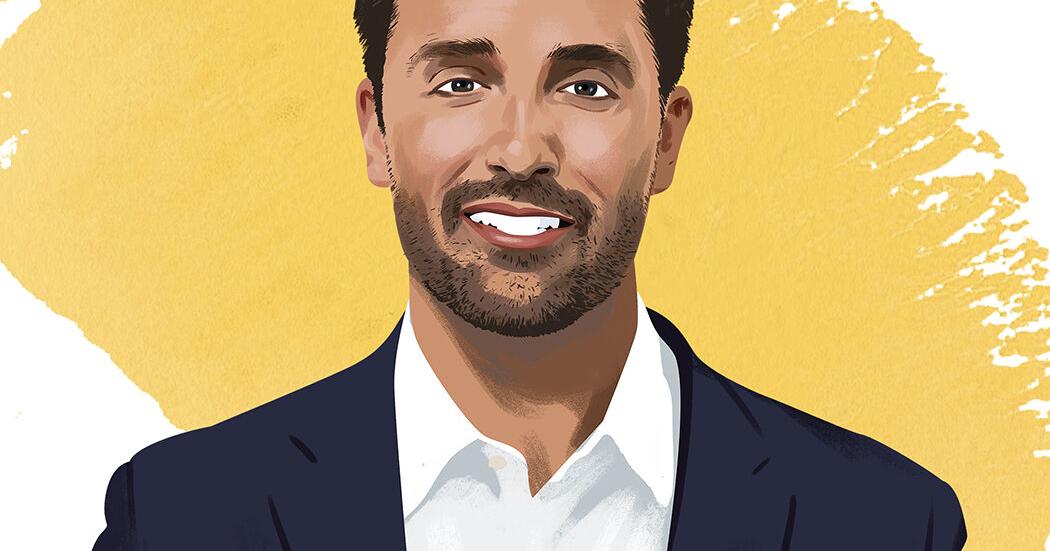

The first millennial elected to the California State Legislature, the 40-year-old Calderon is a little bit older now. But he argues that if elected governor, he could bring a fresh perspective and new ideas to Sacramento.
The former Los Angeles-area representative comes from a political family. His father also served in the legislature, and his stepmother now holds his former seat.
Calderon spent four two-year terms from 2012 to 2020 in the Assembly, including a four-year stint as Democratic majority leader. He’s now on the campaign trail statewide, promising to rise above the epidemic of political partisanship and focus on making California government accountable to its people.
And he’ll take a decidedly different approach than his predecessor, Gov. Gavin Newsom, with respect to President Donald Trump. Newsom has made himself one of the Democrats’ leading antagonists of the president, but Calderon promotes a self-sufficient view of California — one in which it’s less reliant on the federal government.
You’ve talked about being the first millennial to serve in the position that you did. Why does that matter now [if] you become governor, and how do you address the problems that are sort of unique to our generation? I grew up with emerging tech … my experiences are just different. We have a leadership that is very focused on flash and ego, and what I think to me the new generation of leadership represents is, how do we make it about actually doing the job — not how much attention I can get, not about how I can elevate my own future aspirations in political office and use one election to the next to just continue to go on and on and on?
The differentiating thing between me and anybody else in this race and whoever else might get in this race: When I was at the height of my power, I gave it up and I left to go and be with my wife and kids, raise my kids, because I didn’t want to lose out on missing moments that I was never going to get back.
Nobody gives up power freely like that. Nobody does, but I did because it wasn’t about having power. It was about doing what I could do as the first millennial in the Legislature.
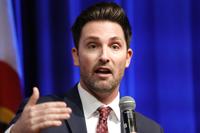
Former state Assembly Majority Leader Ian Calderon: “My focus is on California, and I’m going to work with anybody who wants to work with me to make sure that gets done.”
Craig Lee/The Examiner
How do you make life easier for small business owners and small businesses? First, there’s just the ever-increasing cost — the cost of living, the cost of doing business increases three to five percent every year. So first, you got to get the state out of the way.
What most people don’t realize is that when you pass all these new regulations, it doesn’t supplant the existing regulations on the books. It just sits on top of it. So that doesn’t mean that now I’ve just got to comply with this. Now you got to comply with this new regulation [and] every other regulation that sits underneath it — and a lot of times you’re seeing contradictions.
How do you address, for the individual, that rising cost of living that you’re pointing out? How do you contain prices in California and create an economy that works for everybody? These are challenges that have been created over decades, and so I think the worst thing to do is to get into office and then start shooting from the hip without really understanding the lay of the land, where all the money is, where those investments are going, what is working and what is not working.
A lot of our challenges can be solved by just knowing that there’s accountability and actually understanding where the money is and where the money is going, and then finding new ways to reinvest money that’s no longer going to places where we’re getting that expected [return on investment] and just repurposing it.
And then focusing on child care, things like child care. I have four kids. I had all my kids in child care, and we were paying more in our child-care costs a month than we were in our rent. And so you can have affordable child care where, say, you cap it at $500 a month for 95% of the families and kids 0-5 [years old] in this state and repurpose, say, $4 billion of existing general-fund dollars, and that covers the whole program, using state lands to build more facilities so there’s more capacity and good pay.
During your experience in the Legislature, were there things that stuck out to you as expenditures that we’re not getting that return on investment that taxpayers expect? There are tax credits that are 35 years [old] on the books. I mean, how do we know who is auditing and verifying that that return on investment still exists and that there’s a need for it? Are these tax credits going to industries or businesses that don’t need the tax credits?
I mean, I think that people are just overburdened with taxes and fees in general.
Candidates, to varying degrees, have positioned themselves as outward opponents of Donald Trump, or are trying to not focus on that so much as “control what California can control.” Where do you put yourself on that spectrum? In recent polling, when you ask voters if they want a continuation of Newsom and his policies and approach or do you want to change, they say we want to change. And so it isn’t so much about the next governor needing to be the one positioned as the anti-Trump force in the country. No, it’s about voters’ expectation that we’re the priority, this state is a priority.

Contemporary artist Jeffrey Gibson’s 433-foot mural “This Burning World” spans Mission Street between 4th and 5th streets

‘I wanted in 50 years for my kids to be going to All-Star games and Super Bowls and Olympics in San Francisco,’ Noah Wintroub said

Now shuttered, the once-bustling retail hub now stands as a monument to aspirations and generations
Part of making them a priority is making sure that they feel protected and that they are protected — and when you have federal immigration enforcement or Border Patrol in our state, that they’re abiding by our laws and that there are consequences if they don’t.
But we still need a lot from the federal government. It isn’t about me and my ego and my attention to just have an adversarial relationship with Washington, D.C., and the president of the United States. If he wants to fight — my focus is on California and I’m going to work with anybody who wants to work with me to make sure that gets done. And I will be there to be a fighter at the times of need where we have to draw that line in the sand, but my focus is on actual Californians and solving our challenges and solving our problems.
But to be honest with you, and I think that this is where you’re going to see a lot of states going, “We’ve lost faith in the federal government because it’s become so political that you can make threat after threat about getting rid of your federal funding and not sending it to the state for whatever asinine reason.”
I just think if we’re the fourth-largest economy in the world, well, why don’t we create investment programs that are in the state that give us enough money in return, so that we can end up equaling the amount of money we get from the federal government?
I don’t want to be under anybody’s thumb, and I think nobody’s going to care more about California than Californians.
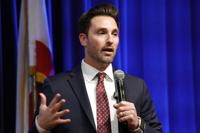
Ian Calderon speaks during the Gubernatorial Candidate Forum at UCSF Robertson Auditorium in San Francisco on Monday.
Craig Lee/The Examiner
So we stand here in San Francisco. I’m curious how you’re taking your message to a statewide audience now, and what issues do you think stand out to you, from different parts of the state than what you represented? I’ve been able to see this beautiful state when I was in the Legislature and traveling a lot of different communities, but one of the communities I’ve been spending a lot of time in is the Central Valley.
Central Valley is a place where they believe that they’re the forgotten region, where they believe that, “We’re just flyover country. You might come here while you’re campaigning, campaigning, but once you’re done, you never come back.”
We have communities that just literally want clean drinking water and the infrastructure that will give us clean drinking water. There are laws on the books that passed when I was there that guarantee your right to clean and affordable drinking water. Yet there are communities all across the state that don’t have that, not just in L.A. and the Bay Area, but also in the Central Valley, where a $6 million investment could completely renovate and provide infrastructure for clean, affordable drinking water to come out of the tap.
When you come to the Bay Area, it’s really understanding what the need is, where the investment is going, where it’s not going, and evaluating. This is where we can make a substantial difference, working with community leaders to help us figure that out and not letting ourselves get bogged down — because we let ourselves get bogged down by bureaucracy and process. The state cannot continue to be the impediment that it has been.
I’m a serious candidate because I’ve been a part of Sacramento. I’ve been able to see where the mechanisms of power lie. I know how decisions are made. I know what it takes to develop relationships, balance a budget, pass strong policies, but when I had an option to hold on to power, I didn’t hold on to it.
You’ve pledged to veto anything that crosses your desk that would raise gasoline prices, and I wonder how candidates like yourself can both promise to do that and address the concerns about climate change that Californians also have. It’s not just about environmental justice, it’s about economic justice. Why is it that every time there’s an environmental priority, the burden is on the shoulders of Black and brown, poor communities because their gas prices go up, their utility prices go up, their cost of living goes up?
So you can’t have environmental justice without economic justice, and a lot of the times the people that are pushing these policies are the people that can afford those cost increases because they live in wealthy coastal California.
When I was [in the legislature], it’s like, “Oh, let’s provide these rebates for Teslas” — which, at the time was a Model S, it’s $100,000. So we’re going to subsidize now, from the state, rich people buying cars. And when I said, “OK, well, if we really want electrification and we want true environmental justice,” I authored this bill. “Well, what about for the secondary market? What about for used hybrid and electric vehicles? Let’s create a rebate program for them.”
“Oh no, we don’t have enough money. No, no, no, we can’t do that.”
So I just think it’s a lot of bulls—. We care about the environment from the press-release perspective and standpoint. But again, we’re not going to solve the global environmental crisis by ourselves here in California. We can be a leader, but part of being a leader is making sure that communities and people of color aren’t being left out of that.
Talk to me about bitcoin. I can’t imagine bitcoin is on the top-10 priority list for the vast majority of people in California. It might not be in your top 10 platform priorities, but you’ve mentioned it. So … why? Because my frustration with government — it was my frustration when I was there — it’s like, “Well, here’s our solutions, and this is what we always pick from, OK?” We can’t think outside the box, we can’t do anything new, we can’t do anything different. These are the solutions that satisfy these interests and these sets of politics, and so that’s what we’re going to pick from.
The reason why I like bitcoin is because it’s like, it’s something new. It’s something different, and it’s an industry that isn’t going away. They’re working on the Clarity Act right now at the federal level, which is going to only make it more of a daily existence in our lives.
And so right now if you’ve got an asset that’s not going to go away, it’s going to continue to go in price — there’s no CEO of bitcoin, it’s completely run on a blockchain which is run by a community of people together, not one person that can control the levers — well, why wouldn’t we want to at least invest a little bit in what the potential upside of that is? Because so much of the problem is, “Well, we need new revenue” — and what do we always do? Well, then we increase taxes.
What if we had some money that was actually tied to an asset that would grow up and grow our revenue over time so that we can lower the cost and reduce tax burdens and investment burdens on people in the state? And if bitcoin could be there, then why not?