
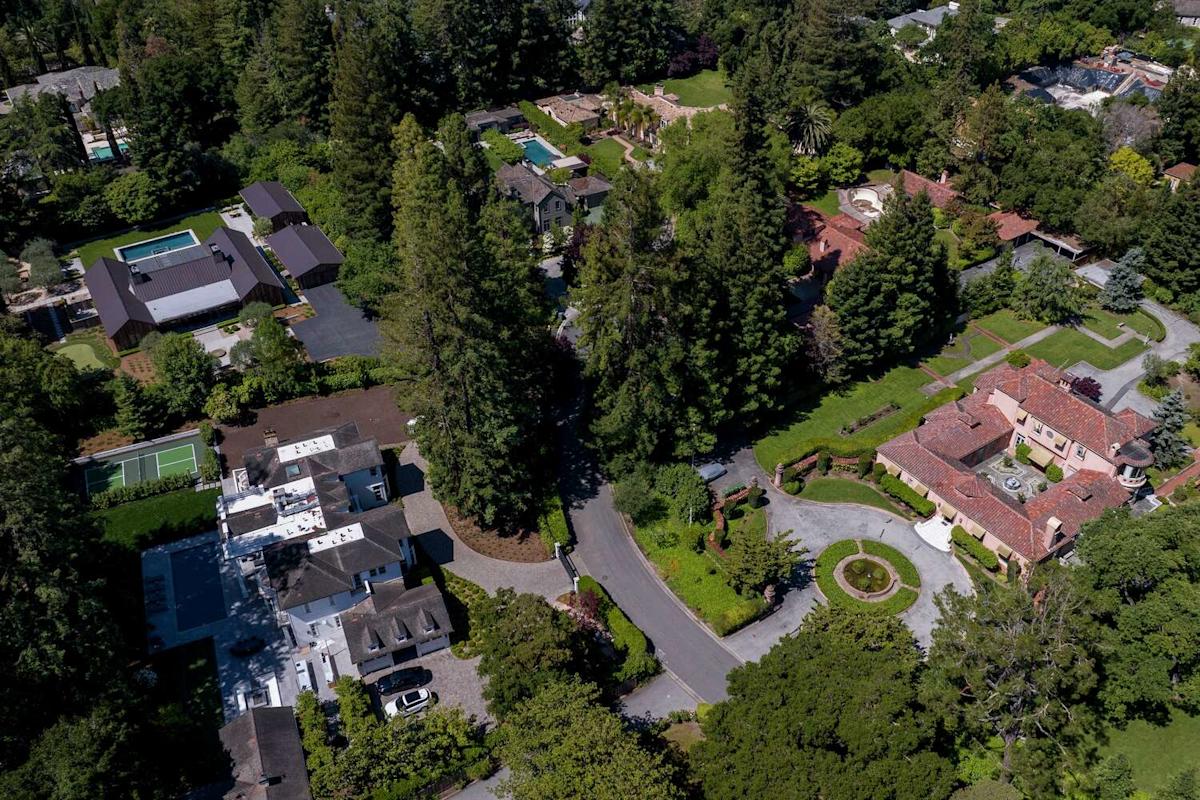
 Homes can be seen in a neighborhood in Atherton in 2023. Some have suggested that a proposed tax on California’s billionaires could lead entrepreneurs to pull back from the Bay Area, restricting job growth – and future demand for housing. (Brontë Wittpenn/S.F. Chronicle)
A proposal to tax California’s billionaires already has some members of the ultra-rich selling their mansions and moving out of state. But unless you’re hoping to score a deal on an eight-figure estate, economics and real estate agents say you shouldn’t expect the tax to cool off the Bay Area housing market much.
Though the proposal hasn’t yet qualified for the November ballot, it has generated intense debate among the state’s business leaders and Democrats. If it lands on the ballot and is passed by a majority of voters, California would levy a one-time 5% tax on more than 200 billionaires based on their Jan. 1 net worth.
Opponents of the tax, among them Gov. Gavin Newsom, say it would push California’s wealthiest taxpayers out of the state. Its supporters argue that concern is overblown, and that California needs the revenue to pay for health care in the wake of the Trump administration’s funding cuts.
The tax would probably be challenged in court if it becomes law, experts say.
A handful of billionaires are already reducing their presence in California. Some observers have suggested that the tax could also lead entrepreneurs to pull back from the Bay Area, restricting job growth – and cooling demand for housing in the long-term.
The tax “is already affecting San Francisco,” said Ruth Krishnan, a Compass real estate agent based in the city. “People are already making decisions because this is being talked about.”
John Young, a Menlo Park-based Realtor with Sotheby’s International Realty, said the threat of the billionaire tax caused an out-of-state client to cancel his offer on a Bay Area home at the last minute. If the tax passes, he expects some startup founders to launch companies elsewhere, fearing that California could repeat the wealth tax later on.
“Everyone assumes they’re going to be a billionaire,” Young said.
The direct impact of the tax on most homebuyers will likely be limited. There’s little reason for billionaires to move their companies outside California, economists at real estate listing company Redfin told the Chronicle. And because billionaires’ properties tend to be at the very upper end of the price range, their homebuying activity usually doesn’t trickle down to the rest of the market.
But what if tech companies did start leaving the Bay Area, for one reason or another? Even then, it’s still not guaranteed that home prices would start coming down. Geographic and regulatory constraints on housing supply keep the market highly competitive, and the presence of top-rated universities, bayside views and large non-tech companies means there’s a high baseline of demand for Bay Area homes.
The fact that some would-be buyers are hoping for a market crash reflects how out-of-reach homeownership has become for the typical Bay Area household. Home prices in the region have historically seen strong growth, with downturns generally lasting only a few years. But in the absence of either new supply or more funding for first-time buyer assistance programs, experts say buyers shouldn’t expect a tech exodus to make housing truly affordable.
Some real estate agents told the Chronicle they think the only way the housing market would cool is if the Bay Area saw a huge number of its major businesses leave – and only if those companies didn’t allow their employees to work remotely from California.
“It’d have to be a mass exodus,” said Adam Touni, a Silicon Valley real estate broker with Compass. “And moving’s not easy.”
In that scenario, demand for Bay Area housing would likely drop substantially. While price crashes in the Bay Area never last forever, they can result in a relatively softer market compared to other major metropolises, as San Francisco experienced during the pandemic.
However, a major tech exodus would probably also reflect a gloomy economic outlook more broadly, especially for employees of businesses who rely on the patronage of tech workers.
Losing wealthy residents would also affect California’s revenue in the long term, its Legislative Analyst’s Office said in its summary of the proposed tax. Historically, the top 1% of income-earners in California – a group that overlaps with but doesn’t necessarily equate to the top 1% of wealth-holders – has accounted for more than 40% of taxes paid by Californians. A major hit to that revenue would affect the state’s ability to fund affordable housing and other social services.
But a slowdown in the tech industry could affect competition for housing in more subtle ways. Fewer people move to the Bay Area when the industry is weaker, said South Bay broker Sandy Jamison, who added that some of her clients have moved to Texas because their companies ceased operations in the Bay Area. That slowdown is already happening in some segments of the market, with tech layoffs and new limits on skilled worker visas eating into demand for South Bay homes, Jamison said.
Still, because there’s such a shortage of good-quality homes, it hasn’t had a major impact on prices, she added.
This article originally published at How could California’s proposed billionaire tax affect the Bay Area housing market?.