
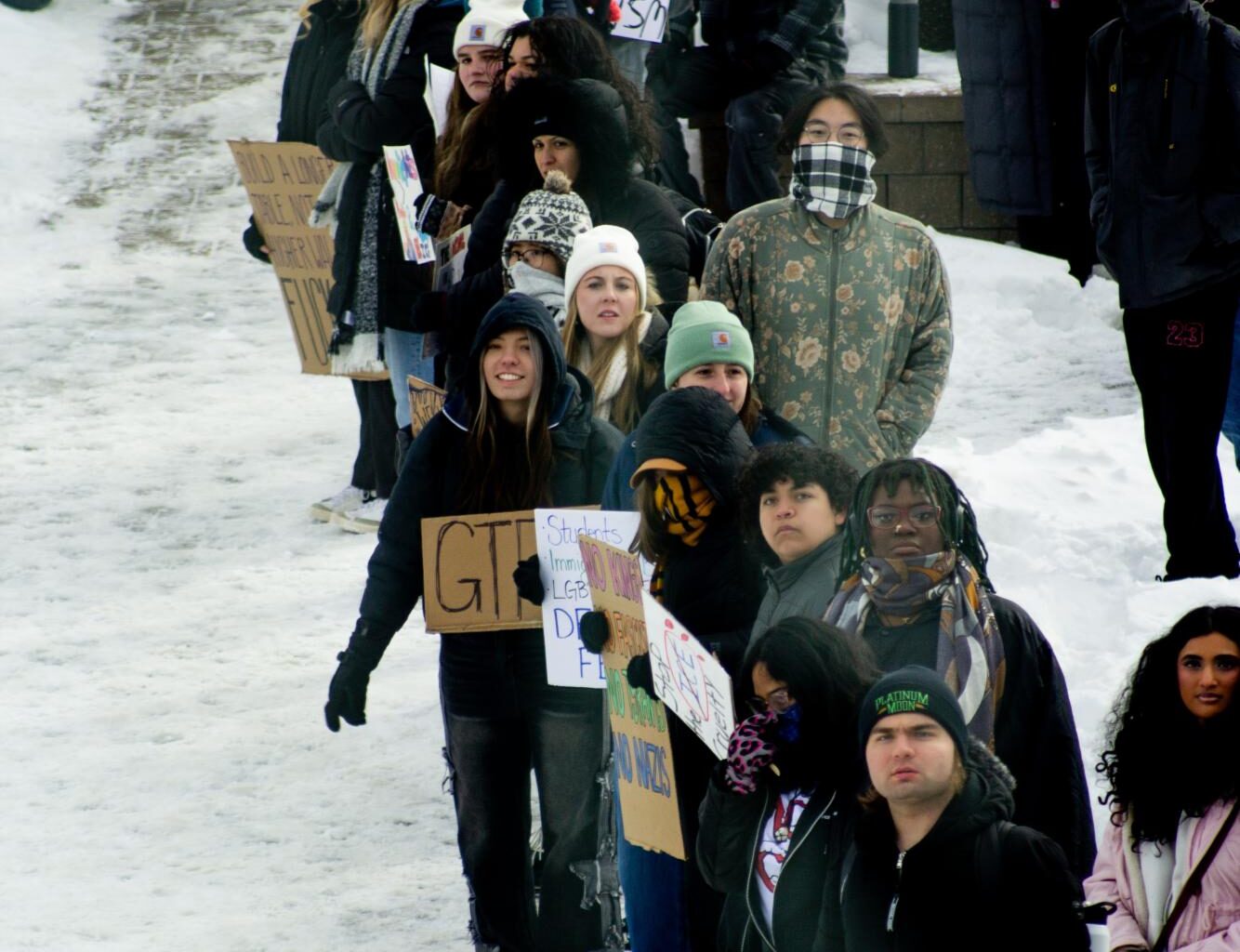
Despite the cold weather, the Oakland University community gathered on campus near Elliott Tower on Thursday, Jan. 29, 2026, to protest U.S. Immigration and Customs Enforcement (ICE).
The anti-ICE protest, hosted by College Democrats at Oakland University, drew more than 150 participants, including students, faculty and union leaders. The protest followed national news reports of recent deadly encounters with federal immigration authorities in Minnesota, events that sparked concern among immigrant communities and higher education institutions across the country.
“In terms of setting up the protest, there are semi-new time, place and manner regulations that the university set, I believe, in Oct. of 2024 that have added further restrictions to the ability to assemble and speak on campus,” Clover DeVore, president of College Democrats at OU, said. “Something that we had to do for the first time was we had to actually register the space out by Elliot Tower and declare that, like, ‘Hey, we’re having a protest here.’”
The university president, Ora Hirsch Pescovitz, addressed the campus in a letter on Jan. 27, highlighting the role of universities as spaces for learning, civic engagement and ethical reflection. Drawing from her experience at the University of Minnesota, she acknowledged the impact of recent events on communities and emphasized that universities can serve as forums for thoughtful discussion, reflection and advocacy.
She noted that engagement may take different forms, from classroom discussions and contacting elected representatives to participating in nonviolent demonstrations and underscored the importance of maintaining civility and safety in such efforts.
DeVore, however, feels differently about the support the university provides its students regarding free speech and assembly.
“There’s a whole bunch of extra steps and I take that as especially with now that there’s, like, the free speech zone signs outside of the Oakland center, the university is trying to restrict the right to assembly and speech at our university, which I find very problematic, because those are just basic first amendment rights awarded to all of us as US citizens,” DeVore said. “I think we should be able to do that, because college campuses have been a cornerstone of activism for a very long time since, especially like the civil rights movement and trying to block that for the purpose of campus safety is just, very problematic.”
Throughout the protest, speakers including professors, faculty members, students and alumni shared their perspectives, each offering a distinct viewpoint shaped by different experiences.
Lilac Lehman-Pace, an OU alum and one of the event organizers, noted the strong turnout and the impact of organizing efforts in bringing participants together.
“We blew past the expected numbers. I think we had a lot of success in peer-to-peer relations, just honestly through word of mouth, getting those posters up, getting shares on Instagram, getting people to talk to their friends and we were really able to capitalize on the moment that we’re seeing nationwide and the outrage against ICE,” Lehman-Pace said.
Between the speeches several chants were led by the speakers including some profanity directed at ICE. “No fear, no hate, no ice in our state,” “when immigrant rights are under attack, stand up, fight back” and “abolish ice, defend human rights” were some of the chants among many.
The event included references to historical immigrant communities in Detroit and broader discussions about civic responsibility, encouraging participants to reflect on the long-standing contributions of immigrants to local and national communities. One speaker structured their remarks around a series of lessons on democracy and engagement, emphasizing the importance of truth, ethical responsibility and public contribution.
Participants emphasized both the symbolic and practical aspects of campus advocacy. Calls were made for Oakland University to consider sanctuary policies, with some speakers asking student governance, campus security and administration to take steps in support of vulnerable students.
“One of the main goals of the protest was, first and foremost, to make students’ voices heard, letting people know that our campus community does not want ICE on our campus and that we do not approve of what the Trump administration is doing right now,” Ethan Vela, co-chair of the OU Young Democratic Socialists of America and parliamentarian of the Oakland University Student Congress said. “We don’t like mass murders. We don’t want ICE on our campus. One of the things we wanted the protest to help with and one of the things we’re pursuing, is a noncooperation agreement between the university and ICE.”
Marcus Johnson, president of OUSC who was in attendance at the protest, had previously posted a statement on the OU Student Congress Instagram account stating his and the institution’s stance on ICE. He included that the Student Congress adopted a resolution calling on the University to take action to protect its students.
“In plain terms, C.R. 68-08 is a statement of values and expectations from the Oakland University Student Congress in response to the growing fear and uncertainty many students, particularly immigrant and international students, are experiencing,” Johnson said. “The resolution affirms that students deserve to feel safe on campus and that a university should be a place of learning, not intimidation or fear. It expresses solidarity with immigrant students, condemns the revocation of student visas without due process and makes clear that Student Congress will not cooperate with ICE or any other agency seeking to harass or deport students unless legally compelled by a court order. It also urges the University to actively protect students through legal avenues when possible, to maintain enrollment access for affected international students and to continue providing institutional support through offices like International Students and Scholars and the Provost’s Office.”
At the same time, other voices on campus offered a different perspective. Caterina DiCosmo, president of NeW at Oakland University, acknowledged the effort of the protesters while expressing skepticism about outcomes.
“I respect them. I think it takes a lot of courage to be out there on campus … I don’t think that they’re gonna get any action from this. I think there’s a lot of like, I think there’s a lot of say … but there’s nothing we can do.” DiCosmo said.
Oakland University Police Department (OUPD) officers were present during the protest and observed the event from inside the Oakland Center. Several participants also noted seeing military helicopters flying overhead during the demonstration, though it is not known whether the aircraft activity was related to the protest.
On Jan. 29, The Oakland Post reached out to OUPD for comment, and as of now, it has not yet responded.