
For decades, Los Angeles business and political figures have focused their attention on creating a sleek, vibrant downtown. The common thought, as the late Eli Broad suggested, has been, “a great city needs a great downtown.”
This notion of a revived downtown is still embraced by booster groups and the Urban Land Institute. Yet despite the huge investment in such things as the convention center, Crypto.com Arena and a downtown-centric subway system, the core remains more dystopic than great.
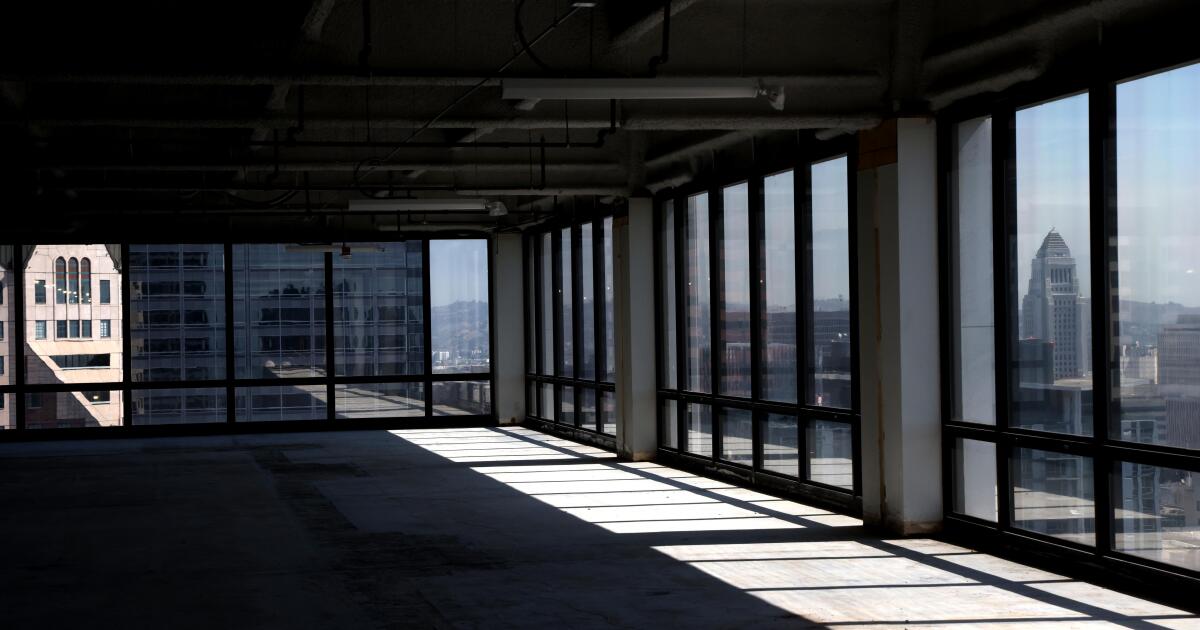
Today, downtown Los Angeles’ office vacancy rate approaches 30%, among the highest in the nation. Office vacancies, notes one recent study released by the Central City Assn., could result in a $70-billion loss in assessed value over the next decade.
This decline is not unique to L.A. The core cities have been losing their share of metropolitan residents since the 1950s, a trend that has accelerated in recent years. According to a recent MIT study, suburbs and exurbs constitute roughly 80% of the nation’s metropolitan population, while barely 8% live in the urban core. The rest are based in traditional transit-oriented suburbs. Even the vast majority of millennials, once seen as immutably attracted to dense environments, are heading to the suburbs, particularly as they start families (albeit later in life than previous generations have).
Across the country, once-flourishing downtowns — Seattle, Portland, San Francisco, Boston, Chicago — suffer vacancy rates over 20%. New office construction, declining for decades, has all but stopped. Even in Manhattan, taxes, regulations and crime are pushing financial firms, the lodestone of the borough’s economy, to places such as Miami and Dallas, where firms such as AT&T often choose suburban locations. New York, despite optimistic predictions, continues to be plagued by “zombie office space.”
Although Manhattan has remarkable cultural advantages, for most workers, it and other high-price cities no longer provide wages that compensate for the local cost of living. Brookings Institution scholar Mark Muro has noted that salaries across the 19-state American heartland region — from the Appalachians to the Rockies — are above the national average, once the cost of living is factored. All 10 of the highest-average-salary metros are small and midsize markets; none has more than a million people.
Under these circumstances, centrifugal forces are increasingly in command, as ever improving communications technology has reduced the necessity to locate in dense centers. But the movement of jobs to the periphery has been going on since the 1950s. Even before the pandemic, 91% of employment growth among major metropolitan areas was outside central business districts. Los Angeles has long led this trend; its downtown generates just over 2% of the region’s jobs, compared to 20% for New York’s business district. In some senses the relative weakness of L.A.’s downtown is fortunate, as our economy is not centered on it.
Artificial intelligence and remote work seem poised to accelerate the movement of employment away from city centers. Jobs in finance and professional and business services — the historic strengths of downtowns — are among the most likely to embrace remote or hybrid working. Despite outbursts from elite CEOs and from the White House, and the use of surveillance and financial incentives to dragoon people back to their cubicles, remote work continues to thrive and appeals particularly to more seasoned employees as well as many female employees.
A study from the University of Chicago suggests that one-third of the workforce could work online, and in the jobs generated by Silicon Valley, it’s closer to 50%. Stanford researcher Nicholas Bloom notes the number of job postings for remote-friendly roles hit record levels last year. Partly because of this trend, even big multinationals, notes the Financial Times, plan to reduce their office footprint 10 to 20%. Tellingly, tech centers such as San Francisco and Austin have already suffered a major decline in office occupancy.
So how do city centers, including in Los Angeles, avoid what the New York Times bleakly calls an “urban doom loop”? The key lies in reinventing themselves as what H.G. Wells predicted 120 years ago as “essentially a bazaar, a great gallery of shops and places of concourse and rendezvous.”
This new “amenity city” would appeal mostly to younger, often single and childless households attracted to proximity to culture and live entertainment. There’s clearly a market. Even as office skyscrapers have become increasingly anachronistic, residential high-rises have soared: from just 11 being built in the 1990s, the figure has risen to 83 in the last decade and a projected 40 since 2019.
Downtown Chicago and its surrounding neighborhoods, for example, continue to grow to record levels although the core economy lags; in New York, even in the wake of Mayor Zohran Mamdani’s election, Manhattan prices continue to climb and retail in the elite areas like Madison Avenue and SoHo still thrives. In fact even as the overall population in Gotham has declined, the number of the super-rich is growing.
Of course, this type of urban growth may not appeal to ascendant progressives who have long railed against gentrification. But core cities’ future is not as effective incubators of upward mobility. Instead, cities such as New York, London, Paris, Tokyo and Miami are now primarily showcases for luxury brands such as LVMH. Even landmarks like Rockefeller Center seek to reposition themselves around tourists and weekend visitors as destinations for recreation, tourism and the arts.
In downtown Los Angeles, where the residential population has grown to 90,000, the best strategy may be to convert office towers into residential buildings, something now being discussed widely. But this shift is being stifled by downtown’s reputation for crime and homelessness. Since 2020, downtown’s share of new apartments has dropped precipitously as conditions on the streets deteriorated. In this decade, the downtown of the nation’s second-largest city ranked 19th in new units, behind not only New York and Chicago but also Houston, Austin and Raleigh.
In addition to residential units, downtown L.A. could also nurture artisanal industries — jewelry, food, garments — that long clustered there, often spearheaded by immigrants. As one travel blog noted in 2019, the appeal of downtown lies not in offices, convention centers and sports stadia but in unique attractions such as Grand Central Market, the Arts District and one-of-a-kind restaurants. Replicating suburbia with chain stores is not a viable strategy.
Of course, even those who yearn to visit or live in a walkable, dense neighborhood are not going to flock to a place surrounded by a grim urban dystopia. Efforts to address downtown’s dysfunctions will elicit the usual cries from progressives, who seem unwilling to carry out the necessary policing. But if L.A. and other cities want their downtowns to survive, this should be the first order of business.
Joel Kotkin is the presidential fellow for urban futures at Chapman University and senior research fellow at the Civitas Institute at the University of Texas, Austin. Substack: @jkotkin