
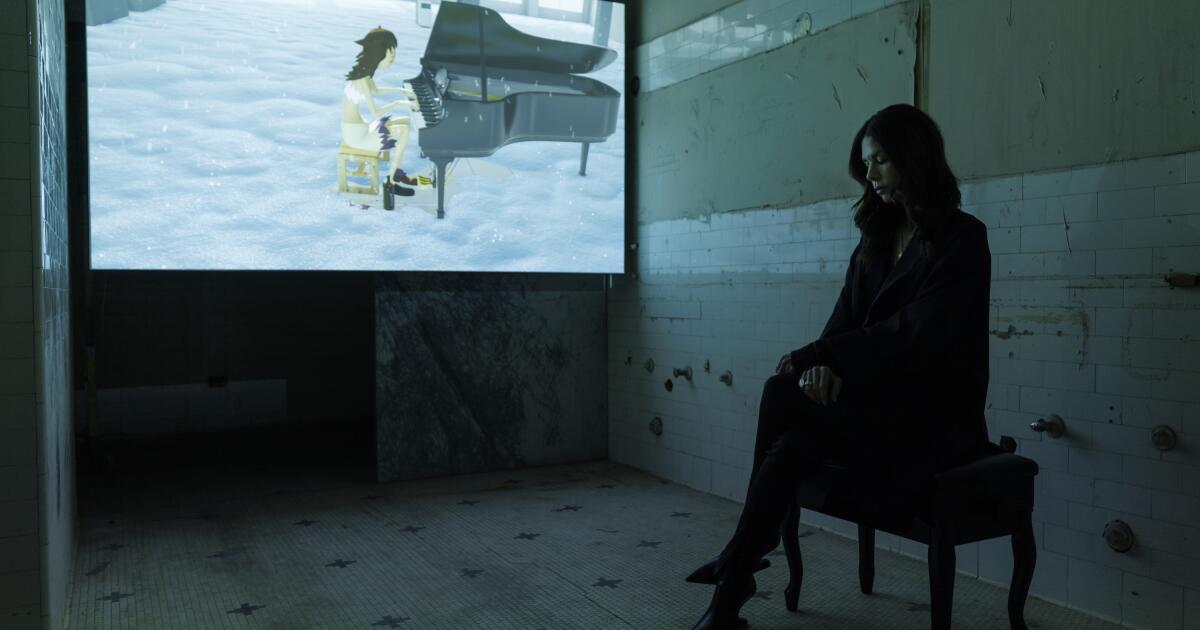
The five-story Venetian-style Variety Arts Theater in downtown Los Angeles will open its doors to the public for the first time in decades Friday — not as a traditional movie palace, but as the site of an unusually ambitious exhibition of film and art.
“What a Wonderful World: An Audiovisual Poem” runs six weeks through March 20 and spans more than 120 years of moving images, from early silent cinema to contemporary video art. Organized by collector Julia Stoschek — whose private foundation forms the exhibit’s core — and curator Udo Kittelmann, the temporary takeover suggests that the history of moving images is less a straight line than a feedback loop in which individual works resurface, acquiring new meaning as they pass into shared cultural memory.
“We are surrounded by moving images,” Stoschek said during a recent tour of the exhibit. “They shape how we think, how we communicate. They are the major artistic language of our time.”
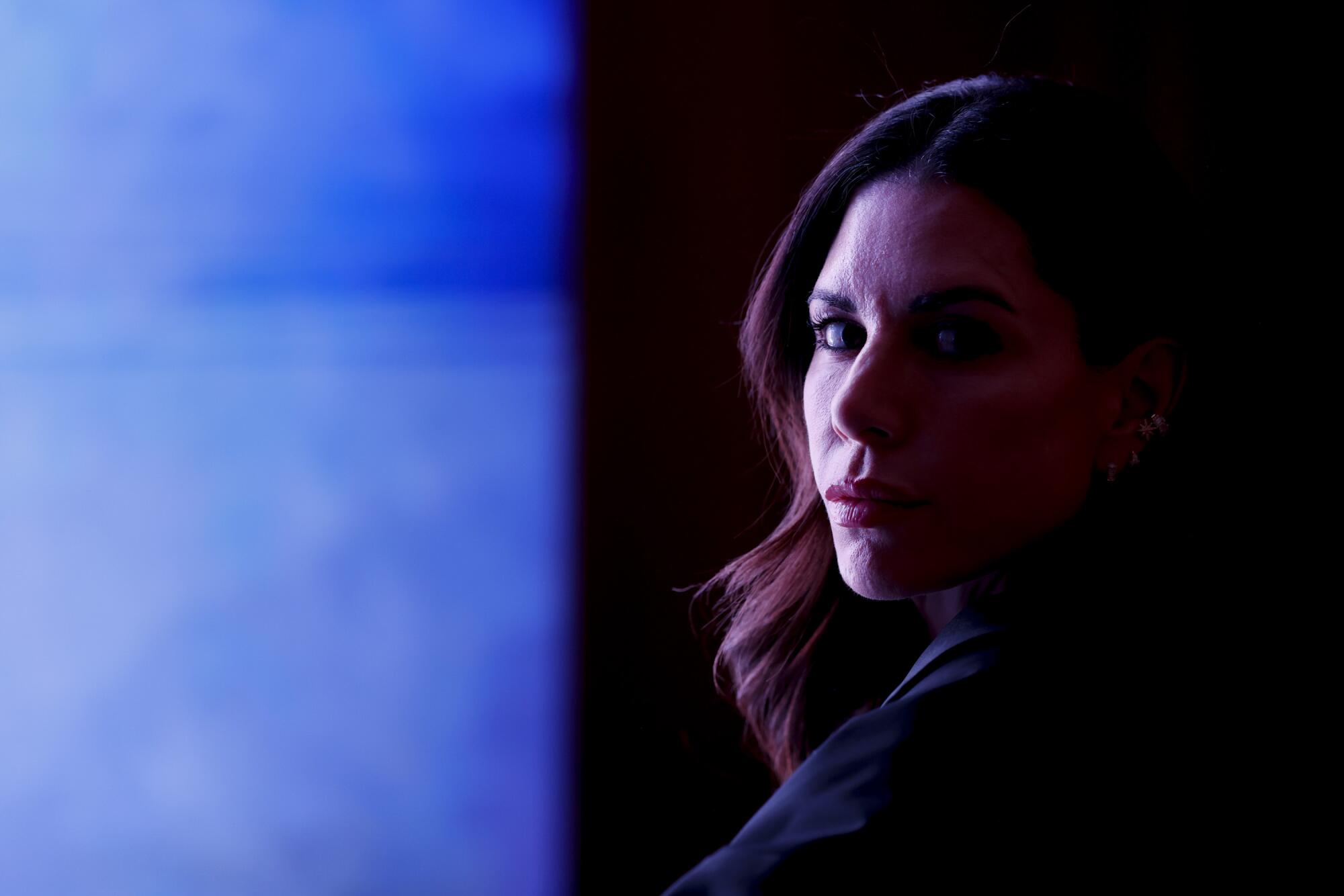
A portrait of video art collector Julia Stoschek. Stoschek’s stunning collection — one of the world’s best — is being presented for the first time in the U.S. during an exhibit titled “What a Wonderful World: An Audiovisual Poem.”
(Carlin Stiehl / For The Times)
The exhibit is anchored by Stoschek’s impressive private collection of more than 1,000 artworks, hundreds of which are digitized online. Time-based art is notoriously under-collected by institutions and undervalued by the market. But through her extended engagement with artists, Stoschek has assembled one of the world’s leading collections — and put it to good use.
Stoschek’s foundation has supported dozens of exhibitions, including two of Germany’s pavilions at the Venice Biennale, and runs public museums in Düsseldorf and Berlin. For aficionados of video art, “What a Wonderful World” is an overdue foray into the United States.
Share via Close extra sharing options
While there is popcorn, there’s no fixed seating, no timed screenings and no attempt to tell a linear history of film. From 5 p.m. until midnight, visitors are invited to wander freely through a dense labyrinth of sight and sound, where cinematic landmarks like George Méliès’ “A Trip to the Moon” (1902) and Luis Buñuel’s “An Andalusian Dog” (1929) are scattered pell-mell throughout the galleries alongside contemporary pieces by artists including Marina Abramović and Wolfgang Tillmans. Venice-based artist Doug Aitken is also premiering a new project, titled “Howl” (2026), two days into the exhibit’s run.
On center stage, Arthur Jafa’s “Apex” (2013) makes its Los Angeles debut. Widely regarded as a masterpiece of video art, its driving, syncopated track pulses over media appropriated from music videos, news footage and pop culture to form a seductive montage of Black cultural achievement, scenes of brutality and vernacular pictures.
“Apex” screens directly across the auditorium from New York Herald cartoonist Winsor McCay’s early animated film “Little Nemo” (1911), which features a princely white child dancing alongside caricatures rooted in minstrel performance. Often contextualized as a milestone of artistic invention entangled with racist representation, “Little Nemo” takes on a different valence here. The former’s pulsing soundtrack tears apart “Little Nemo’s” enchanting dream logic, shattering the illusion that Nemo — despite its virtuosic rendering — can be so cleanly distinguished from its accompanying grotesque depictions.
If the older film depends on a visual hierarchy that isolates refinement from racialized stereotypes, “Apex” refuses that separation. It collapses cruelty and pleasure, grace and grief into a rhythmic kaleidoscope of feeling. The effect is exhausting and unsettling.
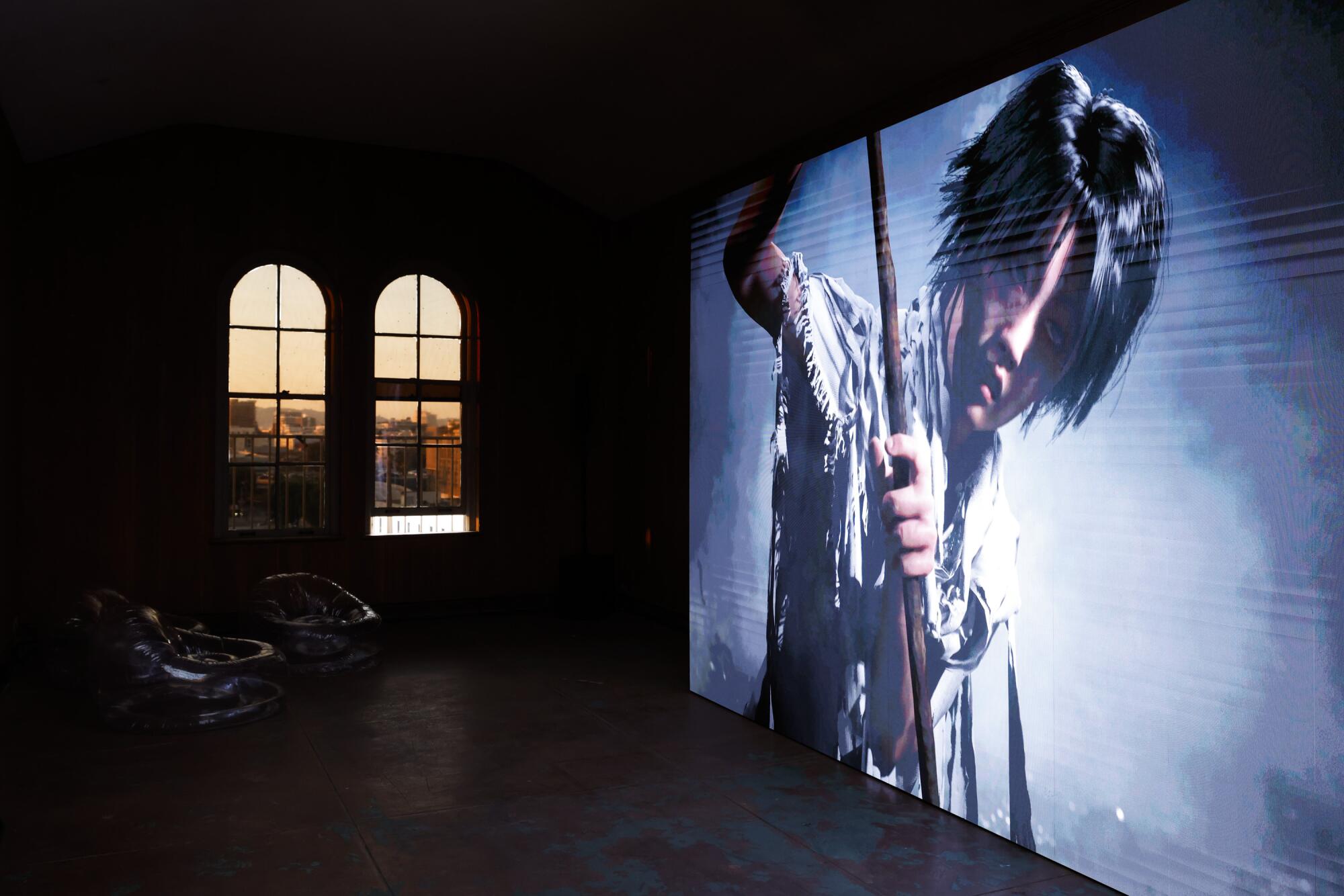
Lu Yang’s “Doku The Flow” plays during the exhibit “What a Wonderful World: An Audiovisual Poem,” presented by the Julia Stoschek Foundation at the Variety Arts Theater in downtown Los Angeles.
(Carlin Stiehl / For The Times)
Cinematic montage — pioneered by Sergei Eisenstein and reinvented by Jean-Luc Godard — becomes an organizing principle of the exhibit, as artworks compete for attention. It would take roughly 12 hours to watch the show from start to finish, but Stoschek and Kittelmann recommend an hour or two of aimless wandering. Audio from one work bleeds into another, while flashes of familiar sounds and images — footage of 9/11, a Britney Spears track — function as what Kittelmann calls “memory triggers” that connect personal and shared experiences.
On one balcony, a recording of Nina Simone’s soulful 1965 rendition of the spiritual “Sinnerman” is set over pirated archival footage of the Civil Rights Movement and Vietnam War protests. Elsewhere, frat boys binge drink at Maya ruins in Cyprien Gaillard’s “Cities of Gold and Mirrors” (2009), while Maya Deren’s nearby “Meditation on Violence” (1948) captures a Taoist ritual of masculine grace.
“What a Wonderful World” treats dissonance, cacophony and intensity as metaphors for daily life.
“The world itself is loud and overwhelming,” Kittelmann said, noting that meaning emerges when familiar connections break open, allowing attention to shift to the gaps between.
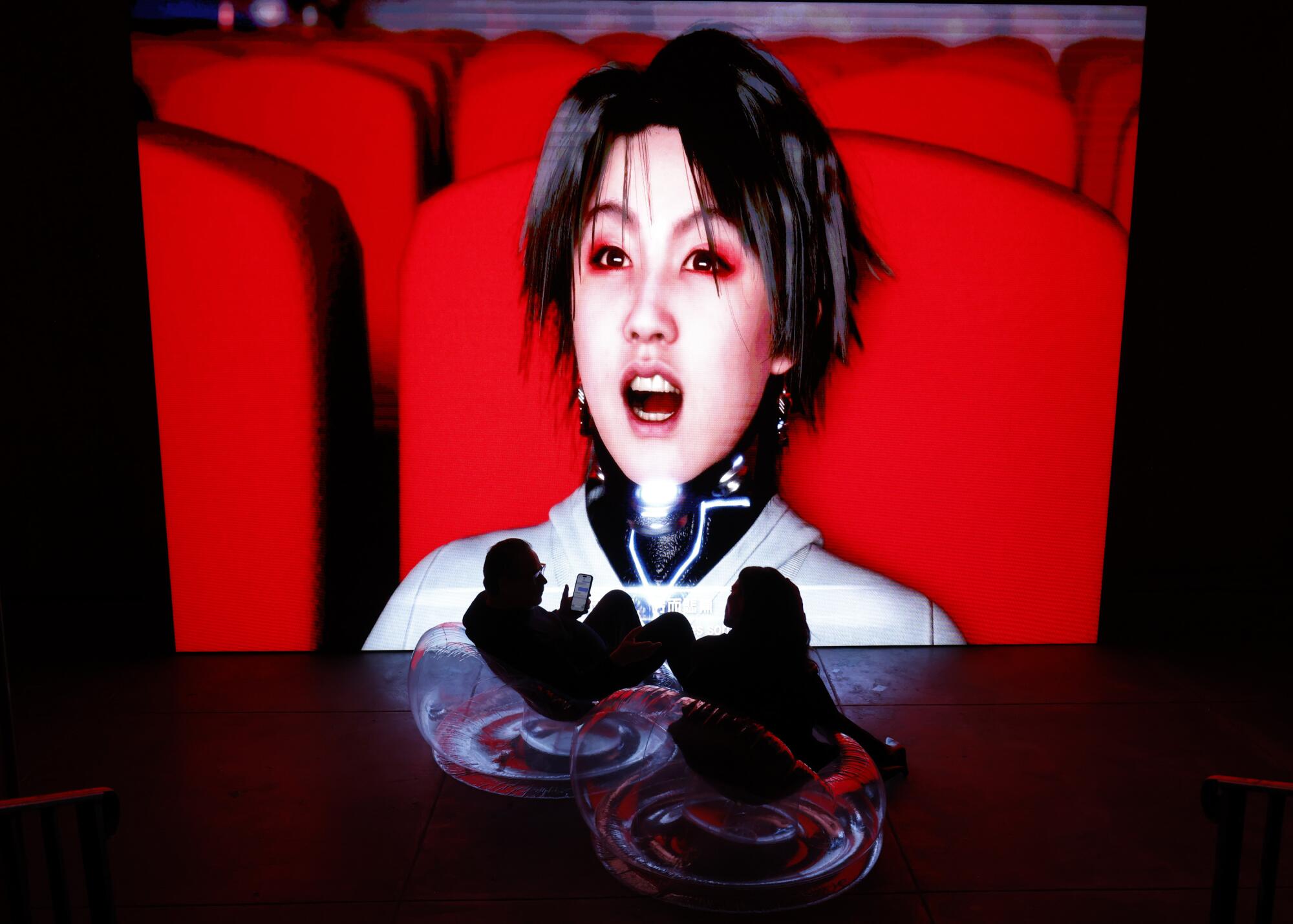
Curator Udo Kittelmann, left, and Julia Stoschek sit in front of Lu Yang’s “Doku The Flow” at the exhibit “What a Wonderful World: An Audiovisual Poem,” which brings Stoschek’s seminal collection of video art to the U.S. for the first time.
(Carlin Stiehl / For The Times)
Stoschek builds her collection around what she calls “art with an afterimage,” seeking out pieces that linger in the mind, then subtly change register. The work is often difficult and disorienting, but the show’s aim is not to cow viewers into submission.
“We want people to enter, to pause, to reflect, and to leave with a shift in perspective, with a glimpse of hope,” Stoschek said.
A dry sense of humor surfaces in unexpected places — like by the lavatory mirror, where Douglas Gordon’s “The Making of Monster” (1996) is installed. A droll moment of introspection is offered when Gordon disfigures his face with tape.
A former MOCA trustee, Stoschek spent years trying to bring her collection to Los Angeles, which she calls,“the birthplace of the visual modernity of cinematic imagination.” Access to the Variety Arts Theater presented the perfect occasion. Artworks by Dara Birnbaum and Elaine Sturtevant flank the building’s entrance, honoring the theater’s origins as a women’s civic center. Prominent public figures such as Eleanor Roosevelt spoke there before it transitioned into a vaudeville venue. Charlie Chaplin attended the opening.
Variety Arts has been mostly dormant since the 1990s, seeing occasional rentals and long stretches of vacancy. Over time it’s become a symbol of neglect and unrealized potential in downtown Los Angeles.
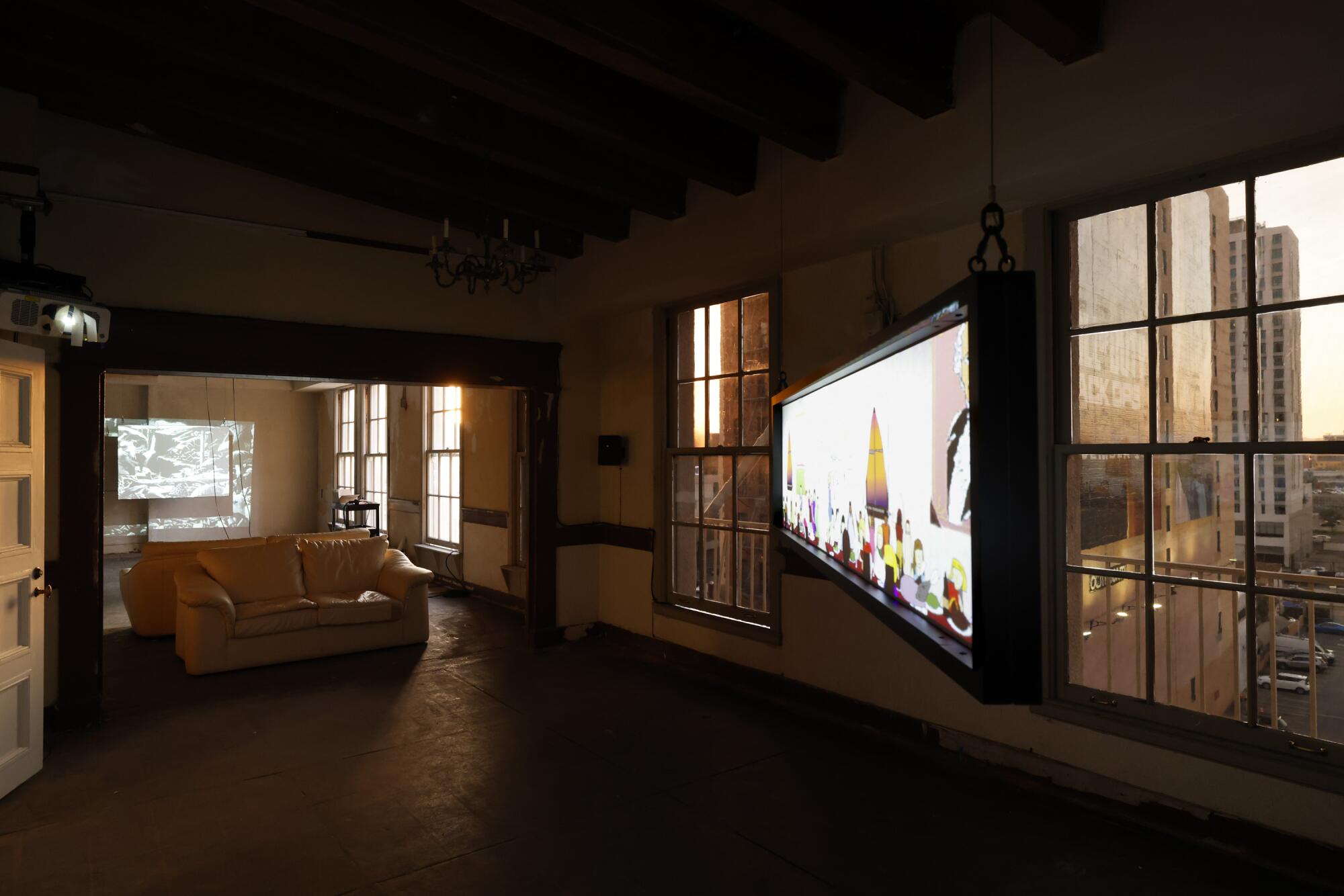
Paul Chan’s “Happiness (Finally) After 35.000 Years of Civilization (after Henry Darger and Charles Fourier)” screens during the exhibit “What a Wonderful World: An Audiovisual Poem” at the Variety Arts Theater in downtown Los Angeles.
(Carlin Stiehl / For The Times)
Showing at the theater represents a full-circle moment for Aitken.
“I went to a family wedding there as a 5-year-old, and to underground punk shows in the ’80s as a teenager,” he said, adding that the exhibit and its setting counter the familiar narrative that Los Angeles is “a city with no history.”
Aitken traces the building’s guiding spirit through downtown’s uncanonized cultural lineage — along Alameda Street and to venues like LACE and Al’s Bar — where artists merged music and film in loft takeovers and avant-garde installations.
“Generations of artists keep inheriting the white box, and we think that’s where art should reside,” he said. “That’s such a conservative view.”
“What a Wonderful World,” he said, models an alternative way to showcase the artistic history of Los Angeles — one that runs parallel to Hollywood’s dominant narrative.
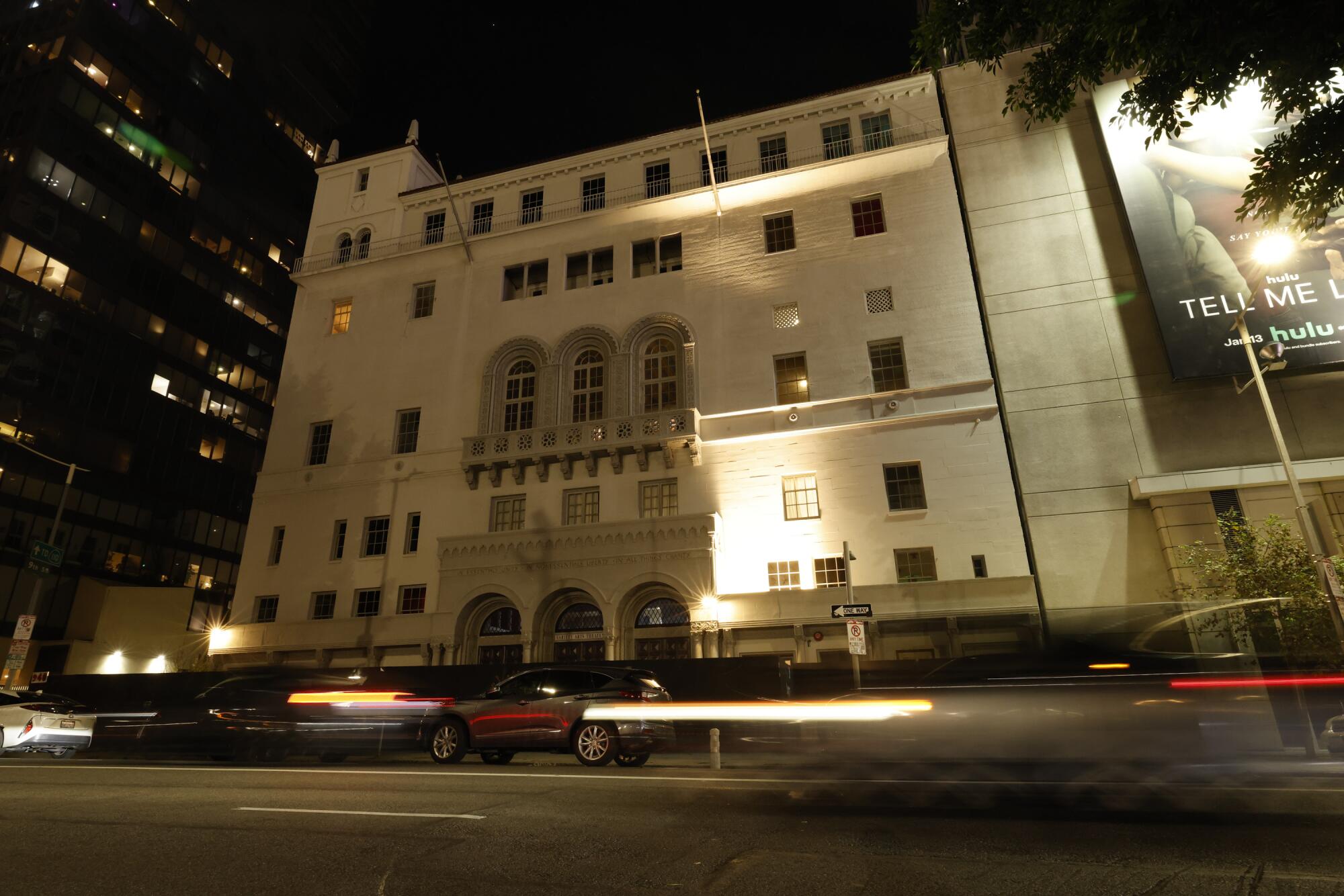
The exterior facade of the Variety Arts Theater in downtown L.A., which is opening its doors for the first time in years to host a video art exhibit from the Julia Stoschek Foundation.
(Carlin Stiehl / For The Times)
Kittelmann, too, sees physical theaters as essential to that ambition.
“There are very rare spaces where, once the doors are closed, you forget about the outer world and you breathe totally differently,” he said.
Through the exhibit, the building is allowed to show its skin: Walls are plastered but unpainted, and the basement is stuffed with bric-a-brac accumulated during its long, colorful history.
Powerfully installed at the end of the basement’s long hallway is Anne Imhof’s “Untitled (Wave)” (2021). In the video, Imhof stands alone at the ocean’s edge, repeatedly striking the water with a whip. As she does so, everything else falls away, leaving only this image of solitary resistance against a force that does not answer back.
In an era when most viewing happens alone, at home or on phones, “What a Wonderful World” insists — almost stubbornly — on collective attention as a radical act.
“It’s a love letter to time-based artworks,” Kittelmann said, “and a love letter to Los Angeles.”