
Staff shuffles at Oakland City Hall are exposing more tensions between city leaders and activists over civilian police oversight.
On Monday, City Council President Kevin Jenkins removed Rickisha Herron from the Police Commission Selection Panel, the board that picks four of the seven members of the city’s powerful Police Commission. Herron’s dismissal comes two months before her five-year term was set to expire.
Herron received an email on Feb. 2 from Meisha McGlothen, the district director for Jenkins’ office, informing her that she was being replaced. “After a vetting process District 6 has identified a community member who is willing to step up and serve as the next Selection Panel member for District 6,” McGlothen wrote.
Herron’s replacement, according to the email, would start their term the following day, on Feb. 3.
Jenkins told The Oaklandside that Sandy Bethune, a longtime Oakland resident, is the new District 6 appointee. City records show Bethune had applied to serve on the Police Commission two years ago. Jenkins said he picked Bethune because she “brings independence, sound judgment, and a clear understanding of the responsibility that comes with serving on the Police Commission Selection Panel.”
In an interview with The Oaklandside, Herron said the email took her by surprise. “There was no previous consultation or conversation with me about this occurring,” she said.
Herron, who led the selection panel, said she interprets her dismissal as retaliation for asking the City Council repeatedly to reappoint two incumbents to the Police Commission, the city’s civilian police oversight body.
The selection panel in recent months has twice nominated Police Commission Chair Ricardo Garcia-Acosta and Alternate Commissioner Omar Farmer to renew their terms, which expired in October. But both times, the council declined to reappoint the two commissioners.
While several council members have cited concerns about the selection panel’s application and review process, some police accountability activists have argued that the council is bowing down to the Oakland police union, which has signaled that the Police Commission makes it harder for officers to do their jobs.
Herron’s removal wasn’t the only personnel move in City Hall related to police oversight in recent days.
On Feb. 3, Felicia Verdin, an assistant to the city administrator who helps the Police Commission Selection Panel run its meetings and carry out its business, informed them that she was being replaced by Burt Jones, a new assistant to the city administrator.
Jones previously worked under Jenkins as a deputy mayor when the latter was Oakland’s interim mayor last year.
Jean Walsh, a spokesperson for the city, told The Oaklandside that Jones was hired by the city administrator’s office one week ago, on Jan. 31.
Verdin declined to comment.
Walsh said the city administrator “is redistributing the responsibilities of staffing boards and commissions in order to address operational needs and better balance staff workloads.”
When we called Jenkins to ask about these changes, he said people are trying to spread “conspiracy theories” about him, claiming he is working with the Oakland police union to weaken civilian police oversight.
“It’s all conspiracy theories for doing one’s job,” Jenkins told us, saying that it is normal and within his purview to replace Herron because the city charter allows council members to replace selection panel appointees each year.
Jenkins said he is replacing Herron with a new appointee because she had “clearly and in writing indicated that she was no longer interested in continuing her service on the Police Commission Selection Panel and that she intended to focus on transitioning out of her role.” He added that he’d offered Herron the opportunity to serve on other boards or commissions, should she be interested.
Herron said Jenkins incorrectly interpreted her words and that she’d intended to complete the rest of her term on the selection panel. She was appointed by former District 6 Councilmember Loren Taylor in 2021; her term would have expired on April 6.
Some police reform activists have expressed concerns over the City Council possibly being lobbied by the Oakland police union, which has accused the commission of fostering an atmosphere of distrust in the police. Sgt. Huy Nguyen, president of the police union, confirmed to the East Bay Times that he has spoken to council members about the commission.
Some believe the police union and its allies want to weaken — or even dismantle — the civilian police oversight board.
Herron said she agrees with this concern.
“It’s very strategic and, to me, is leaning towards pandering to the police union to eventually erode the existence of the Police Commission and therefore the selection panel,” she said.
Another member of the selection panel, who asked not to be named for fear of also being removed from the board, told The Oaklandside they felt “surprised and shocked” by Herron’s early dismissal.
The selection panel was envisioned as a way of distancing council members from the process of appointing police commissioners
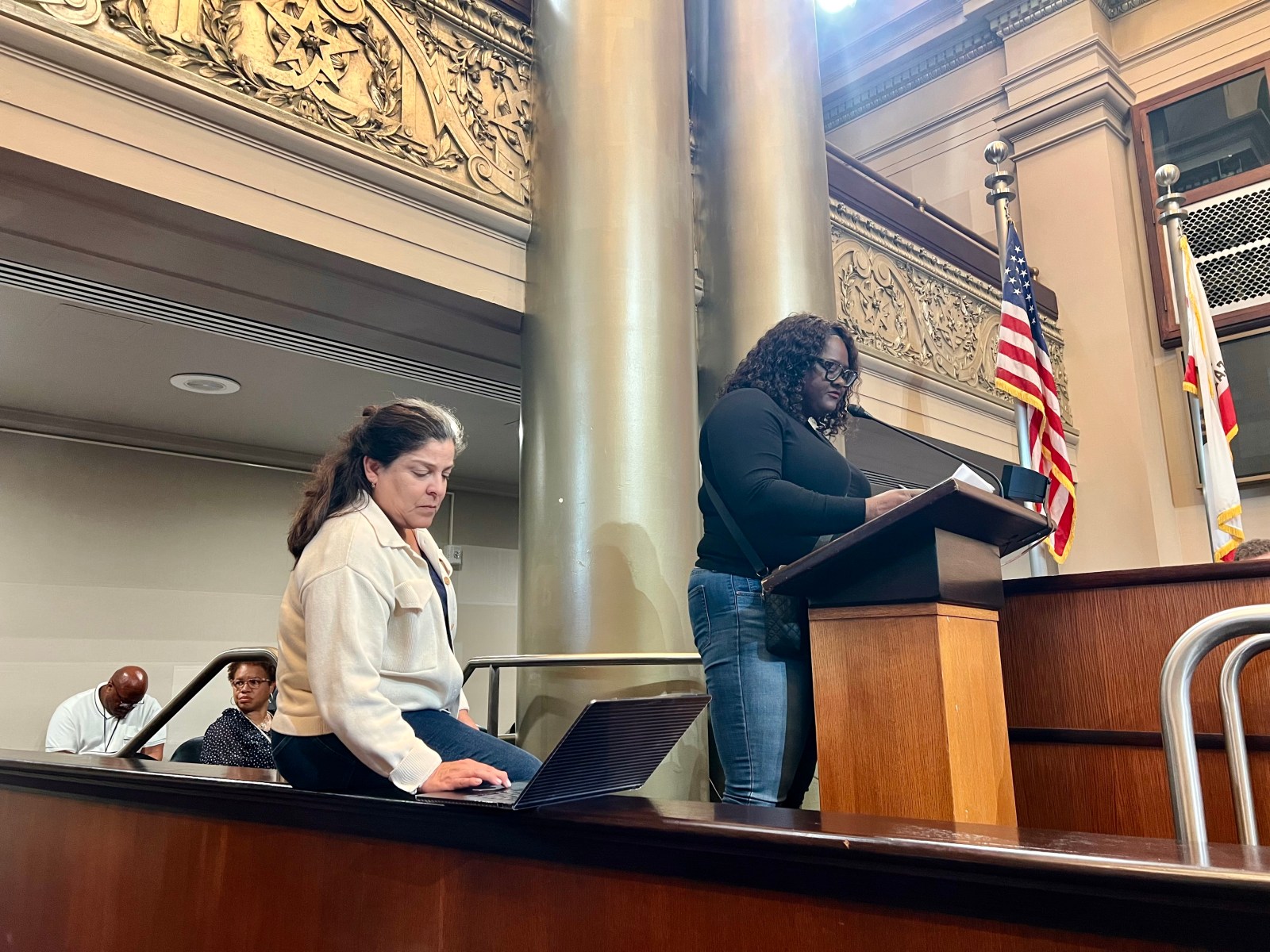 Rickisha Herron, right, addresses the council members during a City Council meeting at Oakland City Hall on Oct. 21, 2025. Credit: Roselyn Romero/The Oaklandside
The Oakland Police Commission Selection Panel is a nine-member board of volunteers appointed by the mayor and each City Council member. Appointees serve for a maximum of five years.
Rashidah Grinage, a longtime Oakland resident whose activism helped lead to the creation of the Police Commission in 2016, told The Oaklandside that having a selection panel helps maintain the commission’s independence.
“The whole philosophy of creating the selection panel was to establish distance between the police commissioners and the City Council so that commissioners would not feel directly beholden to their councilperson,” Grinage said.
Grinage believes Herron’s dismissal raises questions about the independence of the selection panel and the extent to which council members are trying to get involved in civilian police oversight.
“The degree to which the council wants to influence this middle-ground party is closing that distance we had hoped to create,” she said.
Last July, the selection panel, led by Herron, nominated two incumbents to new terms on the Police Commission: Garcia-Acosta, the commission’s chairperson, and Farmer, an alternate commissioner. Per the city charter, after the selection panel submits a slate of nominees to the City Council, the council must approve or reject the entire slate.
In October, the council rejected them, citing concerns with the application and recruitment process. But some council members may also have been influenced by an activist who has been highly critical of the commission and the Oakland Police Department’s federal court oversight. Ahead of their vote, council members got a letter from Rajni Mandal, a Montclair resident, who laid out a list of criticisms of Farmer and asked the council to reject any slate containing his renomination. Mandal has also outlined her gripes with the commission in essays for the publication Oakland Report, which was run last year by a former Oakland police officer.
When the selection panel reconvened in December, they voted to resubmit Farmer and Garcia-Acosta’s names to the City Council.
At the council meeting on Jan. 20, all but two council members — Carroll Fife and Noel Gallo — declined to reappoint the incumbents, again citing concerns about the Police Commission Selection Panel’s process.
“The Council’s focus on the selection panel’s process was an excuse to justify their vote and sabotage the selection process,” said Millie Cleveland, a member of the Coalition for Police Accountability, an activist group that wants to see a stronger and more independent police commission. “Our Council is seeking the approval of the police union for Police Commissioners. This is an assault on the checks and balances that are required for good government.”
District 1 Councilmember Zac Unger also appointed a new member to the selection panel this week. Breeanna Decker, who works for the San Francisco Foundation, assumes a seat that was vacated by Roger Smith, a panelist who served for just one meeting in December before he stepped down because he moved to San Diego to take a job running that city’s Commission on Police Practices.
Unger told The Oaklandside he chose Decker because of her competency and experience as a public servant. He said she helped with the creation of the fire department’s MACRO program several years ago and has deep roots in Oakland.
Garcia-Acosta and Farmer, whose terms as commissioners expired in October, are currently serving in a hold-over capacity.
“I am hopeful that the city will find a resolution to this process, which has now dragged on for nearly a year,” Garcia-Acosta wrote in a statement to The Oaklandside. “I remain steadfast in my commitment to the work of the OPC and look forward to being evaluated based on the merits of my qualifications and the accomplishments of my leadership.”
“*” indicates required fields