
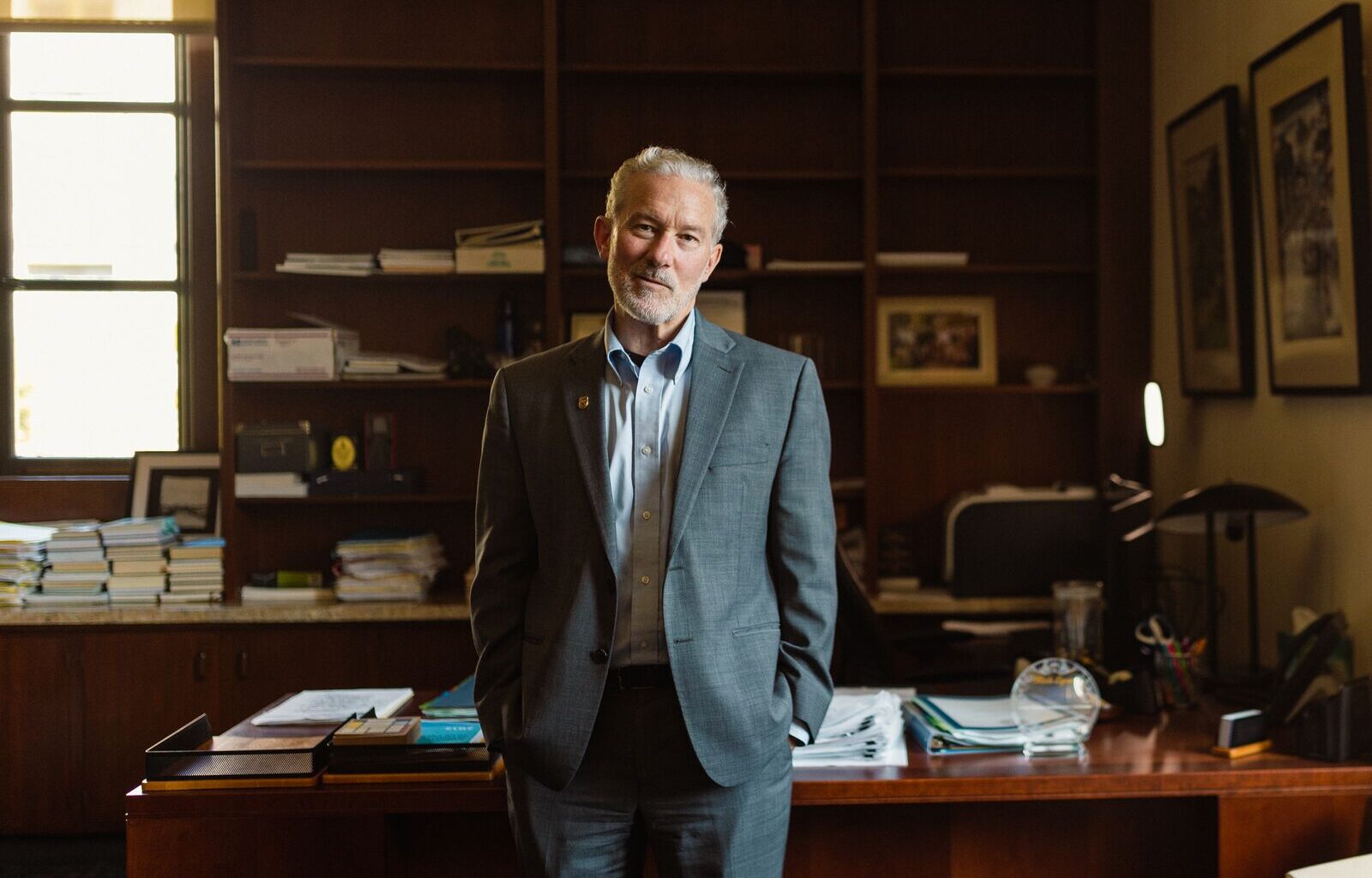
 UC Berkeley chancellor Rich Lyons in his office in California Hall, on Sept. 20, 2024. Credit: Ximena Natera, Berkeleyside/CatchLight Local
Rich Lyons has one of the tougher jobs in California right now. Six months after he took over as UC Berkeley’s chancellor in mid-2024, Donald Trump was sworn in as president for the second time, ushering in an era of unprecedented tension between the federal government and universities.
As the Trump administration has attacked higher education’s independence — launching investigations into colleges’ handling of antisemitism and efforts to attract a diverse faculty and student body, and demanding sweeping changes to admissions, hiring and curriculum — institutions are seeing their reputations defined by their response to the pressure.
Trump officials and Congressional Republicans have initiated at least seven separate investigations into UC Berkeley since 2024, and the administration had revoked $50 million in federal research grants to the campus as of December.
Lyons, the first UC Berkeley chancellor to have earned an undergraduate degree at Cal, remains ebullient regarding the university and its future. He’s the university’s former head of innovation and entrepreneurship, and the kind of chief executive who hosts a panel discussion titled “Why Kind Leaders Win.”
Last year, as the Trump administration began revoking research grants nationwide, some faculty publicly wondered whether Lyons had the temperament to fiercely defend UC Berkeley from what they saw as an existential threat. He drew sharp criticism from free speech advocates when the university shared with the Trump administration unredacted files from internal antisemitism investigations that named 160 faculty and students, and again when it suspended computer science lecturer Peyrin Kao for comments he made in the classroom about the war in Gaza. The Berkeley Faculty Association, a progressive group representing a fifth of tenure-track faculty, said the latter decision “threatens the faculty’s fundamental political freedoms as citizens.”
But Lyons’ background as a prolific fundraiser and focus on generating new revenue sources for Cal feel, to admirers of his leadership, tailor-made for a moment when federal research funding is increasingly under threat. He has particularly emphasized capturing more of the profit generated from discoveries made at the university. It’s an effort that he projects could bring in an additional $100 million annually within the next 10 years, and which he frames as a way to preserve scholars’ ability to study what they deem important, regardless of the political winds.
Berkeleyside sat down with Lyons on Feb. 3 for a wide-ranging talk about academic freedom, his role in protecting the university’s students and its bottom line, and the legacy he wants to leave as chancellor. The following interview has been edited for length and clarity.
How do you balance the need to react to changes at the federal level with the day- to-day business of running a top-notch research university?
The metaphor I use a lot is that it’s a bifocal moment. There’s stuff coming at us, very significant stuff. And then there is this idea that, look, Berkeley is one of society’s most valuable assets. Paint the picture of what we most need for society 10 years from now, and let’s aim at it and let’s commit to it.
Bound up in that is the greatly diminished trust and confidence in higher education, which predated this administration. Trust and confidence has fallen in the minds of society for three main reasons: One is cost, affordability. One is careers – are we shaping people for what they think they need? And one is culture – are we ideologically tilted? We need to tell better stories across those three things.
The administration has changed the game in a pretty fundamental way over the last year, so there’s no question about that. I need to protect our freedom to learn, to teach and discover. And I’m going to protect those things.
What does protecting that look like?
If the federal government, in its decision-making capacity, says we’re not going to fund this kind of research anymore, we need to come up with a different set of resources. I need a research resources flywheel. And we can’t be as dependent, I think. Whatever this administration does, whatever comes next, I think there is a secular shift downwards across administrations in the research funding we will get from the federal government. And we need to respond to that and position ourselves.
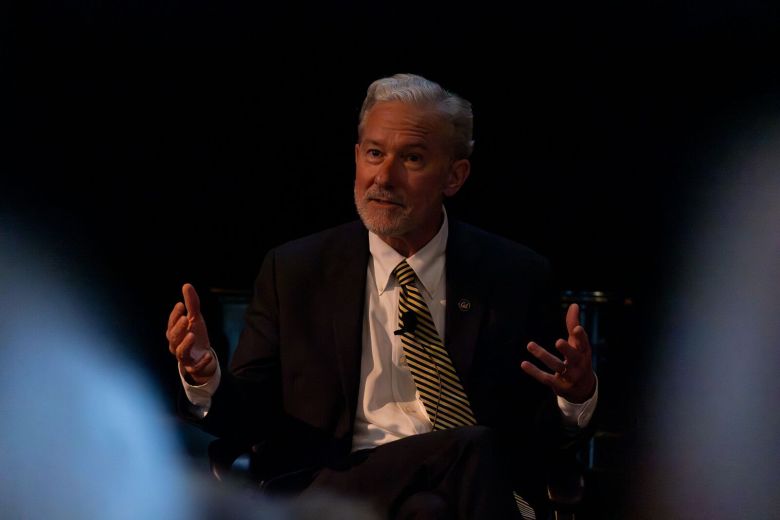 Lyons talks at the Berkeley City Club on July 2, 2025. Credit: Sara Martin/Berkeleyside
That’s been a big emphasis for you – cultivating entrepreneurship and looking at how to capture more of the revenue that’s generated from the university’s intellectual property. Can you speak specifically to how you’ve done that so far in your tenure?
Our undergraduate alumni produce more venture-funded startups than any other university in the country, and actually by quite a margin.
When we license our technology to a startup now, instead of saying these are the royalties and other kinds of payments we could receive from a licensing contract, we will say, “We’ll dial down the royalties a little, but we want to own 3% to 4% of your company.” How many of those do we have? Well over 100. It’s really a big category.
There’s a set of external venture capital funds that are investing in Berkeley companies and part of what they’ve contractually committed to us is, when that fund starts making money, the general partner gets 20% of the upside. Well, in each of those funds, the general partner has contractually committed half of that 20% back to Berkeley. So de facto we own 10% of each of those portfolios.
That spreadsheet is new. It wasn’t even on our balance sheet, it wasn’t in our economic model. And that will enable – how are we going to go after climate in a new way? How are we going to go after human health in fundamentally different ways? How are we going to go after the fracturing that’s happening within and across societies? You know, these really fundamental things that people need Berkeley to go after.
One of the most exciting elements is that the revenue from these new streams can be used entirely at our discretion, for the benefit of the entire university including perennially underfunded areas like the humanities and social sciences. [People might say], ‘Oh that’s just all about the money.’ It’s like, no, it will enable all this other really important stuff.
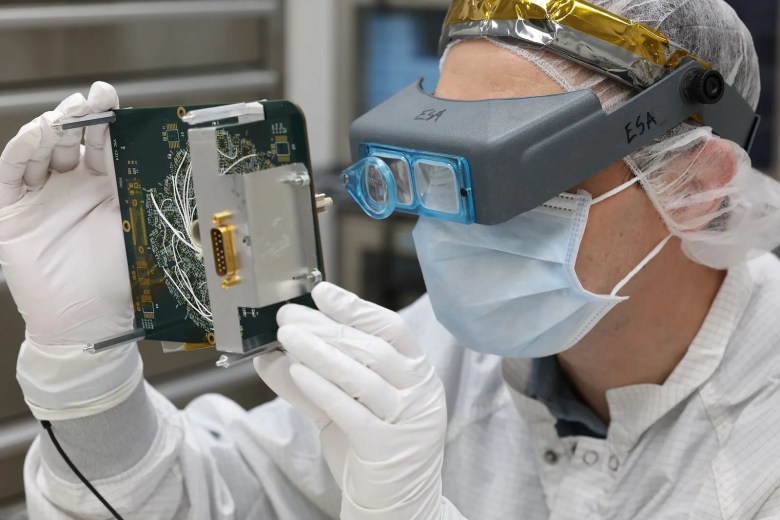 Researcher Roberto Livi inspects space hardware for the ESCAPADE mission in a cleanroom at the UC Berkeley Space Sciences Laboratory. Credit: Alan Toth
I’m going to shift gears to academic freedom. Your staff have said you can’t legally comment on individual disciplinary cases. But speaking generally, when the university chooses to discipline a faculty member or a student in a case that involves questions of political speech or academic freedom, to what degree are you personally involved in those decisions?
The general answer is really not so much. When things start getting more complicated is, ok here’s a second or third or fourth offense – what are we going to do now? The policy doesn’t outline that. The policy also doesn’t say exactly what happens when someone crosses the line. So when things get more acute like that sometimes they pop up to me and at the very least I’m briefed.
What are the values that guide you when you’re approaching a case like that?
A fundamental value is, to the extent we possibly can, content neutrality. If we’re thinking about the activist tradition at Berkeley, which is a really important tradition, and people expressing free speech rights on the Berkeley campus, there are hundreds of ways and places to do that on the Berkeley campus. We don’t just condone it, we encourage it. And: No more tents. No more blocking Sather Gate.
Somebody could say, “Well, by not allowing tents you’re not allowing free speech.” I reject that argument. So part of it is the free speech tradition of Berkeley, it doesn’t mean anything goes. And that’s true in the classroom as well.
Some faculty members have publicly supported the way the university has enforced policies that regulate speech on campus and in the classroom. But I also have heard widespread concern among students and faculty that those policies are being unevenly enforced, particularly around Israel/Palestine, and that that is being done in an attempt to appease the Trump administration. How would you respond to the folks that have those concerns?
Part of the question is, does it become an issue on campus? If no one reports it, if nobody says that was problematic for me, I felt uncomfortable, this feels harassing or discriminatory to me… Sometimes people say, but what about X [situation]? It’s sort of like, nobody reported it. Nobody expressed discomfort. We have a formal reporting process.
What I’m hearing you say is, if nobody reports an incident or expresses concern, there’s not necessarily a reason for the university to take action.
Well, I don’t want to overstate that. If a policy’s clearly been violated, I think we have to address it, we have an obligation to address it. But as a practical matter in terms of what are our procedures, if no one reports it we may never know about it.
Diversity, equity and inclusion has obviously been a huge topic of debate nationwide. Has the university made any changes to its Division of Equity and Inclusion under your tenure? And if so, what have those been?
The university is and was dedicated to making society more inclusive, to making it more equitable and to making it more diverse. It’s the Division of Equity and Inclusion;, we haven’t changed it. Its basic structure looks the same. I think if anything we’ve increased resources to the general area. [Editor’s Note: Berkeleyside later reviewed figures provided by UC Berkeley that show the division’s funding from the university rising steadily from 2020 to 2024, then remaining flat from school year 2024-25 to 2025-26. Funding from outside sources such as philanthropy and grants increased during that year, leaving the division’s total budget up 8% year over year, and up by about half since 2020.]
We owe it to ourselves and the society that we serve to continually think about, Could we move some resources from A to B, because A isn’t actually delivering as much as we hoped it to?
Are there particular initiatives, then, within that broad area of diversity, equity and inclusion that the university is now either doing less of or doing more of?
One of the things that’s so distinctive about Berkeley and the whole UC system — and this is not true of Michigan or Virginia — a third of our incoming undergraduates are transfer students, 95% from California Community Colleges. So when we think about what upward mobility looks like, and how to drive more upward mobility, we are thinking an awful lot about those questions.
This is a hypothetical, it’s an idea, so I’m not saying we’re committing to it, [but] with so many of the jobs going away for new graduates…what if we designed a bundle of services for career and life for first-generation, Pell-eligible, lower-income students for the five years after they graduate?
That’s really interesting at a number of levels, because students who come into Berkeley with a lot of social capital, their family’s connected, they’re getting internships, they’re not as reliant on a lot of those things. So as jobs dry up in the new graduate market, the people with fewer advantages are going to lose the most.
You could look at that and say that’s just economics, [but] this is a more inclusive way to be, this is a more equitable way to be, it’s a more diverse way to be.
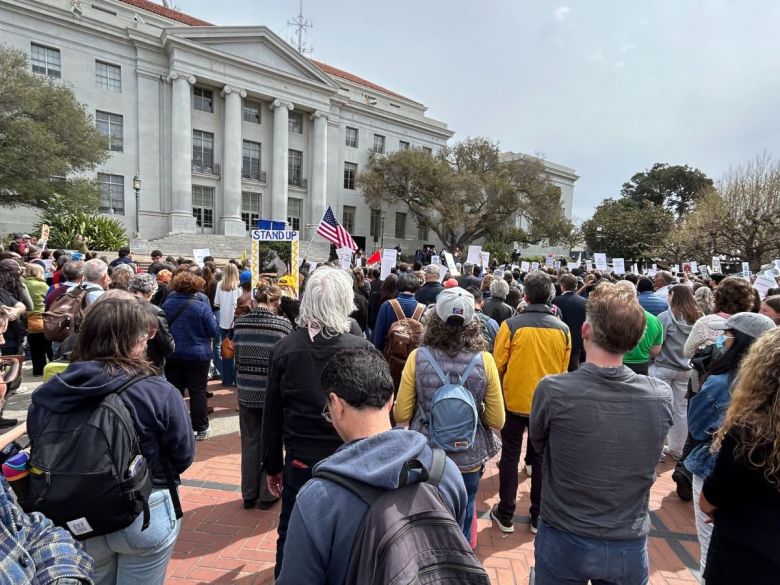 Students rally March 19, 2025, on UC Berkeley’s Sproul Plaza in opposition to the Trump administration’s promises to slash federal research funding and to crack down on diversity initiatives. Credit: Natalya Nielsen
The Multicultural Community Center has provided cultural programming and community with an emphasis on communities of color, and I’ve heard from students and alums that it has been a strong space of support for some of those students who are first-generation, trying to navigate campus and find their support system. It’s been closed since the summer. Is it going to reopen? And can you comment on why it closed?
The answer to the first question is an absolute yes. We expect it sometime this semester. The why is that Berkeley, like any public institution, we need to be welcoming in all of our spaces. And we were hearing from some people, some groups, that it’s not even that I felt unwelcome in that space but some felt threatened in the space.
What were the things that people were saying made them feel unwelcome?
I think there are a lot of images and messages in there that certain people would look at…and say, “This is not the place for me.”
I know one of the things that came up was the “Free Palestine” artwork that was up on the walls. Is that what you’re referring to?
That’s an example of it, but by saying it is that, then all of a sudden you’re not being content neutral. You’re quashing one side or the other. I think there were a number of things in there. There were signs that were pointed toward the outside — this was before it closed — and we said we get free speech, we get the history of the Multicultural Community Center, but we are not going to have signs in a Berkeley building pointing outside to the public, because it looks like Berkeley has endorsed that sign. And some of those signs were very aggressive.
There’s a lot of discussion and consultation with the student interns that run it, there’s also a staff leadership team that we’re working closely with and then the head of our whole equity and inclusion [division], Fabrizio Mejia. I’m not saying everybody’s going to agree on where we land. But boy is there a lot of consultation and discussion.
We are going to do our very best to do the right thing for our community writ large, and I do believe we can land in a place where people across all kinds of views on all different issues will say, “I now feel welcome.”
You and I both attended here – you were an undergrad here in the late ’70s and early ’80s. How would you say the campus has changed since your time?
Well, it’s even more beautiful. It’s always been beautiful to me, gobsmackingly beautiful.
People are outspoken with their views and they need to be, that part is still there. But it does seem like it’s in many ways healthier than it was back then. Coming out of the ’60s and into the ’70s, it was quite intense and it felt more potentially violent – it just did. By the time we got into the ‘’80s things had sort of shifted. So it feels like we are actually better at [dialogue] even though the perception is that universities are worse.
People ask me, “Why do you keep saying that Berkeley produces more funded new businesses than any other university?” It’s because it violates the caricature [that] Berkeley is just spinning out there in orbit somewhere and it’s not helping America and it’s not creating jobs.
It was last spring’s campuswide commencement and after the fact somebody was asking, “Were there any protests?” and I said, “The optimal amount. Not zero.” If somebody prevents commencement from happening, that’s not OK. But the idea that people stand up and have something to say and do it respectfully and then move on is, like, yay.
We’re at a time when the federal government is escalating its immigration enforcement in Minneapolis and nationally. We’re seeing increased targeting of people who are not just undocumented immigrants but citizens, people of color being detained seemingly indiscriminately. As a university, how are you supporting or protecting those students who, either because they are immigrants or people of color, feel that they are going to be targeted by this administration?
We need to produce a world-class education and deliver it to people regardless of their immigration status. That’s been a commitment forever, and we continue with that commitment. There’s no question about that.
[He pulls out an example of the “Know Your Rights” cards that the university has been distributing.]
We train our senior people so they know if somebody walks on campus and says they are ICE, how should you respond, how can you respond, what do they have a right to do, what buildings would they not have a right to [go into] unless they have a warrant of this type. People know the difference between a judicial warrant and an administrative warrant, and this is the kind of language that was not known even to me five years ago.
There are many things we’re doing where if I offer you the example, it becomes a target. That’s the level at which we are processing all of this. And I want first and foremost to protect our people.
What do you want your legacy to be as chancellor 10 years from now?
It’s a great and unanswerable question. … I want to put an end to financial austerity at Berkeley.
Berkeleyside partners with the nonprofit newsroom Open Campus on higher education coverage.
“*” indicates required fields