
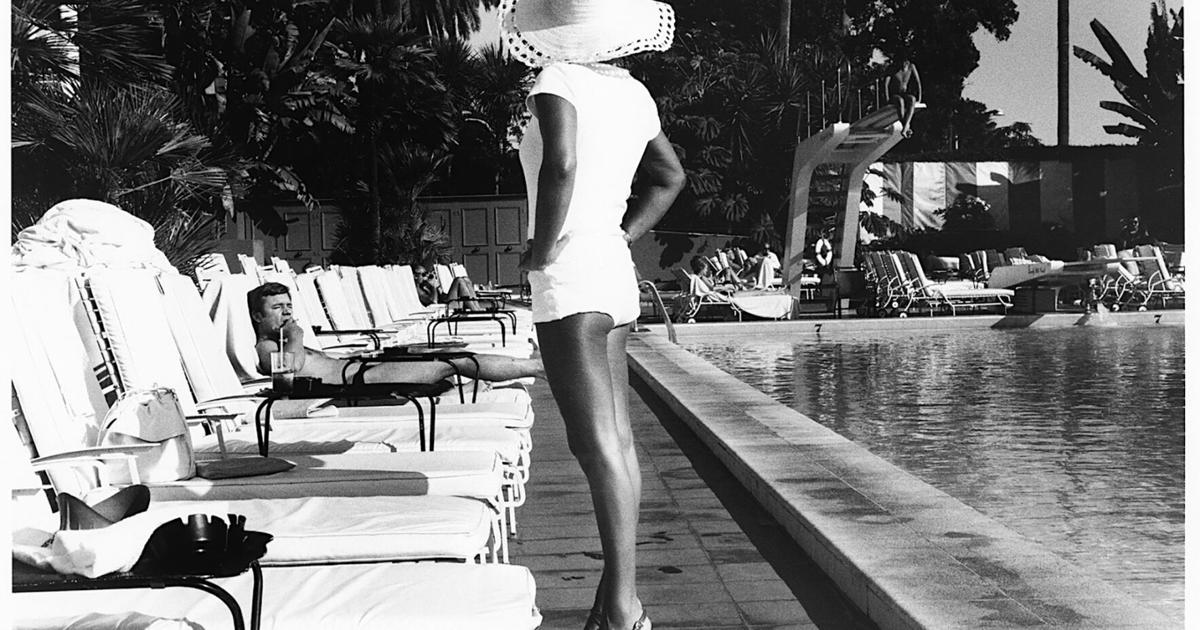
The story behind “Woman by the Pool,” an iconic Los Angeles photograph by legendary photographer and LA resident Anthony Friedkin, is almost as good as the shot.
Friedkin’s most famous work, which captures a tanned, fit and leggy lady at the Beverly Hills Hotel, was taken in a clandestine manner in 1975. Friedkin, while working on his Los Angeles photo essay, requested access to shoot at the Beverly Hills Hotel but was shot down.
“They said we absolutely don’t allow any photography at all at the hotel,” Friedkin said from his Santa Monica home. “I understood it since wealthy people can be very guarded.”
However, a former girlfriend was staying at the luxurious hotel and invited Friedkin to hang out. “I dressed up like a tennis pro with my Leica camera hanging around my neck. I saw this woman standing by the pool and I had to get a shot of her. I dropped to my knees and took two shots of her and walked away. It was meant to be. Sometimes fate plays a hand like an angel coming out of nowhere. All of a sudden I had a historic picture.”
Friedkin, 77, has taken many other stunning photos, much of it focusing on Los Angeles. His work is on display at the Von Lintel Gallery through March 7. “Ex Post Facto” is a fascinating retrospective that spans more than five decades of Friedkin’s photos.
The Los Angeles native began photographing at the age of eight after receiving a Kodak Brownie. By eleven years of age Friedkin had his own darkroom.
The exhibition features selections from several of Friedkin’s most significant photographic projects, such as the surfing essay and the gay essay.
The former is a compelling visual diary, which started in 1975, that focuses on the obsession, risk and ritual of surfing. Friedkin, a lifelong surfer, photographs the athletic art form from inside its physical and psychological demands.
“Since I’m a surfer the ocean is a spiritual place,” Friedkin said. “It’s my cathedral and connection to our universe. The ocean is so moody. It can be serene or it can be violent. I love shooting how waves look and how surfers look in action and what they look like when they’re out of the water.”
The gay essay, which commenced during the early ’70s, stands as a landmark body of work. It’s an insider’s chronicle of gay life in Los Angeles before visibility became codified. Friedkin’s work is touching since he unveiled unguarded tenderness. The images resist sentimentality.
“I saw the horrific way gay people were treated in our country,” Friedkin recalled. “The shaming of gay people, who some believe are not worthy because they’re flawed human beings, is awful. If you believe that God is not down with gay people, well that’s crazy. I decided to do a series of photographs of their community. Sex is a celebration of life. Humans need intimacy. It’s how we express ourselves. Sexuality is universal to our species.”
Friedkin, who has photographed for such national publications as Rolling Stone and Newsweek, documented life in the brothels of New York City and California inmates. “I arrived with dignity and respect for the prostitutes I photographed in New York,” Friedkin said. “What might surprise people is that some of those women were very intelligent and decided that prostitution was the best way for them to make money. I approached those in Folsom prison; many had done horrible things, in the same way as everybody else, with dignity and respect.”
Friedkin shoots in color but the majority of his subjects are captured in black and white. “What I love about black and white photos is that they cut to the truth,” Friedkin said. “Color can be sensual or textural, which is so different than black and white.”
It’s as much about what a photographer doesn’t include in the shot as what he does feature, according to Friedkin, who is approaching his 70th year as a shutterbug. “That’s a part of it,” Friedkin said. “Being a photographer is also about how you interact with your surroundings. I believe my photos are split second movies. There’s a beginning, middle and end of a photo.”
Friedkin is far from finished chronicling life in Los Angeles. Count on more love letters to the City of Angels courtesy of Friedkin’s Leica. “I’m not done yet,” Friedkin said. “I love what I do and I’ve been doing this for a long time.”
But much has changed since Friedkin covered demonstrations during the Vietnam War era as a photographer. “Back then during Vietnam protests cops would hit you over their shoulder with their flashlight,” Friedkin said. “I remember what it was like in downtown Los Angeles. Journalists take a risk today since rubber bullets are fired into crowds. Guys are pepper sprayed. It’s much more dangerous now. Back during the ’60s you might get arrested or pushed around but now you might get blinded.”
Folks occasionally reach out to Friedkin claiming they’re related to the unknown subject, who is the star of the “Woman by the Pool” photo. “People try to scam me to get a print,” Friedkin said. “Their claims fall apart quickly.”
Admirers can check out the perfect “Woman by the Pool” photo at the Von Lintel Gallery. “It was a lot of work getting ready for this exhibit but I’m excited about it,” Friedkin said. “I’m from Los Angeles and I love this city and still love photographing it. Every decade things change in Los Angeles but it’s still an amazing city.”
Anthony Friedkin: Ex Post Facto
WHEN: Noon to 6 p.m. Tuesday to Saturday, through March 7
WHERE: Von Lintel Gallery, Bergamot Station, 2525 Michigan Avenue, Santa Monica
COST: Free Admission
INFO: 310-559-5700, vonlintel.com