
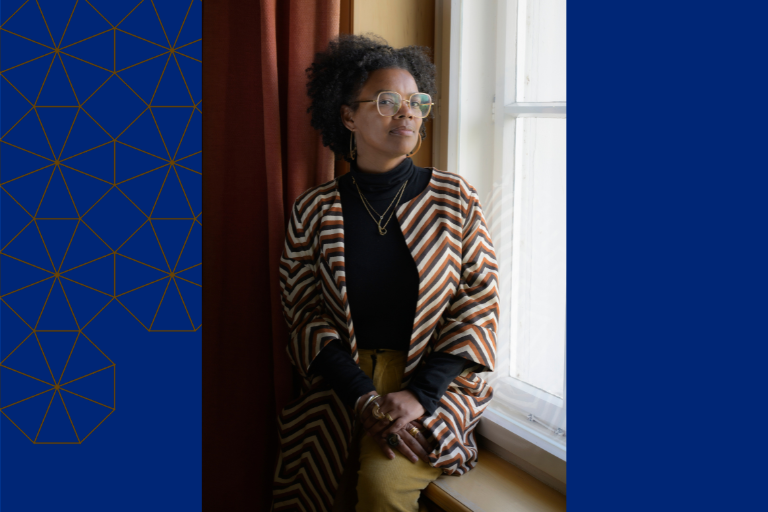
UC Berkeley African American Studies Professor Leigh Raiford has been named the 2026 Gordon Parks Genevieve Young Fellow. The prestigious, invitation-only fellowship provides $25,000 to “support the research, development and publication of a new project” related to the work of the famed African American photographer Gordon Parks.
Before arriving at Berkeley in 2004, Professor Raiford earned a bachelor’s degree in African American Studies and Women’s Studies from Wesleyan University, along with her PhD from Yale University’s joint program in African American Studies and American Studies. They are also the author of “Imprisoned in a Luminous Glare: Photography and the African American Freedom Struggle,” which explores how photographs shaped and documented Black social movements across the 20th century, and a forthcoming book on photography and Black archives
With the support of the fellowship, Professor Raiford plans to focus on Parks’ abstract photography, examining how his images challenge and reimagine representations of Black life. Her project will include an essay and a curated exhibition planned for fall 2027, based on direct engagement with the Gordon Parks Foundation archives in Pleasantville, New York.
Raiford recently spoke to Berkeley Social Sciences about the fellowship, her research and ongoing work exploring Black visual culture. This interview has been edited for clarity and length.
Can you tell us a bit about your work at UC Berkeley and the areas of research that you focus on?
Leigh Raiford: I’m a professor in the Department of African American and African Diaspora Studies at UC Berkeley, where I’ve taught since 2004. My research centers on Black visual culture and the ways racialized Blackness is produced, challenged and reimagined through visual forms like photography, art and film. I teach classes on Black art, visual culture, photography, museum and curatorial practice, as well as Black intellectual thought.
You were recently awarded the Gordon Parks Genevieve Young Fellowship — what do you think set you apart for this honor, and what does it mean to you?
Leigh Raiford: The Gordon Parks Foundation houses the archives, papers, photographs and artwork of the late great photographer Gordon Parks, who was the first African American staff photographer at Life magazine. He photographed the whole world, especially the racial conditions, joys and struggles of Black American life.
About a year ago, the foundation invited me to write an essay for a reissue of “A Harlem Family.” What began as a 6,000 word essay ultimately became 9,000 words after I immersed myself in Parks’ work and research over several months. The Genevieve Young fellowship is awarded by invitation, and I believe it was through that essay that I was invited to be the 2026 fellow.
How did it feel when you found out you were selected for this fellowship?
Leigh Raiford: Even before I was selected, I was so excited to be invited to write the essay on “A Harlem Family.” Gordon Parks is such an important figure in the history of American photography and Black life and culture. I’d always been afraid to write about him because I knew you can’t enter that work lightly. So, to be asked to write that essay, I already felt like I had won something. It just felt like a real acknowledgement, a vote of confidence in my ability to do a serious work of scholarship that would also appeal to broad audiences on one of Parks’s most well-known photo essays. Then, when they invited me to be the Genevieve Young Fellow, I was really honored. The past fellows are people whose work I admire so much.
What research or projects are you most excited to pursue in the Gordon Parks Archives?
Leigh Raiford: The fellowship is designed to support the research, publication and curation of a new project related to Gordon Parks. While Parks is best known as a social documentary photographer, whose work shaped our understanding of race and class, he also produced abstract photographic images. My essay and exhibition will focus on Parks’ abstract photography. This fellowship gives me the opportunity to travel to the Gordon Parks Foundation archives in Pleasantville, New York, and to spend time with his work in person, and organize an exhibition planned for fall 2027.
What do you hope students and the Berkeley community take away from your work?
Leigh Raiford: I like being in Black Studies because it gives students tools for living in a world shaped by racism and inequality. Our ideas and experiences are deeply influenced by visual media — especially photography. Photographs teach us how to see and how to pay attention to the things that surround us. I want students not only to consume those images, but to critically engage with them, and hopefully, to become creators themselves.