
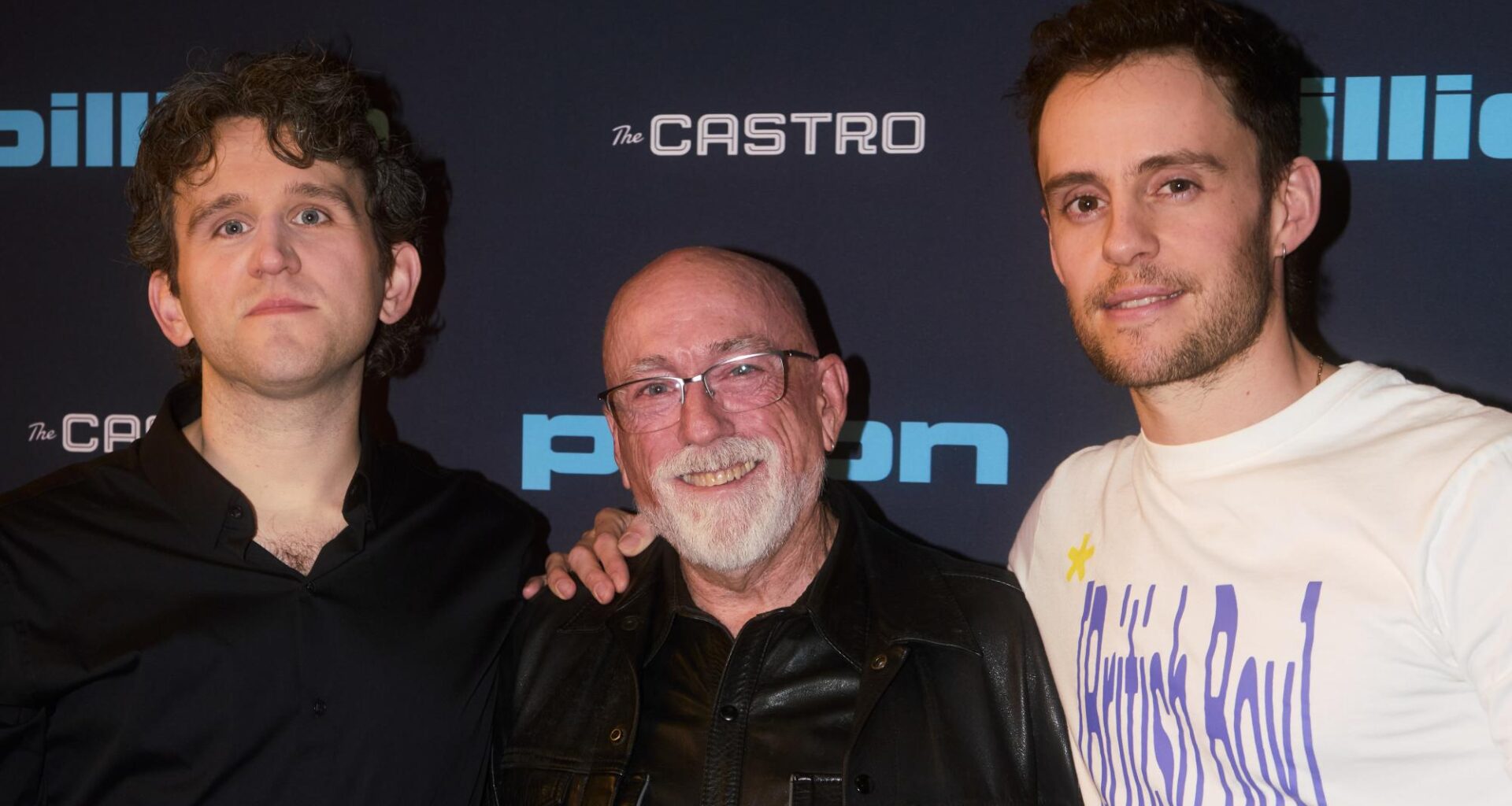
In one of the Castro Theatre’s first events since its Feb. 6 reopening, the newly-rennovated theater hosted director Harry Lighton and co-star Harry Melling for a sold-out screening of the A24’s “Pillion” on Thursday night ahead of its slated nationwide release the following day.
Hundreds of San Francisco moviegoers — many decked out head-to-toe in leather and chains, symbolic of the city’s BDSM scene — lined up around the block for a first look at the acclaimed romantic comedy. The film follows the sadomasochist relationship between Ray, a dominant motorcyclist (Alexander Skarsgard), and Colin, a shy, submissive gay man living in London (Harry Melling).
Lighton debuted “Pillion,” his first feature-length screenplay, at the 2025 Cannes International Film Festival last May, where he took home Best Screenplay as an official Un Certain Regard selection.
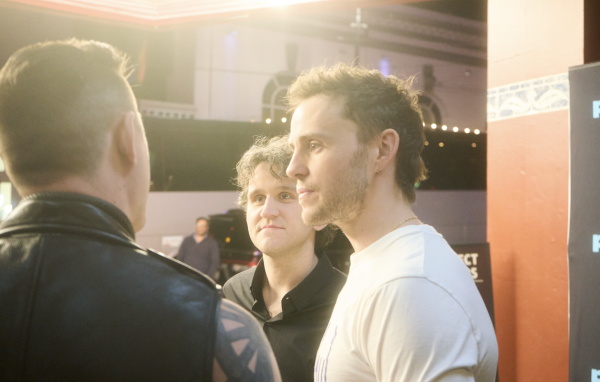 Harry Melling and Harry Lighton being interviewed at the screening of A24’s “Pillion” at the Castro Theatre on Thursday, Feb. 12, 2026. (Lindsey Hoang / Golden Gate Xpress)
The Castro Theatre screening concludes a successful four-screen run in New York and Los Angeles that grossed nearly $250,000.
“I’ve had dreams about the Castro and having a film here,” Lighton said. “It’s a proper ‘pinch me’ moment.”
The screening of “Pillion” marks the historic theater’s first film screening since a “Victor, Victoria” sing-along in Feb. 2024. Doors were shuttered for a planned two-year restoration project spearheaded by Bay Area-based live entertainment company Another Planet Entertainment upon partnering with the venue’s owners, Bay Properties Inc., in early 2022.
Following opening remarks from Melling, Lighton and Castro Theatre house manager Raul Rangel, Skarsgård appeared via video to introduce the film. Rangel praised the film as a representation of the progression in positive on-screen LGBTQ+ representation.
“To see this theater evolve, and watch the movies evolve with it has been incredible,” Rangel said. “Tonight’s film shows how far we’ve come, and there is no better place to show it than here.”
“Pillion” received widespread acclaim for its lighthearted, earnest portrayal of the dom-sub dynamics involved in the BDSM and leather scenes, facets of LGBTQ+ culture with historical roots in San Francisco dating back to the early 1960s.
In early 2018, the City of San Francisco established the city’s South of Market neighborhood — home to the annual Folsom Street Fair celebration of kink culture — as an official “LGBT and Leather Cultural District” after community advocates lobbied City Hall to formally recognize its significance in the city’s vibrant queer history.
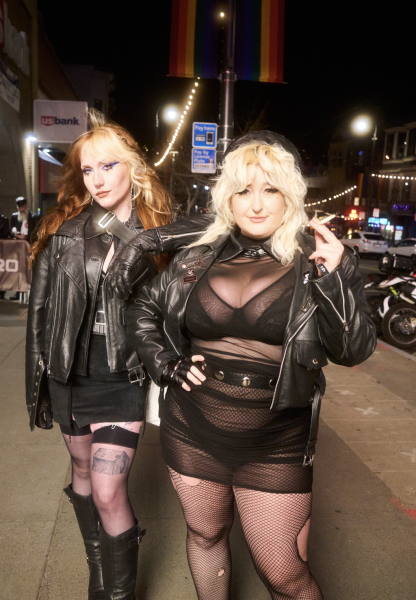 Charlie Carpenter and Suki Berry after the the screening of A24’s “Pillion” at the Castro Theatre on Thursday, Feb. 12, 2026. (Lindsey Hoang / Golden Gate Xpress)
As an active member of the local BDSM scene, San Francisco State University alum Charlie Carpenter found the power dynamics of her community properly represented on the screen for the first time, particularly in the mainstream.
“As someone who’s sought out an accurate D-S dynamic in film, it’s rare to come across [one] where you’re like ‘Oh, that’s relatable,’” Carpenter said. “Before I saw this movie, I was like, ‘I hope [the filmmakers] ask somebody something,’ and it definitely felt that way.”
Sloane Holzer first moved to San Francisco to be a part of the city’s leather scene. She thinks Lighton did a fantastic job using humour as a means of introducing an often misunderstood culture for a wider audience in a “disarming” way that invites viewers to empathize with characters they might not otherwise.
“It was genuinely a very heartfelt representation of a community that I think gets very often maligned,” Holzer said. “There’s something about [“Pillion”] being so intentionally sweet and easygoing in a lot of ways. It really brings you in in a very effortless way.”
As “Pillion” makes landfall across the pond following its $1.5 million-grossing run across the U.K. and Ireland through late 2025, Melling hopes the film will continue to resonate with members of the community, as well as evoke conversations of empathy and understanding among American audiences.
“Hopefully they can feel something true and a reflection of their experience,” Melling said. “But also for people that aren’t familiar, they now have a window into understanding what it is to be part of this subculture. Hopefully that can provide empathy in a time where we need to have more empathy and kindness.”