
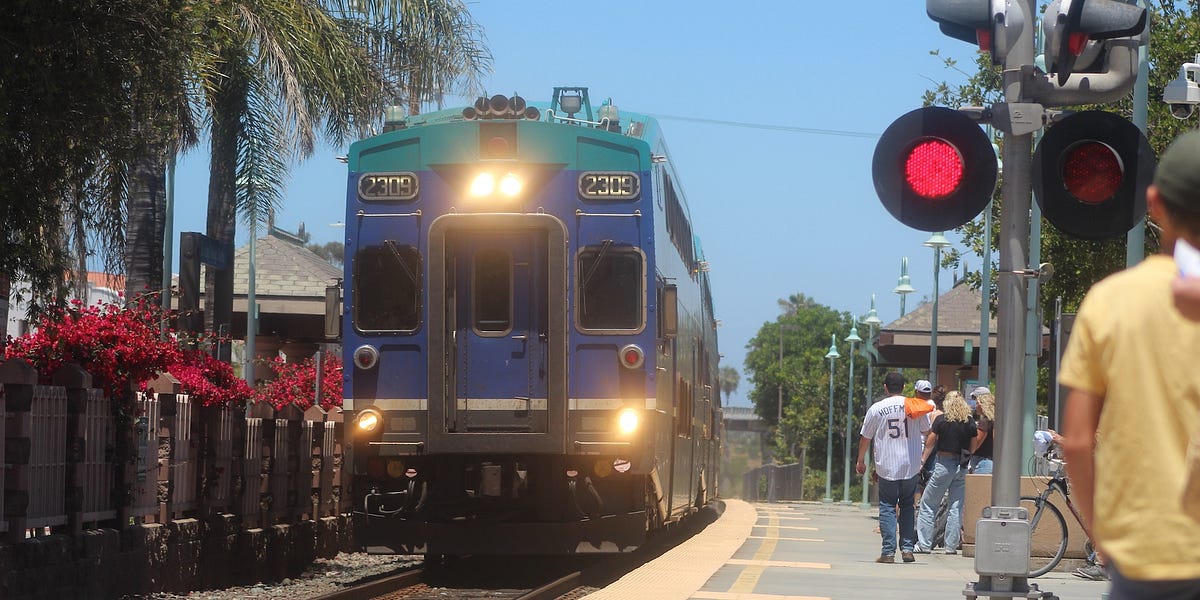
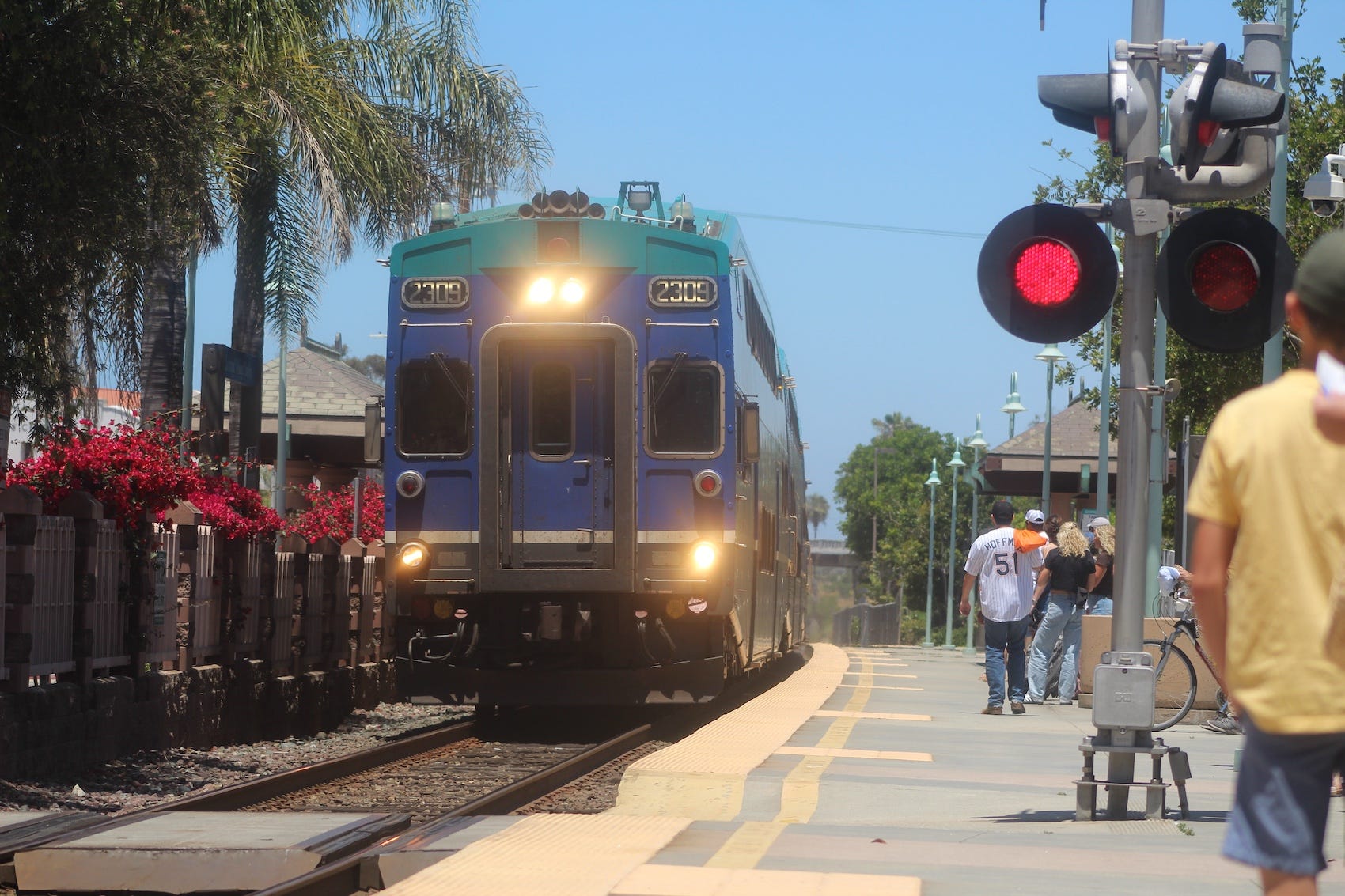
 A proposal from Sen. Cathernie Blakespear (D-Encinitas) could see the Coaster make trips to Anaheim. The issue is in its infancy, but North County Transit District officials are skeptical. Steve Puterski photo
OCEANSIDE — A proposal in Sacramento could send the Coaster to the doorstep of Disneyland, leaving North County Transit District officials stunned on Thursday.
The idea was briefly mentioned during the North County Transit District’s Performance, Administration and Finance Committee meeting. NCTD Board Vice President Mike Sannella of San Marcos said the proposal was met cautiously by some on the board, as there are few details and no draft bill to review.
Even so, early conversations raised alarm bells about cost, operations, and the possibility of the district being pulled into an unfunded mandate to run trains into Orange County. Sannella said there are significant concerns and would like to see an analysis, while there is potential upside if the mandate is funded and NCTD can acquire new customers in Orange County.
However, NCTD Chief of Staff Mary Dover said several years ago, the agency and Metrolink began discussions regarding operating within both territories. However, it was predicated on the necessity for additional funding and required infrastructure expansion.
NCTD has not been advised or received any new funding mechanisms that would support this change, and they are focused on maintaining their current services.
“NCTD is currently working to ensure that our local services are the priority for North County communities,” she explained. “With our Breeze bus service and Spriner hybrid rail carrying the majority of our ridership, we must focus on that first. While we certainly appreciate that there is a desire to see more services north, unfunded mandates (in any form) create an imbalance in the services we can provide. We have already experienced the impacts of such mandates, related to the cost of fuel and equipment, as we have transitioned to zero-emission vehicles.”
Blakespear is the current chair of the Senate Transportation Subcommittee on LOSSAN Corridor Resiliency. The Los Angeles-San Diego-San Luis Obispo corridor is the second-busiest in the country. She did not respond to questions by deadline.
NCTD’s Annual Comprehensive Financial Reports (ACFRs) and Fiscal Year 2025-26 operating budget show the agency’s current revenue is just enough to sustain existing operations, let alone entertain a complex multijurisdictional service expansion, which likely comes with a hefty price tag.
“Creating unfunded legislation without the necessary studies done for NCTD to operate outside of its service area has the potential financially to impact our core services for our communities,” Sannella said. “Our partners at Amtrak and Metrolink do an amazing job of connecting people throughout the LOSSAN corridor and to our services here in North County.”
Across the district’s five modes of transportation, NCTD has seen slow but steady growth in ridership since the pandemic. In Fiscal Year 2023-24, there were 7.7 million passengers, 8.5 million in FY 24-25, and a projected 9 million for FY25-26, according to NCTD’s budget.
However, farebox recovery was just 7.1% in FY 23-24, while last year’s data has yet to be released. Regardless, the most significant cost drivers for the upcoming year are employees’ wages and benefits, contracted professionals and fuel costs, the budget reads. Next year, the agency will absorb bus operations as it terminates a contract with an independent operator, Sannella said. NCTD’s employee count will grow from 420.75 to 878.
Meanwhile, the agency manages some of the most challenging rail geography in the state, including the Del Mar Bluffs. The San Diego Association of Governments, along with NCTD, has engaged in multiple bluff stabilization projects with the long-term goal of a multi-billion-dollar track realignment.
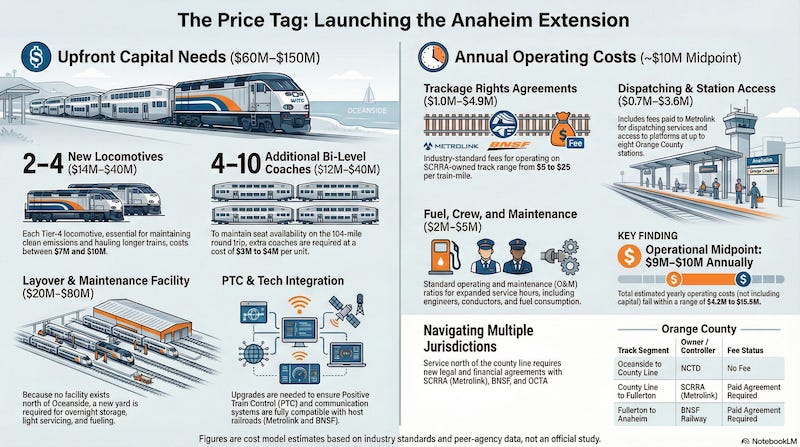 The graphic above shows the potential costs for NCTD to launch service to Anaheim, based on industry standard and peer-agency estimates. Steve Puterski graphic/AI
In 2024, NCTD outlined a five-year capital need of $585 million, which includes stabilization and a new Del Mar Fairgrounds station. About one-third of it is funded, although SANDAG plays a significant role in securing funds.
Much of NCTD’s operating budget is allocated to maintain a state of good repair, such as keeping rail equipment, tracks, signals, buses, and facilities functional and compliant, along with meeting agency-mandated reserve funds.
“Based on my knowledge of the budget situation, I don’t see where we’re going to be buying new trains,” Sannella added. “We’re going to be repurposing the trains we have now and taking them off routes they’re operating in San Diego to meet this requirement, if it actually comes to fruition. That’s the only possible way we could even try to do it.”
Next year’s budget, though, does include $48.4 million from Senate Bill 125, authored by Blakespear, to help with operations and capital projects. NCTD allocated $37.1 million for its capital projects.
Dover said even if a bill were passed, NCTD would likely not have to buy new trains and coaches, but would face an increase in operational costs. She said it would be a necessity to have state funding for any northern expansion, as the agency cannot cover those costs.
Sannella, though, also had questions about how the finances would work. He said the budget is set and limited, so any expanded service may come at the expense of those in San Diego County.
Also, he said Anaheim is already covered by both Metrolink, the Southern California commuter rail system, and Amtrak’s Pacific Surfliner, the intercity route linking San Diego and Los Angeles. Sannella said it may be redundant for NCTD to join the party. Sannella said the news about the proposal left many in a confused and guessing state, as little has been revealed about how the mechanics and financial components would work, let alone forcing the agency to pivot to a new direction when it’s already trying to bolster the Sprinter.
“Amtrak does a wonderful job of providing service from San Diego to Anaheim, currently 26 per day,” NCTD Board President Priya Bhat-Patel of Carlsbad said. “In the event NCTD were to be allocated additional resources, such funding would be better utilized by expanding service on the SPRINTER or BREEZE as these services are relied upon by North County communities.”
It remains unclear how a Coaster extension to Anaheim would operate, including train frequency, equipment needs, or how service would fit into other agencies’ schedules. The 52-mile corridor between Oceanside and Anaheim runs across multiple jurisdictions: Metrolink and the Southern California Regional Rail Authority own the segment from the county line to Fullerton, while BNSF Railways, a private freight operator, owns the line through Anaheim.
NCTD owns the corridor south to San Diego and east (Sprinter line) to Escondido.
NCTD operates the Coaster, Sprinter, Breeze, Flex (on-demand fixed route), Lift (paratransit) and NCTD+ (on-demand microtransit). The Coaster runs from the Oceanside Transit Center to Santa Fe Depot in San Diego; the Sprinter operates from OTC to the Escondido Transit Center, while the buses and microtransit service North County.
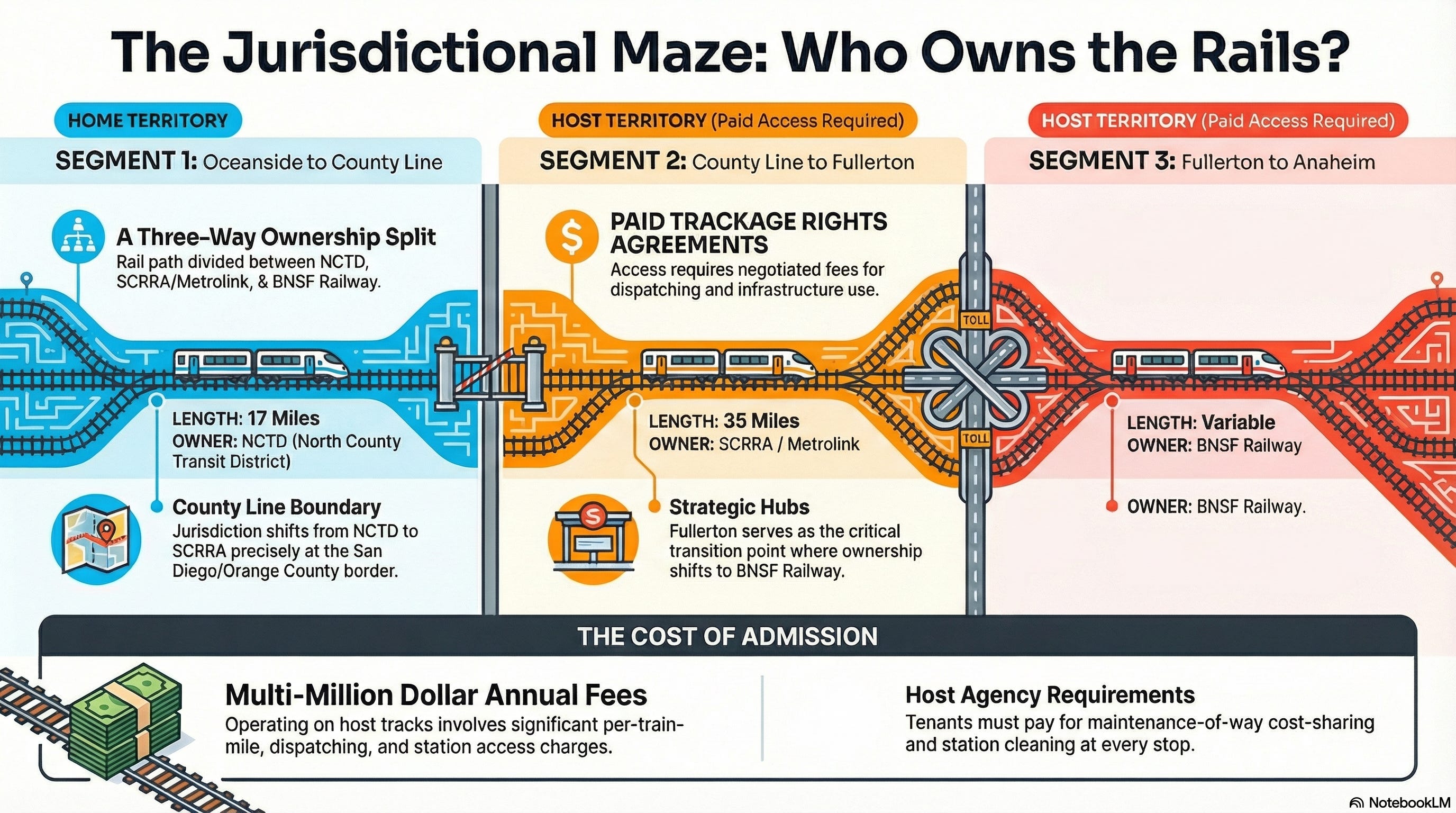 Above is a graphic detailing the ownership over the rail line from Oceanside to Anaheim. Steve Puterski graphic/AI
While NCTD, SANDAG, and state partners are advancing double-tracking projects in San Diego County, Sannella said much of Orange County remains single-track, creating logistical challenges for all operators.
Any extension could trigger additional costs, including trackage-rights fees, dispatching charges, station access, and fees for yard or layover space. Based on peer agencies and industry standards, those costs could range from:
$1 million to $4.9 million per year for trackage rights
Up to $2 million for dispatching
$200,000 and $1.6 million for station access
$500,000 to $2 million for layover facilities
Should a new layover yard be needed and owned by NCTD, those construction estimates could run more than $10 million.
Dover said any fees to other agencies for use would be dependent on the impact on Metrolink, Amtrak and BNSF.
“Because of our current agreements with our partners, something as small as adding an additional train could impact the schedules of all trains along the LOSSAN corridor,” she added. “We recently added an additional Amtrak train, which brought us to near full capacity on the San Diego Subdivision (NCTD), and given the constraints along the Orange County portion of the corridor, would almost certainly require services to be impacted. All of these are subject to contractual obligations that we have with our partners, as well as our responsibility as the Railroad of Record with the FRA and Surface Transportation Board.”
Regardless, Sannella said the current service to Anaheim already exists with Metrolink and the Surfliner. Also, he and others are curious as to what frequency the Coaster would be required to service Anaheim.
“A good example is how many times does she want the Coaster to run up to Anaheim a day?” Sannella asked. “Are we talking one time a day, six times a day? I know no one is going to let us go on their tracks for free. They are going to have to change their schedules for their trains.”
Rolling stock presents another expense. A new Coaster locomotive costs about $6 million, while each coach car costs $3 million to $4 million. Depending on service frequency, start-up costs could reach $60 million to $150 million, with no guarantees of a realistic return on investment. Ongoing service would likely require state subsidies.
Send story ideas and tips to ncpipeline760@gmail.com. Follow North County Pipeline on Instagram, Facebook, X and Reddit.