
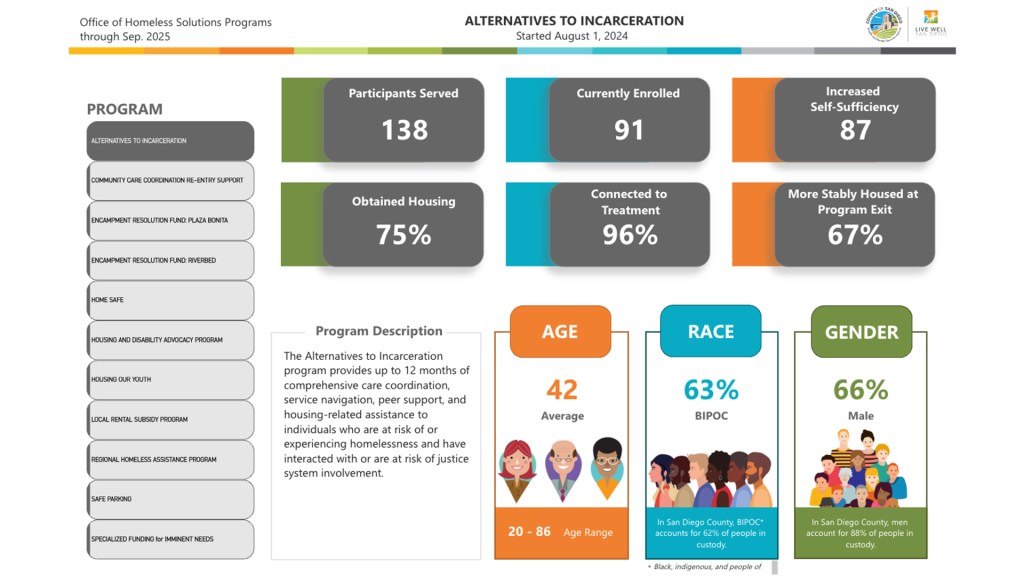
It’s now easier to see how many homeless people live in unincorporated communities like Lakeside, Alpine and Fallbrook because of new statistics published on San Diego County’s website.
The interactive dashboard breaks down how many individuals are being served by initiatives like safe parking lots and the Regional Homeless Assistance Program, which helps residents rent local motel rooms.
In total, nearly 590 people accepted some form of aid in December.
“By sharing this data openly, we’re not only demonstrating progress but also inviting collaboration to strengthen solutions for our most vulnerable residents,” Dijana Beck, director of the County Office of Homeless Solutions, said in a statement.
The dashboard joins several other methods for tallying the region’s homeless population. The Downtown San Diego Partnership tracks people sleeping outside in the city’s urban core (a number that’s been ticking up), the San Diego River Park Foundation counts those living by waterways (that number’s going down) and schools report how many children lack a stable address (there were 19,841 countywide during the last academic year).
But the region has generally lacked regular updates on just unincorporated areas. In September, the Board of Supervisors unanimously approved a proposal from Supervisor Jim Desmond to release more data.
The dashboard is located on one of the Office of Homeless Solutions’ webpages, and tabs on the left offer a range of statistics for different county initiatives. Clicking on “The Local Rental Subsidy Program,” for example, shows that dozens of vouchers which temporarily help people pay rent have not yet been used. A tab about an Encampment Resolution Fund notes that 151 people who’ve been living by waterways have so far received guidance finding housing.
The county is also publishing monthly reports — the document is titled “Monthly Unincorporated Regional Homeless Services Dashboard” — summarizing homelessness numbers for all unincorporated areas.
The most recent is from December, when outreach workers aided 213 individuals living outside or in vehicles, according to the statistics. That number doesn’t include anyone who refused offers of help.
Regardless, a population of 213 unsheltered homeless people is comparable to, if somewhat higher than, the totals found in unincorporated areas during recent point-in-time counts, a separate method for quantifying the crisis that takes place once a year. (The results for this year’s count are still being calculated.)
The county’s report additionally noted that 96 people became newly homeless in unincorporated neighborhoods during December.
At the same time, 115 individuals stopped being homeless in the area, although it was not immediately clear from the statistics how many may have simply moved their tents to a neighboring city.
In an email, county spokesperson Tim McClain clarified that 81 had found some form of housing or shelter. The other 34 were either still homeless or had lost contact with their case managers.
The online dashboard is available at sandiegocounty.gov/content/sdc/sdhcd/OHS/ProgramDashboard.html.