
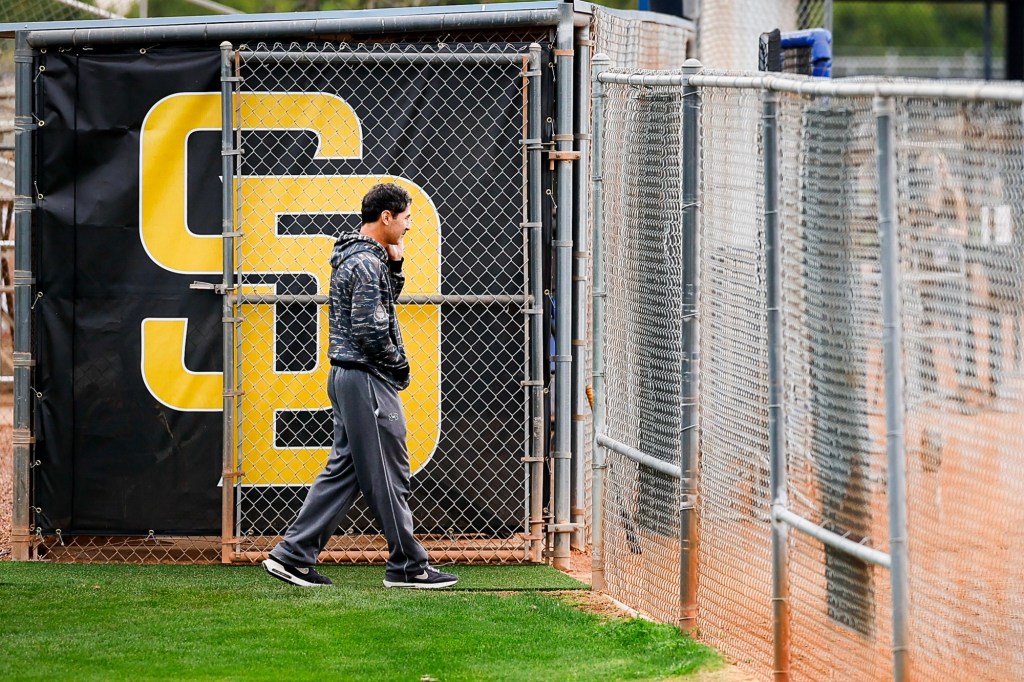
If a billionaire is indeed on the verge of buying the Padres, he or she had an A.J. Preller decision to make.
The options were:
Replace Preller with someone else to run baseball operations;
Retain him for now, but take a wait-and-see approach;
Or sign Preller beyond this year.
Now that an extension has been announced, for multiple years, does that mean Preller will stay with the team through 2028?
We’ll see.
Working with Preller, 48, would give the new top boss a better sense of him and how the two get along.
If expectations aren’t met, getting out of a president of baseball operations’ contract shouldn’t be overly difficult. In many cases, the remaining salary money can be voided if an executive takes the same job with another team.
This isn’t to say things will change. It’s a reminder that the Padres are for sale. If or when the sale happens, everyone within the club will have a new top boss.
Quickly, let’s revisit the decision menu from above.
To replace Preller now would’ve meant taking a brutal risk. Besides Preller’s considerable selling points, spring training is no time to replace a team’s top baseball executive.
Retaining Preller without extending his contract?
The pluses: Padres continuity in decision-making would be maintained, while the new top boss could get a firsthand read on Preller before pledging him millions of dollars per year in salary.
But, again, those millions really aren’t an obstacle.
The extension made a lot of sense.
It forecloses a cloud of uncertainty that would’ve hovered until Preller’s status was resolved.
For a franchise in win-now mode, it puts the focus where it should be: on the field. The main thing — winning this year’s World Series — remains the top item.
Surely, our mystery billionaire sees that it’s an urgent time in Padres Land.
Manny Machado and Xander Bogaerts, each 33, are past the typical peak years and have heavy contracts that may make them untradeable. With Machado and Bogaerts coming off fair seasons and several other key players in their early 30s, it’s only right to go for it this year. This means increasing the payroll if Preller has firm reason to do so between now and the Aug. 3 trade deadline.
For all of Preller’s many successes — much-chronicled in this space — his resume does have holes in it that a new owner should be motivated to help fill.
Whereas the 1984 Padres team built by general manager Jack McKeon (and others) and the 1998 Padres club built by Kevin Towers (and others) reached the World Series, none of Preller’s 11 Padres teams has won a pennant.
Good for Padres leaders if they want to continue trumpeting the top on-field accomplishments under Preller: namely, four postseason berths in the past six years.
But context matters.
The first of those playoff teams was fortunate that the season was shortened to 60 games, as its starting pitching was ankle-deep shallow. What’s more, MLB expanded that 2020 postseason field to 16 teams, while several clubs punted due to the complications of the pandemic.
Major League Baseball added a wild card to each league in 2012 and in 2022. The expanded fields further encouraged Seidler to jack up spending on players.
No other Padres era’s leader saw the team rank so highly in MLB’s payroll rankings as recent Padres teams did. And while Preller inherited a major problem in the Dodgers, who were on the verge of becoming a monster under new ownership, the Padres’ farm system he assumed fell among the top-12 in many rankings. It included future stars Trea Turner and Max Fried.
Let’s talk World Series trophy.
Compared to other Padres eras, the Preller era hasn’t come close to winning it.
The ‘84 Padres fell three victories short. Fourteen years later, Kevin Brown and Co. wound up four wins shy.
Seven wins is the closest a Preller team has come, after Bob Melvin’s first club reached the 2022 NLCS and lost in five games to the Phillies.
Of course, the enlarged postseason — now a World Series tournament — makes it harder for any playoff team to get the trophy. See how context can matter?
The trophy is more distant than it may appear. Wild-card winners must win two more playoff games than the top two seeds. So, don’t stop improving the roster if Preller makes a smart case for it.