
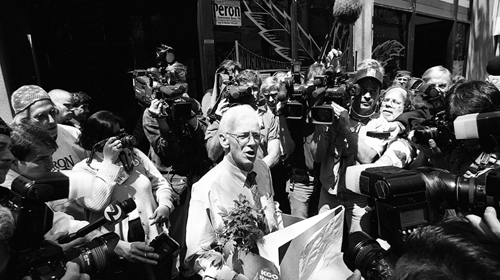
The Dan Lungrens and Gregory Corraleses of the world would brand Kip Andersen and Chris O’Connell’s documentary “Join The Club” a cinematic hagiography of an unrepentant miscreant. For those of us aware of the lives saved and good times delivered thanks to the film’s subject, we’d call Andersen and O’Connell’s entertaining film both a joyous time capsule and a wonderful memorialization of a local S.F. hero.
The person in question is Dennis Peron, the gay man who opened America’s first (street legal) medical marijuana dispensary in San Francisco. As this film shows, the ravages of the AIDS epidemic played a key role in making Peron’s enterprise a local life-saving endeavor. It’s a colorful story that takes viewers from the jungles of Vietnam to the California ballot box. Along the way, there are appearances by such local luminaries as Supervisor Harvey Milk, famed defense attorney Tony Serra, and grandmotherly pot activist Brownie Mary. Wonderfully cheeky (and sometimes serious) animation provides a reality check on the recounted events.
For those who lived through the events recounted, this film will remind them of graceful good times in the midst of a larger world of horror. Those who would try to dismiss Andersen and O’Connell’s film as “preaching to the converted” are merely trying to rationalize their own internalized callousness towards the gay community. What the film shows is that Peron’s enterprise was an embodiment of neighbors helping each other in a crisis, even if those words are never directly used by anyone in the film.
Nobody denies that Peron’s enterprise generated a lot of money. Yet there’s no evidence presented that the medical marijuana dispensary founder lived a lavish lifestyle or even maintained secret Swiss bank accounts or Cayman Island holdings. If anything, Peron’s more credible in his altruism than a charitable foundation administrator paid hundreds of thousands of dollars a year.
That point would undoubtedly be lost on Corrales, Lungren, and Joe Bannon. They were the three law enforcement personnel primarily involved over the years in trying to shut down Peron’s operation. Andersen and O’Connell’s film gives these three men, particularly Bannon, room to talk about why they were so focused on this goal. Unlike right-wing filmmakers, “Join The Club”’s directors treat the film’s villains with respect, as getting these law and order guys’ candor is more important than engaging in petty cinematic one-upmanship a la James O’Keefe and his Project Veritas louts.
But respecting the viewpoints of Bannon et al. doesn’t mean approving of what law enforcement did over the years to try taking down Peron. Shooting Peron in the leg during one bust was an act of homophobia hiding behind a police badge. More brutal treatment, though, was visited on Peron’s then-lover Jonathan West during his arrest. West may have been slowly dying of AIDS at the time, but that didn’t matter to the thugs in blue. Viewers who self-delude themselves into thinking ICE officers just need a “little extra training” to become good cops will be disabused by this film of the notion of the inherent benevolence of law enforcement personnel.
Candor demands this writer acknowledge that he’s personally acquainted with one of the film’s interview subjects, local LGBT historian Joey Cain. However, that relationship does not unduly heighten this writer’s feelings regarding “Join The Club”’s merits.
It was mentioned during the post-film screening that this feature is an abridged version of what was originally intended to be a documentary mini-series. However, the more obvious avenues for wider distribution such as PBS or even the Sundance Channel are not available in these semi-authoritarian times in America. Where the full version of “Join The Club” will show up remains a question mark. What is certain is that if the broadcast venue is big enough, right-wing critics will launch bad-faith verbal salvos against a film whose only aesthetic crime is not parroting the critics’ extremely crabbed view of how the world should be.
***
William Shakespeare’s tragedy “Romeo and Juliet” has been frequently adapted in various media over the centuries since its original theatrical performance. The simplicity of its story accounts for this popularity. Boy meets girl and they fall in love. However, their passion can’t survive the deadly feud between their two families. It’s been adapted as everything from a Baz Luhrmann spectacle starring Leonardo di Caprio and Claire Danes to a (thankfully forgotten) Rankin-Bass animation where the title characters were robots.
Oddly evoking the joys of hearing Shakespeare’s lyrical dialogue is director Ryen McPherson’s modernization of the tragedy “C.R.E.A.M.” For the uninitiated, the title is an acronym for “Cash Rules Everything Around Me,” a song written and performed by legendary hip hop group Wu-Tang Clan. But the title’s much more than an oblique reference to the slant of this “Romeo And Juliet” adaptation. What McPherson has done is draw from the lyrics of 700 Wu-Tang Clan songs to create the characters’ dialogue.
Merc and his African Killer Bees (the guys with the honeybee symbol on their polo shirts) run a profitable shaved ice dessert truck in an unnamed inner city. The key to their success is a particularly delicious and sweet honey drizzled on the shaved ice as a final touch. Merc’s prosperity arouses the jealous ire of Tyb and his crew, who plot against Merc. For African Killer Bee crewmember Rome, those tensions are far from his mind, as he’s utterly fallen for the beautiful Kiana. Unfortunately, the beautiful girl’s part of Tyb’s gang, and that gang leader plots to help himself to Merc’s assets after taking out his rival. Whether Rome likes it or not, he will be forced to take violent action against Tyb.
The plot details aren’t the most important criterion for assessing McPherson’s adaptation. The important question is: does the director’s use of Wu-Tang Clan lyrics bring something new to the Bard of Avon’s timeless tale? For viewers such as this writer who are unfamiliar with the group’s music, there might not be any frisson from recognizing how a particular song’s lyric has been creatively repurposed. But what can be admired is the rhythm created en masse by hearing those lyrics spoken. More than a few Shakespeare adaptations which don’t use the Bard’s dialogue directly eschew the poetic aspect of his original words altogether. McPherson’s adaptation is the first this writer knows of which brings the poetry back to Shakespeare via modern metaphors. As one character notes, “When life takes a p**s in your mattress, you flip the mattress.”
For non-Wu-Tang Clan fans, admiration of what McPherson has done in “C.R.E.A.M.” is likely to be akin to a non-Spanish speaker watching Bad Bunny’s stunning Super Bowl LX halftime show. They may not always understand the exact meaning of the words spoken, but the context suffices to effectively channel the words’ energy.
***
How well could a brain-damaged person navigate the challenges of social interaction? That’s the problem dramatized in Yana Alliata’s “Reeling,” a film boasting the great director Werner Herzog as Executive Producer.
Ryan has returned to his family’s Hawaiian homestead to join in the clan’s birthday luau celebrations for his sister Meg. The event’s also a way to mark Meg’s making it through a particularly trying year.
Part of that stress comes from her helping take care of Ryan. Some time ago, Ryan was involved in an accident which left him with a head injury that completely wiped his memories of friends and family…and even the details of the accident itself. Yet the injured man yearns for a return to some degree of independence. .
“Reeling” is told from Ryan’s perspective. When the viewer’s introduced to him, he’s driving an SUV without any major difficulties. His forgetting the turnoff to his family’s place and the unusual part in his hair don’t seem insignificant flaws.
It’s only when he reminds himself to bring in his cake for Meg as well as how some of the other guests greet Ryan that the viewer realizes something is wrong with him. The other guests whisper among themselves out of curiosity whether Ryan even literally remembers them. Meg’s greeting and helping him settle in is both friendly and slightly over-solicitous.
Only as the day wears on does it become clear the welcome mat for Ryan might not be terribly huge. He’s shooed away from helping some of the other men dig a luau pit. Nor is he asked to aid in any of the other party preparations. His only significant social interactions involve playing scoop ball with a little girl and talking with a small lizard that crawls on to him. Generally, the other adult guests treat him like an awkward child in a man’s body.
To be fair to the other attendees at the party, Ryan’s behavior isn’t completely blameless. His difficulty in finding a drinking glass causes him to loudly curse in frustration. His very audible snickers at a spectacularly inappropriate moment definitely don’t make him any new friends..
Yet for all his Tim Robinson-like behavior, the film’s protagonist is ultimately a tragic figure. “Reeling” is not one of those stories where Ryan’s recalling the details of his life-changing accident will magically make his life better. A “Hamlet” quote triggers a revelation that painfully illustrates just how much Ryan has lost as a person. A Tarot reading for Ryan makes clear both his awareness of his situation and the frustration he’s forced to live with.
Alliata’s film thankfully doesn’t back away from its darker implications by providing fake sentimental uplift. Instead, it ultimately reminds viewers that learning to live long-term with a disability is an unending work in progress.
***
Gary Mairs’ “Adulthood” is the cinematic version of a short story anthology. Made over a period of 16 years, it’s a sextet of mini-dramas bound by two things: the same director (Mairs) and the different life paths taken by Amy (Amy Seimetz) and Terry (David Nordstrom). Otherwise, each chapter is written by a different person in styles ranging from purely observational to theatrical two-handers. The low-budget cinematic technology used to film each segment is different, the contrasting visual textures an indirect commentary on the changes these two characters undergo as they age from their 20s to their early 40s.
Chapter 1, “All That She Surveys,” begins with Amy in college. Her studies do not distract her from being a silent observer of the world around her. Thanks to a nice use of sound mixing, the viewer knows when she’s really paying attention to someone (e.g. a man sobbing by himself at a BART-like station) and when she’s immersed in her own world. The latter is indicated by conversations around her reduced to general indistinct background noise. Interestingly, the moment when she steps out of observational mode occurs during her communion with an all-red painting at an art museum. A head tilt serves as a gesture of connection (and is also the film poster’s central image). Avant-garde observational documentary master James Benning wrote this segment.
Verbal fireworks from Theron Patterson’s script give Chapter 2’s “Say It” an obviously different character from the prior chapter. The film’s chronology, if this writer understands it correctly, places this story a couple of years before “All That She Surveys.” Amy at this point in her life is in a relationship with Terry, who works in some unspecified office job. They may have moments of physical affection, but they’re like lulls in a violent war. Amy is depressed and directionless, a couch potato a little too emotionally dependent on Terry. He in turn alternates between wanting to help her and wanting to be free of her, yet is unable to commit to either approach. The resulting arguments are over such things as whether Terry had eaten something or the seriousness of Amy contemplating infidelity with Terry’s friend Mark. Watching the duo repeatedly go at each other verbally makes the viewer rightly suspect that their relationship is not long for this world, an event likely foreshadowed by Terry’s going too far in lashing back at Amy.
There’s something incredibly sad and pathetic about Terry’s situation in Chapter 3’s “The Hemingway Night.” The short film starts up a couple of months after the events of “Say It.” Terry’s broken up with Amy by this time. In trying to bounce back emotionally, he decides to look up an old friend named Leon and go out for dinner together. But those plans don’t come to fruition as the evening turns into a night of heavy drinking where uncomfortable secrets get dredged up. As Tom Block’s script reveals, Terry and Leon’s friendship revolved around the fact that Terry was a regular at Leon’s parties, where plenty of pot was smoked and supposedly deep intellectual discussions took place. Amy doesn’t make an onscreen appearance in this chapter, but the meaning of her statement about Terry, “There’s something very sad about you,” gets shown by his having a desire for companionship married to an absence of empathy. The event referred to in this chapter’s title turns out to be an example of these personal qualities of Terry at work.
There’s a time jump of a few years forward in Chapter 4, “Retreat.” Amy’s spending a long weekend as a writer’s guest at a Santa Cruz artists’ retreat. Yet as Lee Ann Schmitt’s observational script shows, the protagonist is both physically and emotionally alone at this point in her life. Her host welcomes her visit, but his primary concern is working on his writing. An extended phone call reveals Amy has married and had a child, but she’s now divorced. In a way, her life has become bigger and more exciting as her travels have taken her to Copenhagen and Los Angeles. Things could be a lot smoother with her ex-husband, whom the viewer realizes has custody of their child. But there’s never a sense that Amy’s overwhelmed by her current life difficulties.
It’s a far different story for Terry in the painful Patterson-scripted Chapter 5 segment, “Mom.” Terry’s belated “Thanksgiving dinner” visit to his mother Mrs. Larson becomes an exercise in spiraling family tension. His denials of needing money from his mother and mention of a dirt bike incident leads to the slow revelation of some painful truths. Chronologically, Terry may be close to 40; emotionally, he’s still as irresponsible as he was in his 20s. Deception and untrustworthiness turn out to be his defining character traits. There’s even a sad callback to his relationship with Amy.
Mairs himself scripts the final chapter, “Kids.” Some time has passed between the previous chapter and this one. A chance encounter between Amy and Terry leads to a catchup chat between the two ex-lovers. It’s clear that Amy has reached a satisfying middle age with her running a Los Angeles art gallery, a remarriage, and a supportive relationship with her probably genderfluid child. It’s not clear if this is the same child referred to in Chapter 4 as Charlie. Terry, on the other hand, tells Amy he leads a satisfying life that’s a 180-degree turn from his situation at the end of the previous chapter. The reasonable viewer will suspect he’s baldly lying again to save face. Any rancor left over from Amy and Terry’s previous relationship is now water under the bridge, even if the viewer understandably maintains some skepticism regarding Terry’s sincerity.
One interesting note the viewer learns in the end credits is that the chapters were not shot in chronological order. “Say It” is actually the earliest chapter shot, while “Retreat” was shot after “Mom.” It could be argued that Mairs had a better idea of the arc Terry’s life would take than he did the path followed by Amy. Yet even if Amy is to some degree an enigmatic character, she ultimately winds up being a more sympathetic one.
“Adulthood” winds up being one of this year’s S.F. IndieFest’s stronger entries.
