
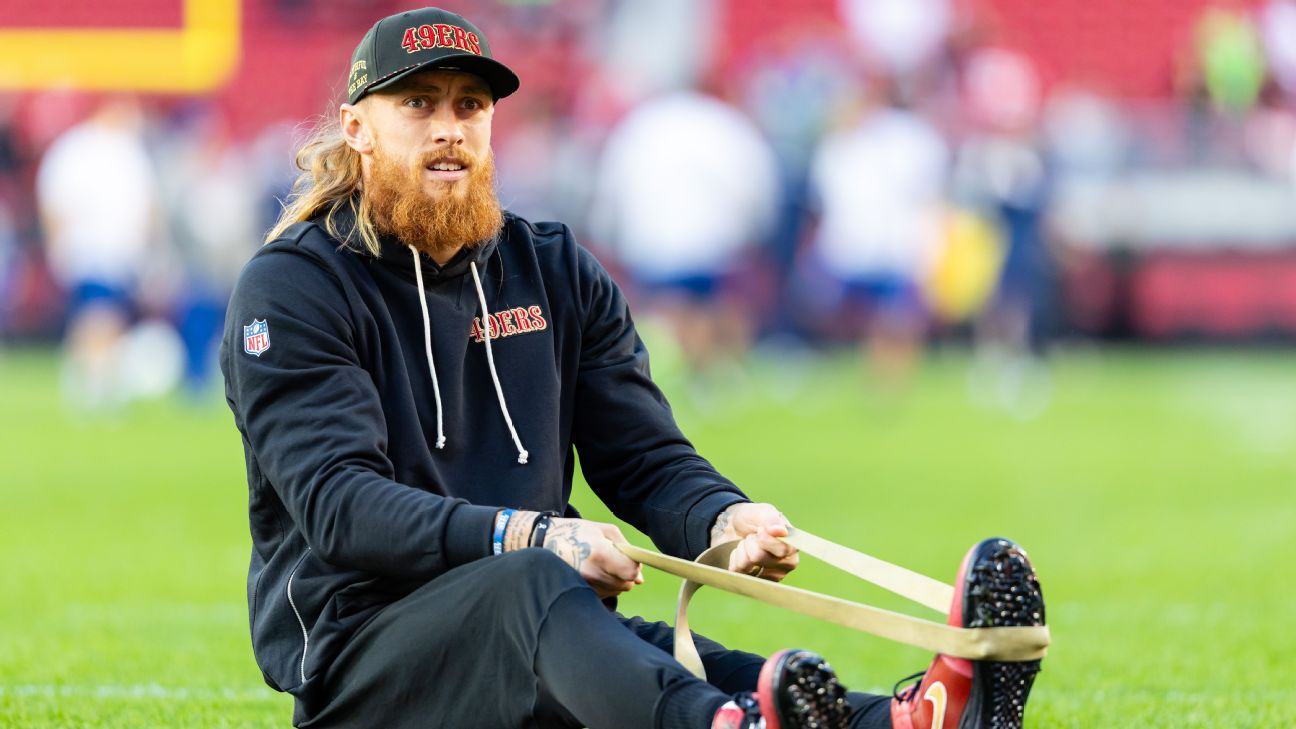
SANTA CLARA, Calif. — As San Francisco 49ers tight end George Kittle went the to ground midway through the second quarter of the wild-card game against the Philadelphia Eagles, he already knew what was happening.
“It felt like someone put a shotgun up against my calf and pulled the trigger,” Kittle said. “The second it happened; I knew exactly what it was.”
Kittle’s self diagnosis? A torn right Achilles. Soon after, the Niners medical staff confirmed Kittle’s suspicions. He headed to Philadelphia’s visiting locker room where Niners owner Jed York went to his aid with a bottle of tequila in hand.
After dulling the pain and cheering his teammates to a win that day, Kittle immediately turned his attention toward a comeback. An injury that, depending on where and how it happens has kept others out for closer to a year, left some wondering when — or if — Kittle would return in 2026.
It’s a notion that confounds Kittle. In fact, at San Francisco’s locker room cleanout on Jan. 19, Kittle scoffed at the suggestion he would return around midseason, suggested he’d return “well before November” and didn’t completely shut down the possibility he could be available as soon as Week 1.
While that idea is undoubtedly rooted in Kittle’s unrelenting optimism, it’s also based on the medical feedback he’s received. Most notably, when Dr. Neal ElAttrache performed the Achilles repair surgery on Kittle on Jan. 14, he noted that it was a clean tear that happened high up by his soleus (a muscle in the posterior of the calf).
“They didn’t have to drill into my heel,” Kittle said. “And where the repair was is where there’s more blood flow. And so, it takes some time off the recovery time. He’s very excited about everything, my recovery, when I’ll be running, when I’ll be ready to go play again … It’s not as bad as other ones, so just excited about that.”
According to Dr. Daniel Kaplan, an orthopedic surgeon at NYU Langone Hospital, Kittle’s optimism is also realistic. Kaplan said that one of the most difficult things about Achilles injuries is a lack of blood flow in what is known as an “avascular region” of the body. That’s especially true when the injuries happen lower in the Achilles.
The lack of blood flow leads to longer healing time as well as additional risk of reinjury.
“An Achilles tendon is sort of like a rope,” Kaplan said. “It connects your big calf muscle to the bone in the back of your foot. So that injury can occur anywhere along that rope … If the tear is a little closer to the bone, you can put sutures through one end of the rope and then put them into something called an anchor, which is like a little device that holds the rope in the bone …
“That’s a little bit stronger because those anchors give you a much stronger point of fixation. Even though it’s rarer, it’s actually more helpful if the tendon is torn off closer to the bone as split in the middle.”
As for a return, Kaplan said he waits about six months before he would allow an athlete to consider returning to high level sports with two to three more months before they could return to full speed participation in games.
That sort of timeline would allow Kittle to return to the field sometime around September, which would also coincide with the start of next season. That doesn’t mean he’d be back in Week 1 or even Week 2, but it’s reasonable to think Week 5 or so would be on the long end of a return, barring any setbacks.
What’s more, Kittle and the Niners are hopeful that when Kittle does make his way back, he will be able to return to somewhere close to his usual level of production.
“George will attack it in a great way,” general manager John Lynch said. “We’re very hopeful to have him back. I remember when I first started playing, you had an Achilles, and everybody’s like, ‘oh man, that’s tough. You’re never the same.’ That’s not the case anymore. I think like a lot of things, they’ve gotten much better at the surgeries, they’ve gotten much better and more aggressive in the rehab and how quickly you get after it. And I think that will be the case for George and we expect to have him back next year and a big impact like he always has been for us.”
Even with Kittle’s anticipated return, it wouldn’t be a surprise to see the 49ers look for additional help at tight end this offseason.
Top backup Jake Tonges is a restricted free agent and could draw interest from teams depending on the tender he gets from San Francisco. And with Kittle having dealt with multiple injuries in 2025 that limited him to 11 of 19 games and set to turn 33 in October, the 49ers would be wise to begin planning for the future at the position.
For now, Kittle has progressed enough that he can sweat and do some forms of exercise again. He’s heard from Richard Sherman and Kirk Cousins, both of whom have dealt with Achilles tears and have offered to help if Kittle has any questions on his recovery.
“It doesn’t take a lot for me to be inspired to play football because it’s like my favorite thing ever besides my wife and my family,” Kittle said. “But anytime that you’re taken away from it, it just makes you want to get right back out there and that’s all you want to do.”br/]
Copyright © 2026 ESPN Internet Ventures. All rights reserved.