
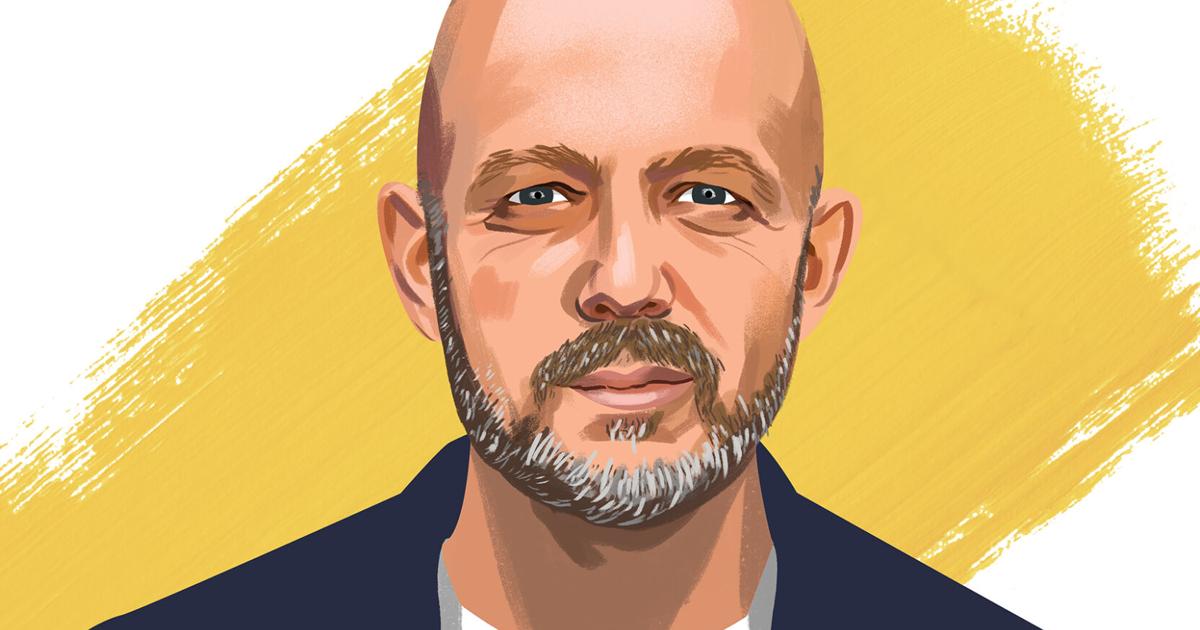


It’s no secret that Californians are unhappy with their state government. Steve Hilton’s big bet is that they’re so dissatisfied, so angry, that this heavily Democratic state will be willing to vote for a former Fox News host and supporter of President Donald Trump.
Hilton is one of two Republican candidates — the other being Riverside County Sheriff Chad Bianco — who have consistently polled well against a splintered field of Democratic candidates in the race to become the next governor of California.
His opponents will inevitably paint him as a fervent Trump loyalist — Hilton has stated that he has “good personal relationships” with many White House officials. But his campaign isn’t focused on the issues dominating national headlines — such as immigration enforcement — that a vast majority of Californians detest, and that Democratic candidates often bring up on the debate stage.
Hilton, who himself immigrated from the United Kingdom to the United States in 2012, said he instead hopes to tap into the rage that has resulted from California’s high cost of living and scarcity of housing. And while Democratic candidates often raise the same issues, Hilton argues that the Democratic Party has spent years in power in California and failed to address them.
How does a Republican win a governor’s race in a state that overwhelmingly voted against President Trump and continues to give him poor approval ratings? Well, the short answer is that the governor’s race this year isn’t about President Trump. It’s about the lives of people right here in California, which are mainly affected by our government here in California.
And if you look at the verdict of the people of California on that performance, it’s incredibly negative. So my starting point would be to say — just as a matter of fact — there is a majority of Californians who want a change of direction politically.
There are enough Republican votes. The question is, can you get Republican voters who voted for President Trump to turn out in large enough numbers in a midterm election for governor to win the race? I think the answer to that is yes, you can, partly through a strong, clear campaign argument — which is what I’m putting out there — focused on very practical things that will affect everybody’s daily life, particularly working-class Californians.
From the beginning of the campaign it’s been very clear and consistent for me. Get $3 gas, cut your electric bills in half, your first $100,000 free of state income tax, a home you can afford to buy.
Steve Hilton and Matt Mahan participate in the California gubernatorial candidate debate Tuesday, Feb. 3, 2026, in San Francisco.
Laure Andrillon/Associated Press
A Democrat will probably argue that reducing or eliminating income tax on people earning less than $100,000 is not feasible, the state budget would be a disaster and the sorts of social support and services that people in California have come to rely on will disappear. Well, “Why isn’t it feasible?” would be my question. They’ve doubled the budget, nearly, in the last five years — doubled, and yet everything’s got worse, and we have the worst outcomes on everything that matters. [Editor’s note: California’s budget grew from around $201 billion in the 2020-21 fiscal year to $321 billion in 2025-26, an increase of almost 60%.]
Secondly, when you actually look at the costings of my tax plan, the one that will affect most people directly and most meaningfully is the elimination of income tax for those under $100,000. But there’s a second part to it, which is above $100,000, a flat tax of 7.5%. And the way I frame that is you’ve got a pro-worker component and a pro-growth component.
It’s going to be a big incentive for investment. I was previously a fellow at the Hoover Institution [at Stanford University]. I went back to some colleagues there and we did the costings [and predicted] a revenue reduction to the state of California of about 18.5%, which is certainly aggressive in terms of a spending cut — but it is not at all unachievable given that the budget’s increased by 100%, nearly, in the last five years.
This is not some outlandish proposal. I think it’s actually a proposal that I would be shocked if Democrats opposed.
Do you want to delve into [business regulation]? I’ve started companies here and back in England before we moved here in 2012, including restaurants, which is a really tough business at the best of times. I talk to small-business owners the whole time … the layers of hassle and bureaucracy that they have to deal with are just unimaginable for someone who doesn’t run a business, and it’s no wonder that they’re leaving or closing down, including much-beloved local restaurants and bars and places like that. It’s just so difficult.
Someone who ran a local restaurant was telling me they expanded their patio from 30 to 50 guests, and it took six years and $1 million by the time you added up the legal fees, environmental inspections, and all this nonsense you have to deal with. It’s all got totally out of hand. I don’t think this is something that any of my Democrat colleagues in the governor’s race actually disagree with. I’ve heard them say it many times on the debate stage and elsewhere. The question is, are they actually going to do anything about it?
I know that you’ve declared war on the “war against single-family homes.” Can we do that while also building enough homes to mitigate the housing crisis? One hundred percent. I believe in housing choice, as it were. I want everyone to be able to afford to buy the home that makes sense for them.

Known for his 2020 presidential bid, the billionaire-turned-environmentalist is eyeing the governor’s mansion

Advocates warn Department of Public Health reductions will be felt in programs serving vulnerable

Sarah Lacy recently opened her second location of The Best Bookstore in Union Square and is aiming to open another dozen in coming years
If you’re just starting out and you’re younger, you may want an apartment in the city. There’s lots of interesting options there. But if you’re in California, most people — especially when the time comes for them to start a family — want a single-family home.
And the truth is we have plenty of land. Five percent or so of our land is developed in California. It’s one of the lowest, I think it’s the lowest in the country. You could expand, you could grow that to 6% … you’d have space for 10 million single-family homes on quarter-acre lots.
That’s just to illustrate the scale of what could be achieved if we free ourselves from the constraint of saying that everything has to be infill development. The problem by insisting on that is, first of all, you limit the choice of housing that’s available to people — it all has to be apartments. Secondly, if it’s all about infill, inevitably that restricts the amount of land that’s available for development. That increases the cost of the land.
And then thirdly, it just makes it more time-consuming because you end up in all these battles about where to build, and there will be people filing lawsuits and all this kind of stuff.
It costs three or four times as much to build anything — housing, industrial, retail, whatever — in California, specifically because of building codes, labor regulations, environmental regulations on the construction itself. And then you add into that the litigation risk. That’s a huge reason everything’s so expensive and time-consuming.
California gubernatorial candidate Steve Hilton speaks during an event to announce the candidacy of Michael Gates as California attorney general Wednesday, Jan. 14, 2026, in Huntington Beach.
Damian Dovarganes/Associated Press
I’m curious what your thoughts are on the billionaire tax that’s been proposed. The premise of it is completely flawed, because the union is arguing that we need it to fund health care to mitigate health-care cuts from the federal government. The actual amount of the budget from the federal government for California for health care is going up.
We’ve massively increased spending; we don’t have good outcomes. So I don’t accept even the premise for this proposal, let alone the proposal itself.
Now you get to the actual proposal. It’s an asset seizure. It’s totally unworkable. They have no clue about how it would work. What are you going to do, just on a particular given day — randomly, arbitrarily pick a day — and value everyone’s stock portfolios on that one day?
Then you’ve got the impact we’ve already seen, just the threat of it driving wealth out of the state, so it’s totally self-defeating. We’ve already lost billions of dollars in tax revenue because people have left the state just at the threat of it because of the retrospective nature of it.
The mechanics of it and the philosophy of it are two different issues. Do you philosophically believe that billionaires — or at least the ultrawealthy — need to pay more taxes in California? They already pay more taxes. It’s a famous statistic — the top 1% pay about 50% of the income tax. So this idea that the rich should pay their fair share is a cliche. They already do by far. It’s ridiculous. We’ve got to be a place that attracts wealth creators.
I think there’s a lot of complacency around the fact that we’ve got — you hear [Gov. Gavin Newsom], all the time, talking about how we’re the fourth-biggest economy. That’s true statistically — and great, I’m proud of that. Of course I want California to do well, and I believe that with the right policies in place that I’m putting forward, we could become the third-biggest economy in the world.
That statistic is really skewed by a small number of very large companies making huge amounts of money, enormous revenue, but not employing very many people. And in fact, even to the extent that they’re creating the kind of blue-collar jobs that we need, they’re all being done in other states.
Nvidia, for example — a fantastic Bay Area success story — announced a huge investment program in the middle of last year. Half a trillion dollars of investment they said they were making in America, none of it in California. None of it.
How do you distinguish yourself, if at all, from the policies that are widely disliked by Californians at the federal level right now? I have a very strong point of view about this. I’m a legal immigrant, and I absolutely understand and cherish the role of immigration as being the lifeblood of any country.
I’m an immigrant twice over. My parents fled communism in Hungary and left the country, and I was born in England. I deeply understand, growing up in a working-class family in England as the son of Hungarian refugees, that sort of basic story of immigrant aspiration.
But on the other hand, I would point out that we moved here in 2012. I became a citizen in 2021. In the nine years — through visa and green card and citizenship application and so on — if at any point in that process something had gone wrong, I’d been denied a green card or citizenship or whatever it may be, it honestly would not have entered my head to just stay here.
And I think we have to just really just say the truth, which is we cannot have law-breaking and a norm of rule-breaking on the scale that we’ve seen for the last 50 years. At some point we have to say that the law is the law, and we have to uphold the law and enforce the law, and I think that’s really important and I’ve said very clearly that. When I’m governor, I will make sure that all laws are peacefully enforced.
In particular, I’ve noticed there’s strong support in immigrant communities and a real resentment at the way that illegal immigration has created a sense of unfairness. And you hear it all the time. I’m in East [Los Angeles] often with Latino communities, and whether their parents or their grandparents came, they all say these very similar stories you hear, which is that “We did it the right way.”