
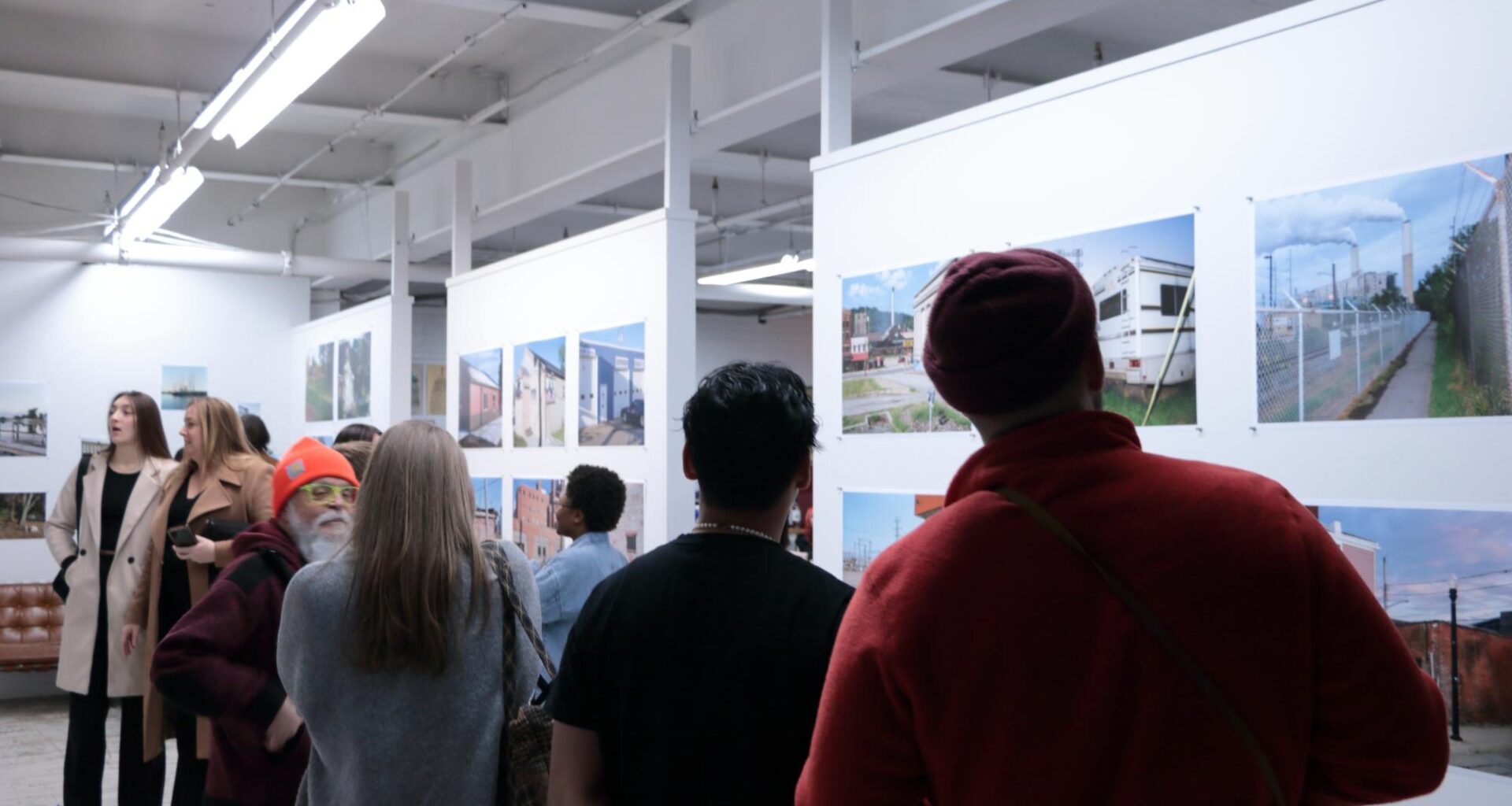
Bathed in fluorescent light, a viewer pauses a few steps from the wall, then leans in closer. The photographs vary in size and tone — some rendered in deep color, others in stark black and white or blasted with flash.
Metropolitan edges and lush autumnal growth betray a distinctly Midwestern character. The images do not rush; they wait, freezing a place in time for the viewer to step into.
This is “The Language of Landscape & Place,” a contemporary photography exhibition on view at the Subjectively Objective gallery in Rochester Hills. The show opened Feb. 7 and runs through April 10, featuring work by seven College for Creative Studies photography students alongside concurrent photographs by their professor, Noah Waldeck.
Waldeck, a CCS alumnus, teaches photography at both CCS and Oakland University, bridging the two institutions through his emphasis on both artistic intentionality and a respect for the traditions and history of the medium. He is the founder and chief curator of Subjectively Objective, which functions not only as a gallery but also as an independent publisher of photographic work.
The exhibition’s contents were made last semester as part of a CCS elective Waldeck developed last year, also titled “The Language of Landscape & Place.” Waldeck asked each student to commit to a single thematic interpretation of the class’s theme over the course of the semester and render it in their own cohesive series of photographs. Students were given wide latitude in defining just what “landscape and place” could mean.
“Some of the photographs here may not be explicit landscapes, but they still are something that you could interpret within the broad scope of an idea that references a place or the landscape,” Waldeck said. “I think what’s very important is that I don’t try to just force students to do just one specific thing, because, as an artist, there’s really no interest in that.”
Accordingly, each student’s personal vocabulary of place is reflected across the walls. The exhibition’s series range from industrial sites and quiet neighborhoods to intimate moments and even images that deliberately — albeit artfully — unsettle.
Recent CCS graduate Nick Talerico focused much of his work on industrial areas around Metro Detroit, particularly Pontiac. His photographs emphasize the most fleeting of moments, shaped as much by his precise timing as by the area’s sprawling urban geography.
“Light is a big factor,” Talerico said. “You see a scene, it’s got a certain ‘je ne sais quoi’ to it. You’re like, ‘Oh, I have to get this right now.’ Even though those things are still there, it won’t look like that again because it’s not that same day anymore.”
One photograph captures a collapsed power structure near the site of the former Silverdome, noticed while driving through the area as clouds briefly opened to let in warm light.
“It’s about capturing that moment,” Talerico said.
For Talerico, the approach is not so different from portraiture.
“You see somebody in a certain kind of light, with a certain demeanor,” he said. “You’re like, ‘I need to photograph them because this is happening right now, and it probably won’t happen again.’”
Norah Sawyer, a CCS junior majoring in photography, took the idea of landscape in an emotional direction. For her, the project came to embody a sense of the locationality of belonging.
“Landscapes can be anything — emotional, physical, or simply visual,” Sawyer said. “The language of a certain landscape can be literally anything.”
Much of her work emerged from everyday movement: stopping to shoot on the way to work or while commuting to class, carrying a camera wherever she went. Some shoots were planned around early sunrise or sunset, while others came about spontaneously.
“It almost becomes meditation,” Sawyer said. “You’re repeating the act of photography, and you’re in a kind of meditative state.”
One contemplative photograph shows flowers left in a parked car, illuminated by flash — an image that came from an entirely unplanned moment Sawyer encountered while out driving.
“It was just fun, random instances that I ended up getting myself into,” she said.
Over the course of the semester, Sawyer said her project evolved beyond its initial thematic focus.
“I think it’s the visual feeling of having a place to call home that is friendship,” she said.
Nick Cetrone, a CCS junior, took a methodical approach, repeatedly traveling to Toledo, Ohio, to photograph the city and its surrounding areas using 4×5 large-format film.
“I kind of photographed as I discovered parts of the city,” Cetrone said. “The series is showing my exploration of it as I saw it.”
Cetrone returned nearly every weekend, photographing dozens of locations. What drew him back to Toledo, he said, was the way industrial and residential spaces intersected, fortifying each other as the city grows around them.
“In most areas, if they built a bridge like this, the neighborhoods would be torn down,” he said. “But here, it just cuts right through everything. It’s a massive part of the way of life there.”
Julia Fortin, another CCS junior, pushed the definition of landscape further still. Her photographs elevate roadkill encountered while driving across Michigan’s Thumb region from the common curb to the camera, confronting viewers with the gruesome final moments of both bird and beast.
“There’s something that interests me about the grotesque in everyday life,” Fortin said. “Something that is not seen as suitable for human consumption. This is taking place out of itself.”
Using a pronounced, flash-heavy style, Fortin emphasized subject texture and detail from a forensic perspective, capturing each image as what she described as a kind of “crime scene.”
“There’s nothing to hide,” she said. “You’re going to see every single detail… like an explosion.”
She cited Midwest emo and alternative scene aesthetics as key inspirations. Originally from Vermont, Fortin said the rural Central Michigan landscape conjured up scenes both strange and compelling.
“It’s definitely a different environment,” she said. “The creepy corn fields. Sprawling nothingness. No mountains and big sky.”
Across the exhibition, students were given full control over how their work was presented — from print size to layout. Waldeck emphasized that a sense of identity rooted in past understanding is essential, particularly in a contemporary media environment dominated by speed and volume.
“There’s this idea that you’re always looking for something that’s new,” he said. “Landscape work isn’t necessarily like that. It’s a genre of photography with an established tradition.”
Rather than reinventing the medium, Waldeck encourages students to locate themselves within it — to be well informed about works past, but also oriented toward the future.
“What you’re really trying to do is find where you can have your own personal place within the tradition,” he said.
Talerico acknowledged that the genre can feel niche at first, particularly for viewers unfamiliar with its history.
“It’s not for everybody,” Talerico said. “This is the kind of stuff that, if you showed it to your mom, she might be like, ‘okay…,’ you know? People who are more visually literate… I think they resonate with it.”
Landscape photography, Waldeck said, has always been about observation — from early Civil War-era photography to contemporary works of the 20th century, which were characterized by human interaction with the environment.
“A successful photograph,” he said, “is something that is personal to you, but it also has that universal quality where it may potentially be evocative for other people.”
As viewers move through the gallery, they bring their own memories to unfamiliar places, reading meaning into spaces they may never visit. Waldeck said that evoking these interactions is the way in which landscape photography comes alive.
“You have to make whatever it is that you want to make personally,” he said. “That’s where the interesting thing comes in — that’s how you make art.”
The exhibition is free and open to the public. “The Language of Landscape & Place” will remain on view at Subjectively Objective through April 10; gallery hours and visiting information are available on the studio’s website.