
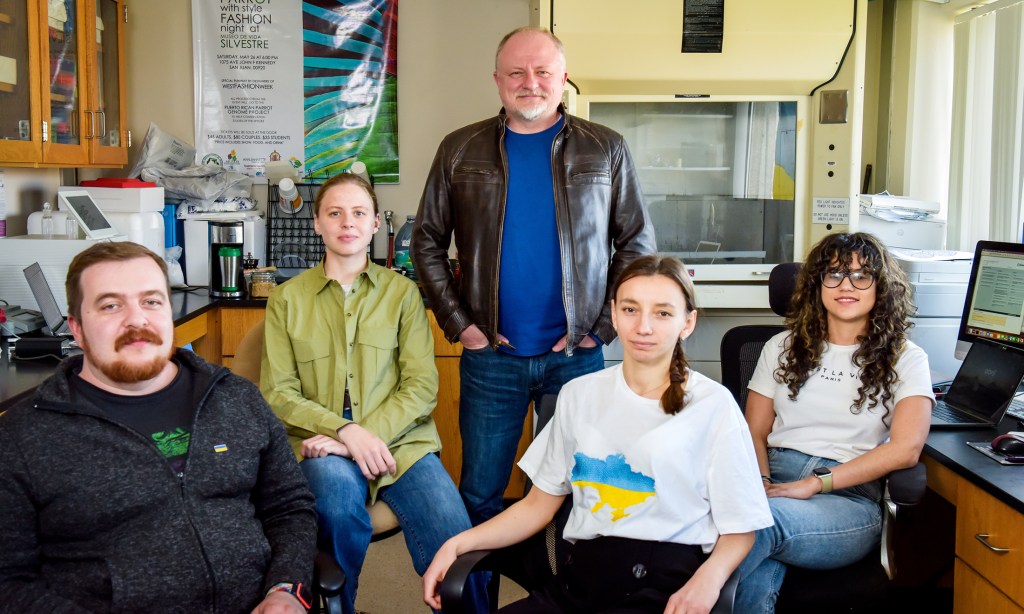
As the fourth anniversary of the war in Ukraine approaches, Taris Oleksyk continues work on keeping scientific research moving forward and looking to reach the next generation of scientists in his home country.
Continuing Russian attacks, constant power outages, and inconsistent funding streams have posed a number of current challenges to Ukrainian science and could possibly impact the future as well.
“Science needs continuity. Science needs mentorship and during a war this gets disrupted,” said Oleksyk, an Oakland University biology professor. “Lots of professors get displaced, lose funding or some of them go to fight in the war and die. The younger generation gets lost and will leave science and that creates a gap and once that gap is there, you have to rebuild everything from the ground up.”
A September 2025 article published in the Journal of Science highlighted his ongoing efforts during the war to collect and analyze genetic data of populations in Ukraine and Eastern Europe.
It was an idea Oleksyk first thought of back in 2018 – creating a new database for studying Type I diabetes and studying the genomics of diabetes in Ukraine.
The research collected from scientists from around the country is stored in a lab at Oleksyk’s alma mater, Uzhhorod National University in Uzhhorod, located in western Ukraine on the border with Slovakia.
OU established a partnership with the university in 2019, not long after Oleksyk was hired. The schools signed a memorandum of understanding and collaborated on the study.
According to Oleksyk, the study focuses on data that can be used to decipher the genetic underpinnings of Type I diabetes, paving the way for future medical breakthroughs.
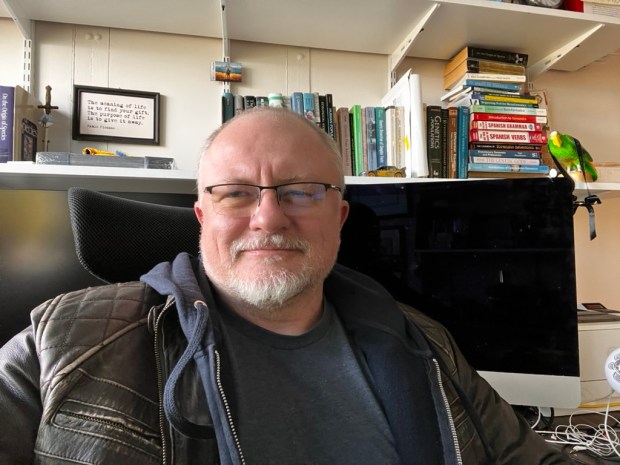 Oleksyk continues to teach remotely in Ukraine and do as much as possible to make sure science and research continue in a country that is about to mark four years at war with Russia.
Photo courtesy Taris Oleksyk
He has joined forces with colleagues in Poland, where he traveled to in 2025 as a Fulbright scholar, to expand the study to include 20,000 patients and controls by mid-2027. Scientists from several other countries are also participating.
“Science is a collaborative exercise. It is not individual scientists that are pushing it,” he said. “It is a network that is pushing the process and the bigger the network, the bigger the output.”
Oleksyk continues to remotely guest teach at Uzhhorod and has recruited some of their students to come to OU and other colleges in the U.S.
A February 2026 article he contributed that was published in the Nature, Ecology and Evolution journal describes what lies ahead.
“One of the most acute challenges now facing Ukrainian science is training and skills preservation for the next generation of scientists,” the article begins. “As financial and human resources are diverted to the war effort, universities and research institutes can no longer reliably invest in long-term education, mentoring, and international experiences for students and early-career researchers.”
One of the ways he wants to bridge the gap is workshops like the Ukrainian School in Evolutionary Biology, held last year in Uzhhorod.
The workshop for over 200 bachelor’s, master’s and doctoral students and researchers focused on delivering up-to-date knowledge in evolutionary biology and other research topics and training in modern research techniques. It featured 26 speakers from France, the United Kingdom, the United States, Japan, the Netherlands, Romania, Ireland, Poland, and Ukraine.
“What we are doing in Ukraine, Eastern Europe and in Michigan is building a network of talent and people working together on this that benefit our health, humanity and our country’s recovery,” said Oleksyk. “Science is not an individual endeavor anymore, it is about building communities.”
Oleksyk also sees what the future can hold locally when the war comes to an end.
“If Ukraine prevails and rebuilds, Michigan can be part of that recovery through trade, joint research, and educational exchanges that benefit both sides,” he said. “How this war ends will shape not only Ukraine’s future but also our own security and opportunities for partnership.”