
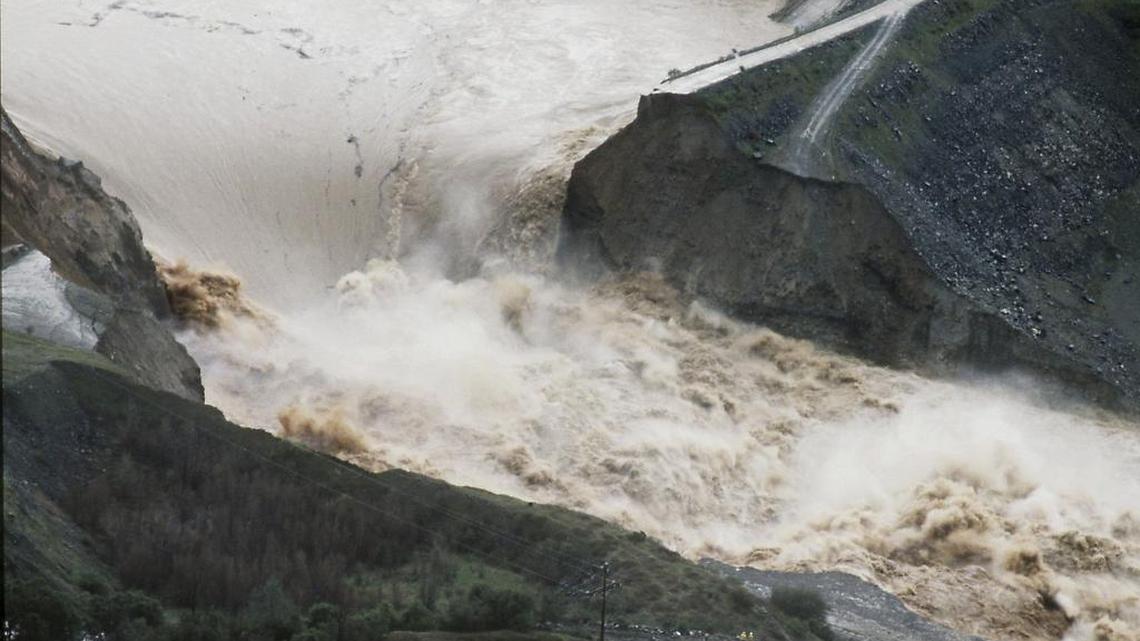
After three torrential storms dumped 10 inches of rain on Northern California in nine days in February 1986, Sacramento’s flood protections were bursting at the seams.
Something had to give — and did.
At 6 a.m. on Feb. 18, water began spilling over an earthen coffer dam built 14 years earlier as part of work on the stalled, and later dropped, Auburn Dam project.
The deluge began to erode the dirt spillway, and then the nearly 300-foot-tall dam itself.
By the time the dam completely gave way 12 hours later, almost 180,000 acre-feet of water — or 58.65 billion gallons — had poured down the American River into Folsom Lake.
The reservoir came within 2 inches of spilling over Folsom Dam and operators had to release the largest volume of water in its 31-year history to prevent it, straining downstream levees in Sacramento to the limit, The Sacramento Bee reported.
But it had all been planned — or at least anticipated — years before.
Here’s what to know about the Auburn Coffer Dam collapse on Feb. 18, 1986.
Raging water spews through a coffer dam that collapsed on the North Fork of the American River and dwarfs a pickup truck on Feb. 18, 1986. Morgan Ong Sacramento Bee file Why was the coffer dam built?
The coffer dam was built in 1972 to divert water around construction of what was intended to be a full-scale Auburn Dam on the North Fork of the American River.
Congress authorized the project in 1965 and construction began in 1967, the American River Authority said in a 2008 report.
The arch concrete dam was intended to join Folsom Dam, Nimbus Dam and other flood protections for the Sacramento area. It also was designed to provide water and power.
But an earthquake near Oroville in 1975 raised questions about the safety of the dam design, and engineers said in a 1976 report that such a quake could cause the proposed dam to fail.
New designs were later proposed, but Congress refused to reauthorize the project following intense opposition from environmental groups, the report said.
Why did the coffer dam collapse?
A combination of heavy rainstorms and snowmelt caused the water held back by the coffer dam to overtop an emergency spillway, the Placer County Water Agency said.
The storms were part of a Pineapple Express, carrying warmer rain from Hawaii, or what is today called an atmospheric river, KCRA reported.
In normal conditions, water behind the coffer dam flowed through a diversion tunnel, but the rain and snowmelt overcame the tunnel’s capacity.
The volume of water began to erode the earthen spillway before eating into the side of the dam itself, undermining its foundation.
Huge chunks of earth collapsed into the raging torrent as the dam failed, a Placer County Water Agency video of the collapse shows.
The water unleashed by the dam’s gradual collapse filled Folsom Lake nearly to its 1 million acre-foot capacity, The Sacramento Bee reported.
In order to keep water from spilling over Folsom Dam, operators released a record 125,000 cubic feet per second into the American River.
The water strained downstream levees, including those protecting Sacramento, The Bee said. Volunteers joined patrols along the levees to watch for breaches.
Emergencies were declared in parts of 19 counties and five cities in Northern California.
In the end, the February 1986 series of storms killed 13 people and caused $400 million in damage to the state, KCRA said.
While the Feather River flooded the town of Linda in Yuba County a few days later, destroying 895 homes, the levees protecting Sacramento held, preventing an even worse disaster.
Was the collapse anticipated?
Oddly enough, the seemingly catastrophic collapse of the coffer dam had always been part of the plan, the Placer County Water Agency video said.
The emergency spillway had been installed as a kind of “safety plug” years earlier. It was designed to slowly erode over hours in an emergency to prevent a full-scale breach.
By spreading out the release of water from behind the coffer dam over 12 hours, it gave Folsom Dam operators time to prepare for the influx.
In addition, the water behind the coffer dam also had always been factored into the capacity of Folsom Lake, anticipating that the earthen dam would someday fail, the video said.
Were Sacramento flood protections strengthened?
Following the floods and the decision not to proceed with the Auburn Dam, work began on other flood safety improvements.
A $373 million project to raise Folsom Dam and berms around the lake by 3.5 feet began in 2020, The Sacramento Bee reported.
A new, lower spillway allows dam operators to release more water sooner as a precaution ahead of major storms.
Downstream levees on the American and Sacramento rivers also have been strengthened since the 1986 storms.
At the site of the proposed Auburn Dam, 3 miles of the river have been restored, including a whitewater recreation area, and a water pump station has been built, the Placer County Water Agency said.
Loading…
Related Stories from Sacramento Bee
The Sacramento Bee
Don Sweeney has been a newspaper reporter and editor in California for more than 35 years. He is a service reporter based at The Sacramento Bee.