
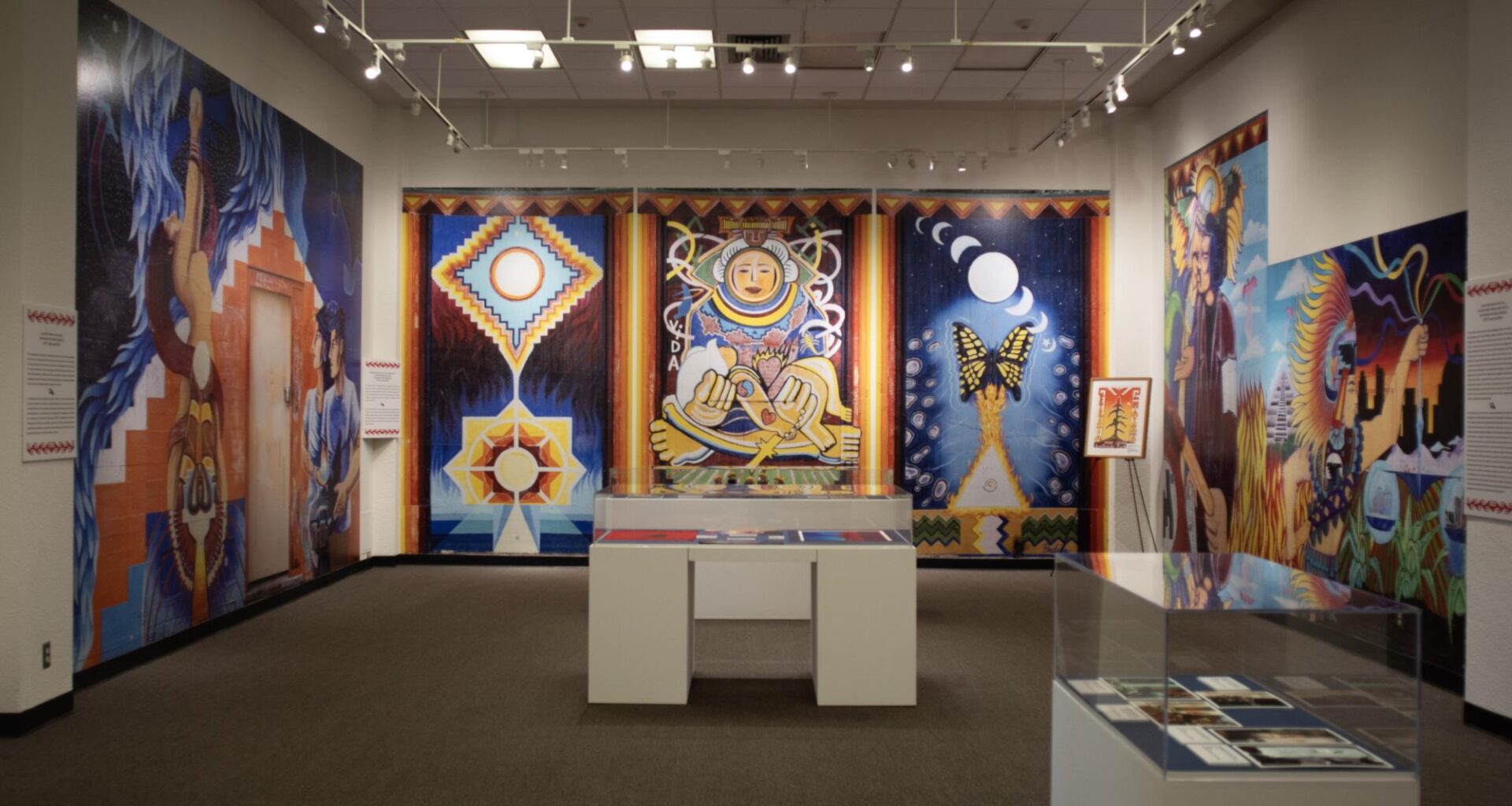
Sacramento’s historic legacy of Chicano art and resistance has returned to its roots in a new exhibition honoring the renowned murals that have become landmarks in the heart of the city.
“Painting La Comuniversidad: Three Murals of the Royal Chicano Air Force” displays the murals, signs and artwork of activists that empowered Sacramento during the Chicano Civil Rights Movement in the early ‘70s. The exhibition opened on Feb. 11 and will be open until May 1 inside the University Library Gallery.
“I think having this exhibition at Sac State is especially important. Several of the artists were professors at Sac State and students,” said Janina López, curator of the exhibition and Sac State alumna. “The history of the Royal Chicano Air Force is very intertwined with Sacramento State, so it’s especially exciting that it’s at the library gallery.”
The RCAF was formed on the principles of activism, community and culture, which is reflected in their work through indigenous and Chicano depictions, spiritually inspired styles and bright colors.
Artists Lorraine García-Nakata and Stan Padilla, two RCAF members displaying art in the exhibition, were present at the opening reception. Over 40 members of the community showed up in support and looked forward to meeting with the notable artists.
“I consider myself a Chicano, so I thought it was a really good opportunity to see the works behind the heroes that I’ve always been curious about, especially the ones here in Sacramento,” said Cassandra Sanchez, a Sac State alumna and Bachelor of Fine Arts graduate.
The exhibition is organized in four parts, with each focusing on different artists and murals. One section showcases the well-known Southside Park mural, which has been a cultural hub for the Sacramento community that has hosted performances and gatherings since its inception.
“This city is filled with so many communities, especially Latin communities,” Sanchez said. “I think it’s very important to showcase this type of art to see what we represent and what creates a community.”
The other parts feature two major recognizable murals in the Sacramento area, “Metamorphosis,” located downtown and “Emergence,” at the Washington Neighborhood Center. RCAF created the murals in solidarity with the broader Chicano Civil Rights Movement and labor movements of the United Farm Workers. The exhibition displayed posters that were used for advertising boycotts, educational events and concerts. The mural “Emergence” was a comprehensive political and cultural piece inspired by Mexican revolutionary legacies that showed the bright red colors of the UFW flag and figures that represented the identities of Chicano culture, labor rights and education.
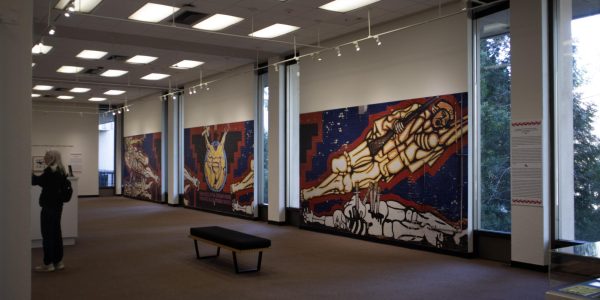 A reproduction of the mural “Emergence,” originally located at Washington the Neighborhood Center, inside the library gallery Thursday, Feb 12, 2026. A student is viewing a different piece on the wall across from the mural. (Photo by Susana Grijalva)
López says she hopes people within and outside of the Sacramento Latino community can understand the history of the RCAF, collaborative art practices and the importance of public art.
Magdalena Cullen, a junior social work student from the Bay Area, attended the opening reception and was unfamiliar with the RCAF and the Sacramento landmarks.
“I’ve never been to one of the galleries, so I am actually really excited about it and kind of moved,” Cullen said.
The artists were not only creating at the time but also providing. They gave resources to the Sacramento community through free educational workshops, art classes and breakfast programs to extend their reach beyond the arts. The Centro de Artistas Chicanos was formed by the RCAF in 1973 and provided free classes on printmaking and muralism as well as other resources like the La Raza Bookstore and the Breakfast for Niños program.
José Montoya, a co-founder of the RCAF, created an extension of the organization’s educational values through The Barrio Art Program at Sac State. One of the courses was recently revived by current professor Luis-Genaro Garcia, who was also a guest speaker at the opening reception. The fourth section of the exhibit shows the work of the former and renewed art program that echoes the power of Chicano resistance art and education as a voice of activism.
The RCAF is an embodiment of radical resistance and community organizing that scholars still teach about in Chicano studies many years later. López hopes their legacy is remembered and believes that these principles are still alive today.
“We’re still dealing with a lot of the same struggles,” López said. “The ways in which they were organizing and using art as activism is something that we can all continue to learn with.”