
Coronado has taken the first step in becoming part of San Diego Community Power, one of the region’s community choice energy programs that offers an alternative to San Diego Gas & Electric when it comes to sourcing electricity for customers.
After a discussion that went on for more than three hours, the Coronado City Council on Tuesday voted 5-0 to initiate the process.
“The people of Coronado deserve the same opportunity for affordability, choice and access to energy programs most of San Diego County enjoys,” Coronado Councilmember Amy Steward said in a statement after the vote. Steward has been an outspoken supporter of community choice energy programs.
But there are still hurdles to clear before Coronado officially becomes a member of Community Power, including public outreach efforts, the city making a preliminary decision in late August and the two entities adopting a joint powers agreement around Oct. 31.
Despite the unanimous vote, Mayor John Duncan and Councilmember Mark Fleming raised concerns.
“The timeline is fairly lengthy,” Duncan said. “I am going to definitely, to the extent those tools exist, run scenarios of what I believe is the average bill in Coronado and see what happens compared to what the bill is now and do further work on it.”
The move also requires approval by vote of Community Power’s board of directors.
“We’re not counting votes in advance, but we are feeling pretty confident about our board members seeing the value in adding Coronado to our service,” said Jen Lebron, Community Power’s senior director of community affairs.
If approved, Coronado will become the eighth municipality on Community Power’s roster — joining the cities of San Diego, Chula Vista, La Mesa, Encinitas, Imperial Beach, National City and the unincorporated communities of San Diego County.
Some 12,000 customers in Coronado could begin receiving service from Community Power as soon as the start of 2028 if the deal gets completed.
Multiple council members said Tuesday that joining a CCA will help Coronado meet its Climate Action Plan goal of reducing communitywide greenhouse gas emissions by 40% by 2030.
“This is the least expensive way the city, on its own, can hopefully meet our CAP (Climate Action Plan),” Councilmember Carrie Downey said.
San Diego Community Power is one of 25 community choice aggregation, or CCA, energy programs that have sprung up across California in recent years.
Created by the California Legislature in 2002 to encourage the growth of renewable energy and provide competition to traditional investor-owned utilities, CCAs are designed to offer customers higher percentages of renewable sources at comparable or slightly lower rates.
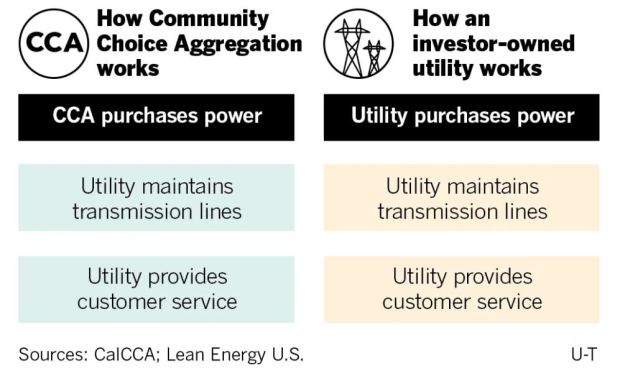
When established, CCAs purchase electricity generation for residents and businesses in their respective municipalities.
Utilities such as SDG&E don’t go away under the CCA framework. They still perform all the responsibilities outside of purchasing power — such as delivering electricity via transmission and distribution lines; maintaining poles and wires; and handling customer services, including billing.
 The San Diego Union-Tribune
As per state rules, should Coronado become a member of Community Power, customers will automatically get enrolled in the CCA — homeowners and businesses in Coronado won’t have to fill out any forms.
Customers will not receive a separate bill. Rather, they will still receive a monthly statement from SDG&E that will include a notation saying “CCA Electric Generation” under the summary of current charges on page 1 of their bills.
For customers who prefer to remain with SDG&E for their power purchases, they will be able to opt out from Community Power.
In place since 2021, Community Power currently serves about 955,000 customer accounts, making it the second-largest CCA in the state.
Community Power offers three different plans for its customers:
PowerOn, the default program that has a portfolio of 53% renewables, plus 2% from carbon-free sources such as hydroelectricity. By comparison, SDG&E’s renewable portfolio of 41%
PowerBase, a less expensive option with a renewable energy content of 45%.
Power100, offering generation that pencils out to 100% renewable and carbon-free sources of energy, but it’s more expensive than PowerOn and PowerBase.
This year, it’s projected that Community Power residential customers enrolled in PowerOn who use an average of 341 kilowatt-hours of electricity will pay 1.28% less compared to SDG&E per month (which works out to a savings of $2.10).
Those on PowerBase will pay 3.38% less, for a savings of $5.56. But residential customers enrolled in Community Power’s Power100 program are projected to pay almost 1% more compared to SDG&E on a monthly bill, which works out to $1.31 higher.