

Plastic surgery. Streaming subscriptions. Trips to Disneyland and Hawaii.
At least $132,000 in San Diego County funds were illegally spent on those and other personal expenses, prosecutors alleged this week. Even worse, that money was supposed to go toward preventing and reversing drug overdoses amid an ongoing opioid epidemic.
Officials this week announced six felony charges against Amy J. Knox, 45, the former chief operating officer of the Harm Reduction Coalition of San Diego. If convicted, she faces up to seven years in prison.
“It’s sickening that this fraudster decided to line her own pockets” with “these precious, potentially life-saving dollars,” San Diego County District Attorney Summer Stephan said Wednesday during a press conference downtown. “It is also deeply concerning that the checks and balances that are supposed to safeguard the county’s large budget and trust funds failed in this case.”
Indeed, Stephan directed some of her most pointed criticism at San Diego County leaders, who she said failed to properly oversee contracts worth millions. Stephan was particularly concerned about how fearful county staffers appeared to be when discussing public contracts with investigators.
 District Attorney Summer Stephan speaks during a press conference on the investigation of Amy J. Knox, former COO of the Harm Reduction Coalition, at the District Attorney’s Office on Wednesday, February 18, 2026. (Kristian Carreon / The San Diego Union-Tribune)
“This type of culture of fear for speaking truth is the kind of thing that, as a prosecutor, has my Spidey antennae up,” Stephan added.
When asked if other people at the coalition or the county are suspected of further wrongdoing, Stephan said only that the investigation is ongoing.
The charges come as the harm reduction approach to stopping drug deaths comes under fire from President Donald Trump, who’s dismissed the strategy as a failure. Harm reduction can encompass a range of practices, including handing out free needles to slow the spread of disease, and many local leaders credit some of those efforts with recent drops in fatal overdoses.
The Knox case involves a pair of contracts that were supposed to fund tests of street drugs and distribute containers of naloxone, an opioid-reversing nasal spray commonly known by the brand name Narcan.
Knox was charged with three felony counts of embezzlement and three felony counts of misappropriating public money, officials said. She appeared in court Wednesday to plead not guilty.
Knox remains incarcerated. The judge set her bail at $200,000 and another hearing is scheduled for Feb. 25.
The harm reduction coalition’s CEO, Tara Stamos-Buesig, denied any personal wrongdoing and praised the district attorney’s office for their investigation.
“I’m so devastated,” she said in an interview.
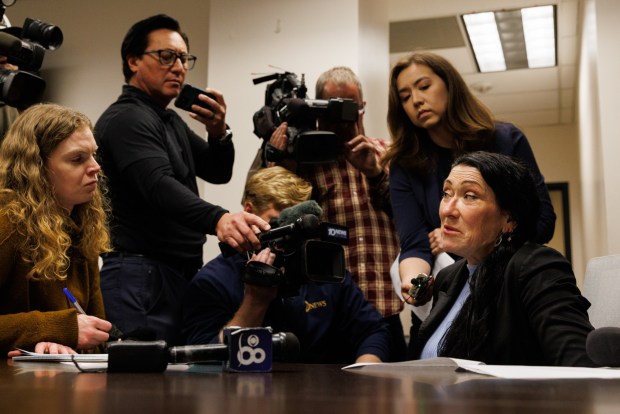 Tara Stamos-Buesig, CEO and founder of Harm Reduction Coalition, speaks to members of the media on the investigation of Amy J. Knox at the District Attorney’s Office on Wednesday, February 18, 2026. (Kristian Carreon / The San Diego Union-Tribune)
Stamos-Buesig said she met Knox around 2014. Stamos-Buesig was aware at the time that Knox had recently been convicted of stealing money, but thought only a few thousand dollars had been taken.
When they later reconnected, Stamos-Buesig believed Knox had reformed and was impressed with her apparent business experience. The old charge didn’t even come up in an online background check, Stamos-Buesig said. Plus, having a criminal background is often not a deal breaker when it comes to serving people struggling with addiction, as many of those residents have also spent time behind bars. The shared experience can help build rapport.
Knox began working as the coalition’s chief operating officer in June 2022. Prosecutors said the warning signs came early.
In April 2023, a county audit of the coalition flagged “significant financial control weaknesses,” the district attorney’s office wrote in a press release. Prosecutors said county staffers raised concerns about the organization with their supervisors. In addition, the county learned about Knox’s old embezzlement case – and that she’d been convicted of stealing more than $500,000.
Yet in 2024, county officials nonetheless gave the coalition a second contract.
Finger pointing began early last year. Knox suddenly accused Stamos-Buesig, the CEO, of mismanaging the organization. Stamos-Buesig in turn noticed problems with the group’s bank records and contacted the district attorney’s office, according to both prosecutors and Stamos-Buesig.
 Amy Knox, former COO of the Harm Reduction Coalition, is seen at an arraignment at San Diego Central Courthouse on Wednesday, February 18, 2026. (Kristian Carreon / The San Diego Union-Tribune)
The county cancelled both of the coalition’s contracts in June. Even then, county officials didn’t reach out to the district attorney to flag possible criminal activity, prosecutors said.
In an emailed statement, county Supervisor Terra Lawson-Remer said the “alleged theft of public funds intended to help people struggling with addiction is a serious breach of trust.” She called for an internal inquiry “to review how this happened and if warranted to propose immediate structural safeguards.”
County spokesperson Tammy Glenn added that employees were always encouraged to report potential wrongdoing through their Ethics & Compliance Hotline. “The County will continue to examine and strengthen processes and reinforce accountability to ensure transparency and public trust.”
Glenn added that the county remained committed to the harm reduction approach and the distribution of naloxone.
It’s possible Knox stole even more than $132,000, the district attorney said, as the county contracts were worth more than $5 million. “We cannot, beyond a reasonable doubt at this time, know fully how much of those millions were compromised by theft.”
Furthermore, prosecutors noted that Knox may have had access to even more county money through her service on the volunteer board of the local Crossroads Foundation, which helps women with substance use disorders. A spokesperson said Knox was no longer affiliated with the group and never had control over the foundation’s finances.