
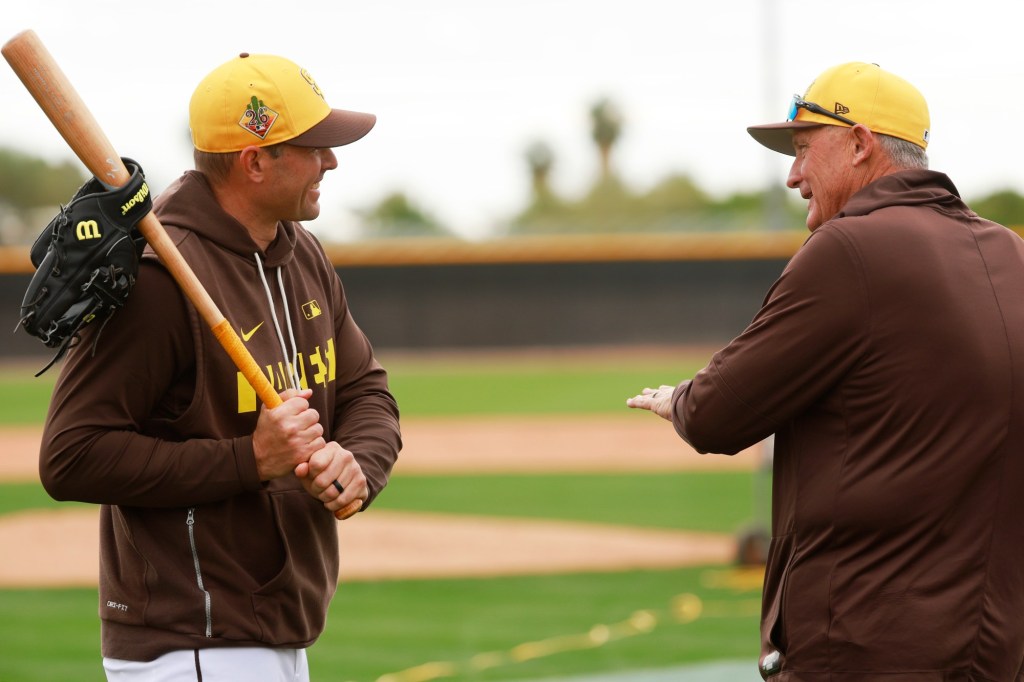
PEORIA, Ariz. — At some point Friday afternoon, during the Padres’ first spring training game, Randy Knorr will look over at Craig Stammen and ask something like, “What will you do here?”
It almost certainly will not be a question about the strategy Stammen will apply in the moment but rather what he might do in a moment like it during the regular season.
“It’s an opportunity when we’re watching the game to say, ‘Hey, during the season, this is going to come up, this is stuff that you’re going to have to make a decision on that’s going to be really quick.’” said Knorr, the Padres’ new bench coach.
“And we don’t have to do it in spring, because it’s all scripted and we’ve got time. And nobody really cares what happens in the spring games. But I can kind of prepare him to set him up for stuff that might present itself during the season and how fast you’ve got to do it with the time clock and all that. … That’s the fun part of it — just to sit there with him and get to see how he views situations when they come up. It’s just constant dialogue as we do it in a very light setting. It will give us a chance to talk, and I’ll know what his views are on certain things.”
The reality, according to men who have held the job, is that in-game maneuvers are a small portion of the duties of being a major league manager. In terms of importance in what determines successful seasons, they estimate game strategy is not even 20% of the job.
Far more crucial is the culture a manager creates, the relationships he builds, how he fosters confidence and sways the ebb and flow of the club’s collective psyche throughout the long season. These are largely dependent on a manager’s communication skills and are areas in which Stammen is roundly expected to excel based largely on his relatability, charisma, empathy and his role as a leader during the latter half of his 13-year big-league career.
But that does not mean in-game decisions are unimportant. A call a manager makes can affect outcomes in what is often a slim-margin proposition.
And managing a game is far more involved than almost anyone who has never managed can fathom.
Four of the five managers who provided insight into what Stammen will face, all of them former MLB players, acknowledged they didn’t fully grasp the speed and complexity of the game until they were in the big chair.
Stammen, hired in November with no coaching or managing experience, has been forthcoming about how much he has to learn.
He laughed when asked what in-game machinations and situations he expected to be most challenging.
“I don’t know,” he said. “We’ve got a laundry list of those things. All of it is new. But all of it, I’ve done it in my head — just not as the guy that has to make the decision. I’ve second-guessed a lot.”
At that, he laughed again, only more heartily.
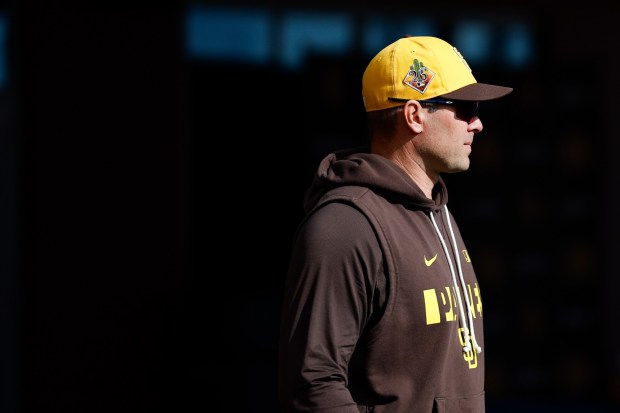 Craig Stammen of the San Diego Padres walks between the fields during spring training workouts at the Peoria Sports Complex on Tuesday, Feb. 17, 2026 in Peoria, Ariz.(Meg McLaughlin / The San Diego Union-Tribune)
Stammen has also said many times he will lean on his coaches.
Knorr is in many ways the man he will lean on most — at least for two to three hours almost every day for the next several months.
The two men have known each other practically since Stammen was drafted by the Washington Nationals in 2005. Knorr managed Stammen in Single-A, was the Nationals’ bullpen coach when Stammen arrived in Washington and later became the bench coach while Stammen was still with the organization.
He is one of the principal people Stammen confided in, learned from and took his second-guessing to as a player.
“I would complain to him all the time about, like, what the manager was doing,” Stammen said.
Now Knorr will be trying to help Stammen navigate his first season as the guy other people will second-guess.
They plan to use spring games as a sort of testing ground, not so much to implement things but to look ahead.
Because looking ahead is one of the requisite skills for managing a game.
Everyone else has the luxury of “managing” a game after the fact or, at best, as it happens. The guy making the decisions has to manage the game like a chess master: several moves ahead.
So over the next 4½ weeks, Stammen will be getting a bit of a crash course, as he asks his bench coach questions and his bench coach points out things that will come up in the ensuing months.
Pitching plans are scripted in spring training, so what virtually everyone agrees is the most crucial component of game management is something Stammen won’t get first-hand experience with until opening day.
Many former and current managers said they felt Stammen will begin his career well-equipped to deploy and take care of his pitching staff, especially the relievers, since he spent the bulk of his career in the bullpen.
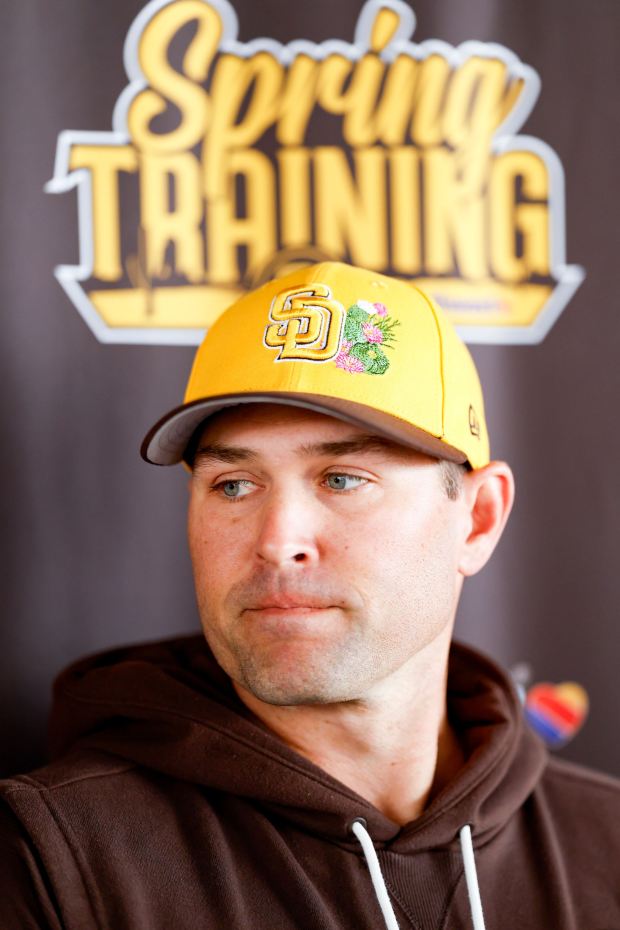 Craig Stammen of the San Diego Padres speaks to the media during spring training workouts at the Peoria Sports Complex on Friday, Feb. 13, 2026 in Peoria, Ariz.. (Meg McLaughlin / The San Diego Union-Tribune)
When to pull a starting pitcher, most said, will be more challenging.
Three former managers said the game is on cruise control for the first four or five innings. Generally, that is about when the decision looms regarding how long the starting pitcher can remain in the game. At that point, particularly in close games, the manager has to operate on a different plane.
With experience, the former managers said, they learned not only what to look for when assessing a game but how to refine their pregame preparation to help ensure they were ready for whatever happened.
These are things ahead of Stammen.
For now, he can get some mental reps during games that don’t count and in which strategy is rarely applied unless a team wants to work on a specific type of play.
Among the situations Stammen can ponder in spring are what he might call with runners on first and third, when he might call for a pick-off, when to call for a pitcher to work around a batter, when to pull in the infield, whether he would want to position outfielders differently for a certain hitter, when he might hit and run, when he might call for a steal and when he might insert a pinch-runner.
Additionally, situations will come up where he and Knorr discuss what they think an opposing manager might do if it were a regular-season game and how they might react to those moves.
“I think the first week is just gonna get a feel for what it’s like,” Stammen said. “… But if certain situations come up in the game, we’ll talk about those as they come up and be like, ‘Hey, we’re gonna have to make that decision, like, two pitches ago. We’re not gonna be able to sit here for four pitches and then make the decision.’ I think that’ll be the challenge for me — making some of those positioning decisions or base-stealing decisions, what play are we running (when runners are on) first and third, things like that, ahead of time.”
Knorr, who played parts of 11 years in the major leagues and was with the Nationals as a coach, minor league manager or in player development from 2008 through ‘25, considers this opportunity to work with Stammen as something of an adrenaline shot.
And while there are a lot of people around the Peoria Sports Complex eager to lift Stammen up, Knorr is arguably at the front of that line.
“I just want to help make him the best manager possible,” Knorr said. “… The more he can get that information in spring, the more he can implement it and then figure out if he wants (something) or not — he picks up things so fast and so well, he’ll do it quickly.”