
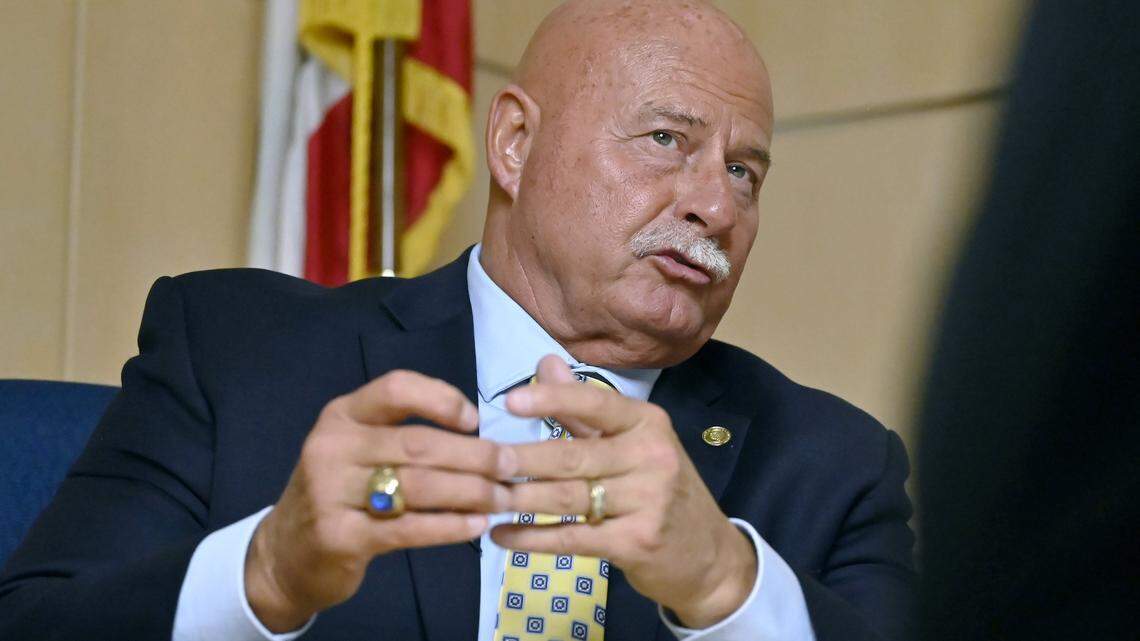
Despite a setback to a planned mega development in southeast Fresno, Mayor Jerry Dyer is committed to seeing it come to fruition.
The Fresno Bee recently sat down with the mayor for a 40-minute interview to discuss his accomplishments as mayor thus far and look forward towards the remaining two years and 10 months of his second term. Read part one of this interview here. One of the major topics of discussion was the Southeast Development Area specific plan, a proposed large-scale expansion to add 9,000 acres and an estimated 45,000 homes in southeast Fresno.
Dyer stressed that throughout his administration, he’s been committed to adding infill housing within the city’s limits. But he also said he sees SEDA as critical to the city’s growth for the affordable homes and good-paying jobs he expects it to bring.
“I would be negligent as a mayor if I didn’t pursue that with a vengeance,” he said.
The project, with a total estimated price tag of $4.3 billion, is controversial, with some opponents saying the city should prioritize investing in existing neighborhoods that “face blight, broken infrastructure, and underinvestment.”
Others have argued that project has a “shortfall” of more than $3 billion, an estimate that a city-commissioned study says the city would need to raise through a new, SEDA special financing district that would generate revenue through fees, taxes and other sources charged to SEDA developers, new SEDA homeowners and business owners.
In a 5-2 vote in December, the Fresno City Council sent the plan back to the Dyer administration for further financial review.
Though he acknowledged the city’s history of sprawl has negatively impacted the city’s historic neighborhoods – Dyer expects developers to pay for most of the project and “generate additional income to the city.”
Here’s what Dyer had to say about SEDA, with light edits for clarity. Q. SEDA, the Southeast Development Area, is another big topic. In December, the Fresno City Council voted to send the project back to the city administration for further review. Do you have a sense of how long that will take or how that’s going? Based on what was requested by the council in terms of additional studies, I think it’s going to take probably six months to get all of that information completed. It was something that I anticipated, but there was probably more requested by council than I thought. I knew there’d be quite a bit, but I didn’t know there’d be that much.
Q. What do you make of all the opposition to SEDA and how would you respond to concerns about sprawl? So number one, I’m not a proponent of sprawl. I think what happened in Fresno over the decades was really a disservice to people who lived in some of our older neighborhoods. And ultimately, what ended up happening with the expansion of the freeways and the development of land that was on the far north – not just in Fresno, but also in Clovis and now in Madera – has really put us at a disadvantage. And so we’ve worked very, very hard to do infill development. In fact, when the general plan was put forth, there was a goal set forth that at least 50% of new development would occur within the city limits, and then 50% outside the city limits. I’m proud to say since that time, 76% of all development has occurred within the city limits. So we have made tremendous strides in developing within our core. We still have room to develop in that.
But I think we’ve gotten to the position where we also need to expand in certain areas in a very smart way to where we still stay competitive, and that we provide opportunities for homeownership. And I believe the SEDA plan that we’ve put forth on the southern part of our city is one that will meet that demand. It will allow for 467 acres for housing, and most of that would be for single family residential, for homeownership at what I think to be an affordable rate for people who grew up in Fresno. But the most important thing, I think, of the South SEDA development would be the 1,547 acres opening up south of Jensen Avenue (between Jensen and North avenues and between Minnewawa and Temperance avenues) that would allow for us to have advanced manufacturing in that area. So that area would be 100%, 99% for flexible research and development, which would allow for advanced manufacturing that will attract good-paying jobs.
And the reason that’s so important to us is, if you look at the statewide average right now of suitable land for flexible research and development, for industrial development, the state average is about 7.5% suitable land available. Visalia is at 16% and Fresno is at 5%. So we’re at a competitive disadvantage by not having the suitable land for that to occur in our city. And we need good-paying jobs here, too.
Q. What would you say about the concern around the multi-billion dollar shortfall to cover the costs of SEDA? Would that be covered by the city or private development? I would say first it is misinformation, because that multi-billion dollar, $3 billion figure is not accurate. There are infrastructure costs that directly fall upon the city that are reimbursed by the developers.
And, in fact, all the infrastructure is paid for by developers. None of it’s paid for by the city. But there are some upfront costs. Even the $267 million figure, though, was too much for me as a mayor. I didn’t feel that that was the risk I was willing to take, nor did I want to put that kind of debt on ratepayers. So that’s when we shifted to South SEDA, and that infrastructure cost for South SEDA is about $61 million for water, sewer, streets – an upfront cost that, I think, is something that we could tolerate as a city. And I also think that that development will happen sooner than it would if you opened it up on the north end (of SEDA). And so, reducing the risk to the city to $61 million – there’s going to be another cost for the housing piece, and we don’t have that figure yet – but it’s going to be under $30 million. And is that a cost that is consistent with what we’ve done in the past for development? Yes. And so I feel comfortable the return on investment will be substantial.
And the reason I say that is that many, many years ago, we did not have community facility districts. That is money that is for people that move into the new development, that pay an additional dollar on their pay as part of their property tax to cover all the future maintenance for streets. We have that today. We also have a Community Facilities District, CFD 18 that also pays for police, fire for additional development. We didn’t have that years ago, like none of this was available before 2005. And we also negotiated a new tax sharing agreement of the county that instead of the city getting 38% of the property tax and the county 62% the new tax sharing agreement in SEDA allows for the city to get 51% of the property tax and the county to get 49%. So between CFDs and the new tax sharing agreement and developers reimbursing for all infrastructure, I’m 100% confident that not only will this new development pay for itself, it would generate additional income to the city to provide additional services like police and fire.
Stay tuned for Part Three of this interview.
This story was originally published February 20, 2026 at 7:18 AM.
Related Stories from Fresno Bee
The Fresno Bee
Melissa Montalvo is The Fresno Bee’s accountability reporter. Prior to this role, she covered Latino communities for The Fresno Bee as the part of the Central Valley News Collaborative. She also reported on labor, economy and poverty through newsroom partnerships between The Fresno Bee, Fresnoland and CalMatters as a Report for America Corps member.