
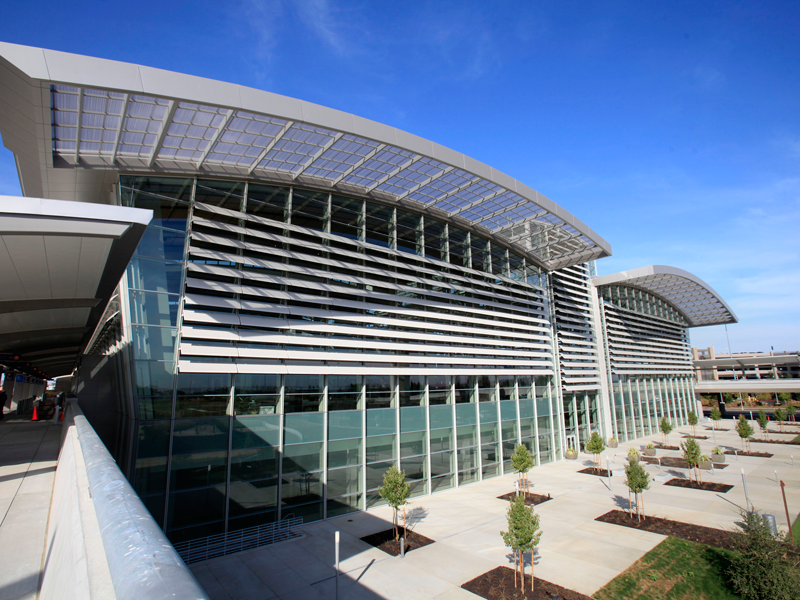
Sacramento International Airport has had a busy couple of years following the pandemic.
Last month, officials said SMF served a record 13,912,178 passengers in 2025. This marked a 2% increase over 2024 and also extended a streak of growth to 23 consecutive months, according to the airport.
Sacramento also increased its number of flights including new domestic connections to cities like Anchorage or Baltimore, as well as new international routes to Mexico.
But as these visitation numbers increase, SMF has also been working on refreshing the experience for travelers and preparing the airport for the future.
The $1.4 billion SMForward project announced in 2023 will make multiple infrastructure improvements to the airport, from a new pedestrian walkway and parking garage, to a concourse expansion and better baggage handling systems.
At the same time Sacramento International is also revamping its dining options, with plans to introduce a host of new locally-owned restaurants. And officials are also continuing efforts to launch new nonstop international flights in the coming years, with a particular focus on Europe.
Stephen Clark is the Deputy Director of Commercial Development at Sacramento International Airport. He spoke with Insight Host Vicki Gonzalez about what SMF plans to add this year.
This interview has been edited for length and clarity.
Interview highlights
How did last year’s traveler numbers compare to previous years, and what’s driving the growth?
In the year prior we had just under 13.5 million [people]. It’s a sustainable amount of growth — we’re not spilling out of the aisles. If you look at what’s going on [in] our region, Sacramento International obviously serves Sacramento, but we serve the eight counties that are around there as well. Actually 30% of our passenger traffic comes from Placer County.
What’s been unique as of last year is we brought 400,000 more passengers who would have used the Bay Area airports and brought them into SMF. This is actually something we’ve been really targeting… we call them a “battleground.” If you’re sitting in the middle booking your flight, and you have a choice where you can turn to the right and go to the Bay Area airports or you can go to the left [to SMF]. We want you to make the left choice.
How does SMF compare to other airports in California, or around the country?
If you look at SMF as it compares to California-based airports, we’re certainly bucking the trend. I think a lot of the California airports are just now kind of getting themselves back to pre-pandemic numbers. We’ve been in growth mode now for several years, we’ve already exceeded those pre-pandemic numbers.
If you look at the larger national picture, Sacramento falls in those mid-sized airports that are growing and we’re doing quite well. One of the most remarkable things is in the last three years, we’ve added on almost 20 new nonstop destinations. That’s a remarkable number no matter where your airport’s at, but for us to be a California airport it’s absolutely fantastic. It’s a testament to what our region’s economy is doing, as well as what the demand is for travel.
We’ve talked about nonstop flights before. What goes into locking down a route like that?
It’s like speed dating; it’s about working with the airlines and telling them what’s going on. One of the things that we continue to see is the diversification of our businesses and our residents, where they want to go, and [we’re] really working with the airlines to tell that story.
The good thing for us is that story continues to become more diverse. Helping get those flights that go to the East Coast. We saw even more international flights into Mexico, more leisure destinations. Our target is still to get that first-ever transatlantic international flight. That’s what we know the community wants — heck, I want that as well. But ultimately we have a portfolio that we want to serve nonstop, and we’re just going after it as aggressively as we can.
When you’re talking about transatlantic, would that be Europe?
I think Europe makes the most sense. You look at what our business community is, we are in the top five of the most unserved markets in the United States without a flight to Europe. Some of the businesses that are coming here — Bosch is a really natural one for us, in Roseville, that’s a natural connection. How can we connect these businesses that are coming into our community?
Also if you look at Rancho Cordova with Solidigm, those are businesses that are growing… they’re going to need to connect to Asia. And long-term, how does our airport system, Sacramento International specifically, support these companies and the region’s growing needs to connect into a global network?
What needs to change at SMF to make it attractive to have a nonstop international flight?
Runways and taxiways, we’re doing really good… we have the infrastructure. The big thing for us is getting our community behind it, making sure they’re going to support it. One of the big things that we have to be mindful of is [that] San Francisco is not far away, they have a ton of service. When an international carrier is going to serve a transoceanic flight, they’re going to spend $25+ million to support that operation, and they’re going to want to make sure that people are going to use that flight.
That’s one of the big things that we’re working with, those carriers. They see the traffic and the demand is there out of Sacramento, there’s more than a million travelers that live in our region that drive to the Bay Area and fly to Europe. We know exactly how many there are. We got to make sure we tell that story that they’re actually going to use that flight, because the worst thing we could do is get that aircraft, get those crews here, and then folks just continue to drive to the Bay Area. That’s just one way to really lose that relationship with the airline.
I would imagine there’s growing pains as well. Where are the pain points?
Any time you’re building large infrastructure, you have to be mindful that there’s going to be impacts. For us it’s about getting through those as quickly and as safely as we can. Where we’re seeing that is obviously in parking. When you have a service area that’s so large, people are driving in and they want to have that close-in parking. Unfortunately we can’t just build a parking garage overnight.
What kind of additions have you made to address the parking situation?
One of the things that we are very blessed with at Sacramento International is space. This last year we built a new south economy lot, which is just right off of I-5. It has direct shuttle service, so it doesn’t have multiple stops. It allowed us to really serve a need while we were building some of the other parking, and it’ll stay in the program long-term as well too.
One of the things that folks will see when they come out to the airport is the skyline is changing rapidly. Otto Construction has been building a brand-new parking garage, which is equal to the size of the existing garage. It is on schedule, on budget, to be completed by the fall of this year.
You’re also building a new pedestrian walkway, right?
This is another piece of operational resiliency. We know that if you’re using Terminal B, which is where Southwest, Alaska, many of our international carriers that we have now [operate]… the train can sometimes be a little bit of a pressure point for us, especially later in the evenings, you may have to wait for a few trains. The pedestrian walkway allows us to open that space. You can walk, there are movable walkways as well… we’re activating that space with more than $2 million of artwork as well.
We wanted to put $11 million worth of artwork into that entire [SMForward] program. There’s a little bit of local artwork, regional artwork, a call for national artwork. What you’re going to see as you go throughout the whole entire infrastructure, you’re going to see a little bit of all of it.
There are also new dining options coming to Terminal A and B, those were announced back in 2024 and seem to be taking shape now.
Absolutely, it’s probably the most exciting thing that you think about when you come into the airport. You want to experience a dining option that is the greater Sacramento region and we’re delivering on that every day now.
Airport food can be expensive, and the quality usually isn’t great. How are you accounting for that as you’re bringing in new restaurants?
It starts with culture. When we started this program going back even into 2022-2023, we wanted to work with local purveyors, local chefs because at the end of the day if they have the skin in the game, that food that they’re going to put on the table in front of you at the airport… we want it to be as similar as what you’re going to experience whether you’re downtown or in Roseville or anywhere else.
Step two, we wanted to change the paradigm about airport pricing, and that’s a really common thing to say. Airports are very expensive places to get food. We went back and looked at how we structured agreements at the airport for our food beverage operators, and the way airport agreements had worked in the past had been “street plus pricing.” Effectively what that means is the airport said, “concessionaire, you can charge $10 for this hamburger plus 15%.” We understand it costs more to operate at the airport because of the operating environment we have. We really threw that off the table and said, “we don’t want to do that here in Sacramento.” What we want to do in working with you is we want to allow you to create a menu that is for every wallet and every palate.
One thing I think is really important for folks to remember; there’s 4,000 folks who are working at the airport, myself included. We have to eat as well. There’s flight crew members. During the summer we had more than 200 non-stop flights a day. So how do we create a menu for everybody when we’re open from effectively 5:00 in the morning and the last flight’s at like 1-2 a.m. It’s really hard to serve all of those palates.
When will all of the restaurants be completed?
We will be done by the end of this year. Our goal is to actually have most of them, if not all of them, done before the holidays as well. That pretty much every single restaurant in the airport will have been turned over by that point and rehabbed, refreshed, the new experiences. So, it’s a really exciting time.
Local and state governments are facing tough budgetary years. How is the airport impacted by that?
The Department of Airports and Sacramento International, we are operated independent of any of the fiscal budgets. We don’t take any local taxpayer dollars, we’re a complete enterprise fund. We’re fully funded by the dollars that are generated at the airport. We’re very mindful of the dynamics that are occurring. We’re a department of the county, our colleagues are at the county. Nevertheless, we serve the broader community. One of the things that we work really hard to do is make sure that we at the department are ready to serve the economy of all of those counties.
Our track is to be ready, safe, efficient, and serve up a great experience for the passengers when they come through.