
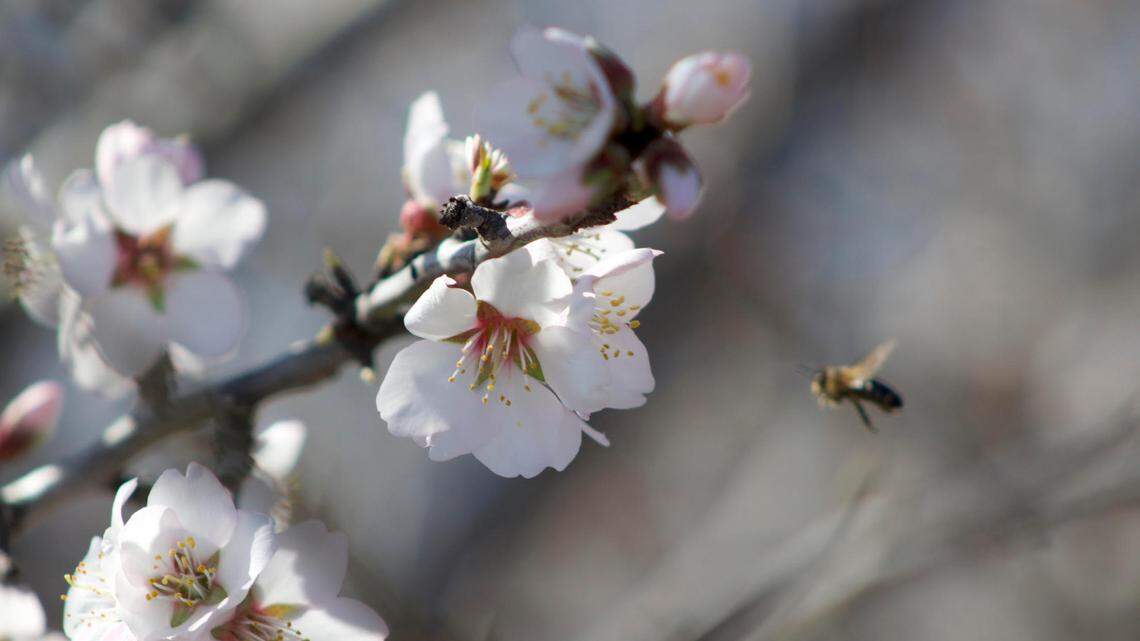
A honeybee buzzes between branches of an almond tree in one of Sarbdeep Atwal’s orchards on Friday, Feb. 14, 2025. The California State Beekeepers Association expects too few bees for California’s almond bloom due to a nationwide shortage.
Jake Goodrick
The Sacramento Bee
The nation’s honey bee population lost 55.6% of its colonies during the 2024-2025 season, the worst year on record, and Fresno-area almond growers are bracing for the fallout. As bee shortages worsen, thieves are also stealing hives by the truckload across the Central Valley.
• The varroa mite, a parasitic arachnid that spreads deadly viruses to bees, has wiped out about 60% of the nation’s bee colonies. Scientists and beekeepers call the 55.6% colony loss rate the highest ever recorded, according to a joint survey by the Apiary Inspectors of America, Auburn University and Oregon State University.
A bee flies near an almond bloom on Tuesday, February 28, 2017, at a Harris Farms almond orchard in Chowchilla. Häagen-Dazs is helps consumers learn about honey bees and how planting bee-friendly, drought-tolerant hedgerows around orchards can help create pollinator habitats for local crops through sustainable agricultural practices. SILVIA FLORES/THE FRESNO BEE SILVIA FLORES sflores@fresnobee.com
• California’s almond industry needs roughly 2.5 million bee colonies to pollinate about 1.4 million acres. Growers currently pay $185 to $210 per colony to rent bees, and those costs are expected to rise as the shortage deepens.
Bees play a vital role in the pollination of more than 1.5 million acres of almond trees in California. SILVIA FLORES Fresno Bee file photo
• Private investigator Rocky Pipkin estimates about 500 hives have been stolen statewide this year. Ryan Burris, president of the California State Beekeepers Association, said 80 hives were stolen in Fresno County and 120 in Madera, with losses potentially reaching 800 to 1,000 colonies.
• Beekeepers face pressure from multiple directions: shrinking pasture land for foraging, high fuel and labor costs in California, and foreign honey producers from India, Vietnam, Argentina, Brazil and Ukraine now supplying 74% of the U.S. market.
• Federal agriculture officials estimate bee-pollinated crops are worth more than $20 billion annually in the U.S. Almond farmer Christine Gemperle of Ceres said, “anybody who is reliant on bee pollination could be impacted by a shortage of bees.”
The summary points above were compiled with the help of AI tools and edited by journalists. The full story in the link at top was reported, written and edited entirely by journalists.
.jpg)
The Fresno Bee
Christopher Kirkpatrick is senior editor of The Fresno Bee and Vida en el Valle.