
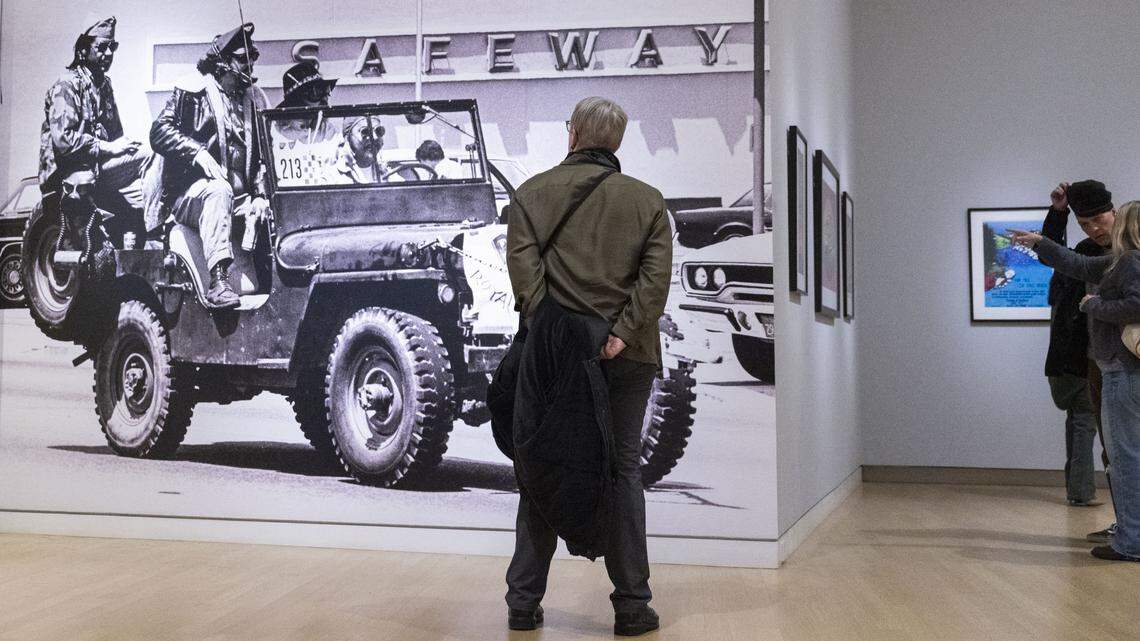
When Terezita Romo began planning three years ago for a Crocker Art Museum exhibition about the Royal Chicano Air Force she wasn’t thinking in political terms.
Romo, 73, is a longtime member of the Royal Chicano Air Force, or RCAF, an artist and social activist collective that began at Sacramento State around 1970. Its members produced posters, murals and even served as bodyguards for labor leader and civil rights activist Cesar Chavez.
Romo’s initial goal was to celebrate the RCAF’s history, as many members have died over the years, including co-founders Jose Montoya and Esteban Villa.
But over the past few years, the national political climate shifted.
“Now, it’s actually making sure that we don’t lose more ground in terms of… getting actually erased rather than just not known,” Romo said.
Erasure of the Royal Chicano Air Force appears unlikely in the Sacramento area. The Crocker exhibition Romo began working on three years ago, “Rebels With La Causa: Royal Chicano Air Force Art and Activism, 1970-1990,” opens Sunday and had a well-attended sneak peek Friday evening for museum members.
The exhibition is one of several around the Sacramento region this year as part of “InFormation: A Celebration of the Royal Chicano Air Force.”
How the RCAF began and what it did
Maria Elena Serna remembers the day her younger brother, Joe Serna Jr., brought Montoya, Villa and Ricardo Favela to meet their mother, Gerania Olvera Serna in Lodi.
It was about 1967 or 1968, Maria Elena Serna said. The Sernas were a family that worked in agriculture, about the time Chavez was beginning efforts to unionize farmworkers and a broader social consciousness movement was underway for Latinos.
Maria Elena Serna, 84, remembered the words her late brother – who would go on to serve as mayor of Sacramento before his 1999 death – had for their mother the day he brought Montoya, Villa and Favela to Lodi.
A campaign banner for Sacramento Mayor Joe Serna, an early Royal Chicano Air Force member, is displayed during the preview night for an exhibit about the group at the Crocker Art Museum on Friday. Serna died in 1999. HECTOR AMEZCUA hamezcua@sacbee.com
“He told my mother that he wanted my mother to meet some really, quote, good Raza guys,” she said.
More people would find each other in the coming years at Sac State, where Montoya and Villa came to teach the late 1960s. Joe Serna Jr. began teaching there at about the same time. Favela became a student. So did Rudy O. Cuellar, who traced his involvement with RCAF to when he came to Sac State in 1971.
An alter in honor of some of the late Royal Chicano Air Force members at the “Rebels With La Causa: Royal Chicano Air Force Art and Activism, 1970-1990,” exhibit at the Crocker Art Museum on Friday, Feb. 20, 2026. HECTOR AMEZCUA hamezcua@sacbee.com
“There was a group of young artists that were all there in the art department, Mexican Chicanos and we threw our own show,” said Cuellar, 75.
The group would maintain ties to the academic world.
“Many of us believed that education was critical to change and enlightenment and all of those associated ideas,” early member Juan Carrillo said.
At first, Romo said, the group called itself the Rebel Chicano Art Front. When people began to confuse the group’s initials with the Royal Canadian Air Force, the group rebranded itself Royal Chicano Air Force.
The RCAF provided hospitality to newcomers by design, explained early RCAF member Luis Gonzalez during an interview at Friday’s event at the Crocker.
“One thing you learn in a movement where the odds are against you is you have to embrace everybody,” Gonzalez said. “You can’t turn anyone away.”
From early on, the group forged connections with the United Farm Workers, which Joe Serna joined in the mid-1960s. RCAF members produced posters that helped establish the UFW’s public messaging.
Of the 95 pieces in the Crocker exhibition, Romo said most are posters the RCAF produced from 1970 to 1990.
Close ties to UFW helped pave the way for RCAF to serve as bodyguards to Chavez. Longtime RCAF member Juanita Polendo Ontiveros, who was also involved with the UFW, said that while Chavez had personal bodyguards with him 24 hours a day, he trusted the RCAF and used them for security for large events.
“From the very beginning, he always let his hair down with the artists,” Ontiveros said.
The collective played an important social role, with the Sacramento History Museum noting that RCAF “members initiated the city’s first Día de los Muertos observance in 1975.”
RCAF members also produced serious artistic work, including an iconic mural the collective painted at Southside Park in the 1970s.
Former Sacramento State art gallery and collections curator Kelly Lindner is glad that there are an array of events going on to celebrate the collective.
“There are so many facets to the Royal Chicano Air Force in terms of their approach for both art-making and community building, education and so trying to encompass that all in one exhibition actually isn’t really possible,” Lindner said.
Woodland Community College professor Manuel Fernando Rios curated “R.C.A.F. Mid-Flight: The Artwork and Influence of the Royal Chicano Air Force,” on display at the Verge Center for the Arts in Sacramento through March 22. He said he was pleased to see a wide celebration of the RCAF.
Family members of the late Ricardo Favela stand in front of some his art work at the “Rebels With La Causa: Royal Chicano Air Force Art and Activism, 1970-1990,” at the Crocker Art Museum on Friday. HECTOR AMEZCUA hamezcua@sacbee.com
“They’re so important to the region, but at the same time, there’s so many people who still don’t know who they are,” Rios said.
There are 16 partner groups in total participating in the series of exhibitions or events for RCAF this year, according to Romo. These groups include the California State Library, SMUD Art Gallery and the Sacramento Poetry Center. Montoya was Sacramento’s poet laureate from 2002 to 2004.
The different events are a source of joy for people like Gema Godina, whose late father Frank Godina was a member of the RCAF.
“Particularly with everything that our community is facing right now, it’s joy, it’s resistance, it’s art,” she said.
A packed night at the Crocker
Stan Padilla, another early RCAF member, was struggling to get the attention of everyone in the room at Friday’s event at the Crocker.
There were as many as 300 people on hand, packed into a space on the ground floor. Some people were listening intently to Padilla, who came in from Colfax for the event. Others were having conversations in the back.
“It took us 50 years to get here,” Padilla told the crowd as he was trying to quiet the room, which drew applause.
The night resonated for many people, including Sacramento resident Melanie Slade, who said she was “so in awe of all the work that I see.”
Kayla Reynolds, an art history senior at Sac State who is working to catalog the art of late RCAF member Armando Cid, said it was “really amazing to see people come together, especially with such an old movement that has deep roots here.”
Raquela Mejia, a board member for the Latino Cultural Center, said it made her proud to see the night’s unity.
“We’re all walks of life here, if you look around,” Mejia said.
After he spoke to the room, Padilla said he appreciated the diverse crowd that the night attracted .
“We’re all educators and so to see the new face of Sacramento, it’s inspiring that we did something and it affects people,” Padilla said.
Follow More of Our Reporting on In the Spotlight
The Sacramento Bee
Graham Womack is a general assignment reporter for The Sacramento Bee. Prior to joining The Bee full-time in September 2025, he freelanced for the publication for several years. His work has won several California Journalism Awards and spurred state legislation.