
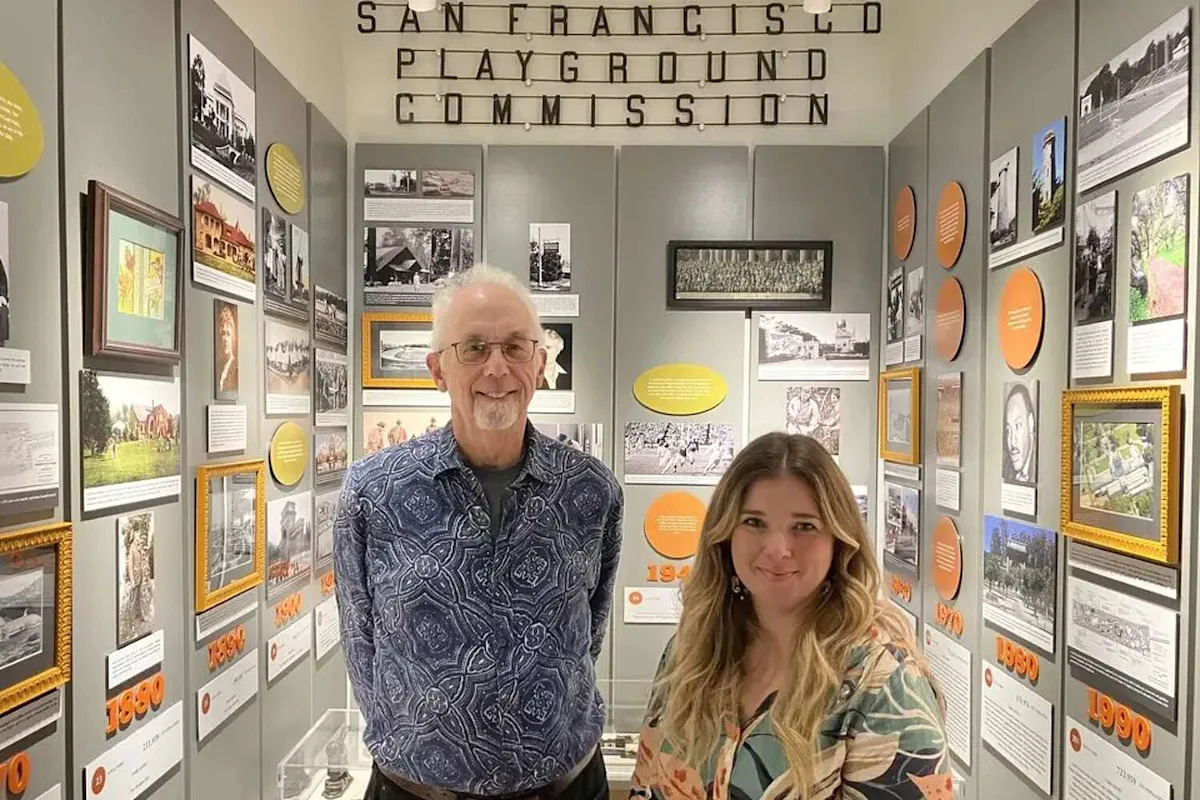
There have been museums in Golden Gate Park since 1895, but not until now a museum about Golden Gate Park. That finally changed when the Commission Vault Museum launched inside the old steel vault at San Francisco Recreation and Park Department headquarters in McLaren Lodge.
The display, which covers the entire history of city parks within a 6-by-10-foot room, had a very soft opening in December. Because the museum capacity is five people and the pent-up demand goes back 130 years, the opening was intentionally kept soft.
The big bank vault doors swung open on the evening of Dec. 4, when all attention was out the window, at the lighting of the city Christmas tree outside McLaren Lodge. Since then about 75 people have come through the exhibit, which is impressive given that there has been no public announcement of the museum and there are no operating hours. It takes an appointment to visit the vault, which can happen only when the attached conference room is not in use. The collection is in the form of tickets to Fleishhacker Playfield and Pool, brochures for Camp Mather, postcards, and black-and-white action photos of the San Francisco 49ers playing at Kezar Stadium and the Giants at Candlestick Park.
“Standing in that small vault, surrounded by fragments of our past, you feel the continuity of it all,” said Rec and Park interim General Manager Sarah Madland. “In every era, San Franciscans have cared deeply, often fiercely, about their parks. That devotion is a throughline in our civic life, stretching from the Victorians to today.”
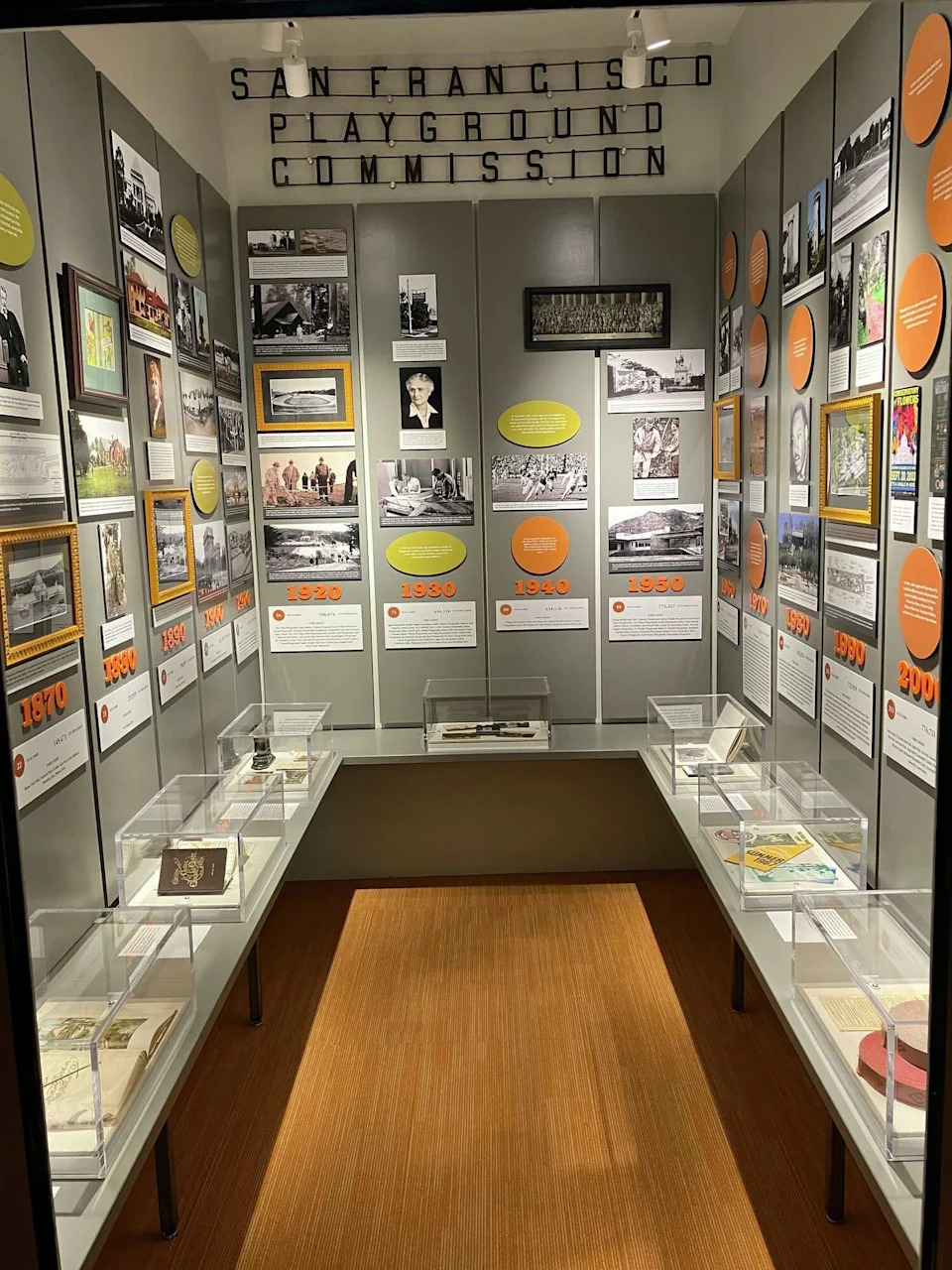
The new museum at Rec and Park headquarters in Golden Gate Park has a capacity of only five people, and reservations are required. (Sam Whiting/S.F. Chronicle)
The collection, which chronicles that throughline through the context of the history of the Rec and Park Commission, consists of 125 objects and pictures packed in tight as if it were an overstuffed closet, which it essentially was. Cabinet drawers and boxes held all of this ephemera until Ashley Summers, liaison for the Recreation and Park Commission, decided to digitize the records held in the filing cabinets and boxes. Summers got the idea to bring the collection into the light and passed it by Rec and Park Commission President Kat Anderson, who was all for it.
“The idea was brilliant,” Anderson said in a phone call from Truckee, where she had been snowed in for nine days. “I’m a history buff, so I immediately approved it. The museum is the right thing to do in order to preserve the rich history of the commission and the department.”
That history goes back to the turn of the 20th century, when the city had separate agencies overseeing the scope of parks. There was a Playground Commission, established in 1907, which expanded into the Recreation Commission in 1932. In 1950, that commission and the separate Park Commission merged to form the present day Rec and Park Commission, a seven-member board that oversees the operation of the Recreation and Park Department.
Originally the commissioners met under the chandelier in the distinguished wood- and leather-paneled meeting room of McLaren Lodge, which was built in 1896 to be the home of park Superintendent John McLaren. Over time, the meetings were moved to City Hall, but the records, which had been held in a bank vault where cash receipts from park concessions were originally stored, did not make the move.
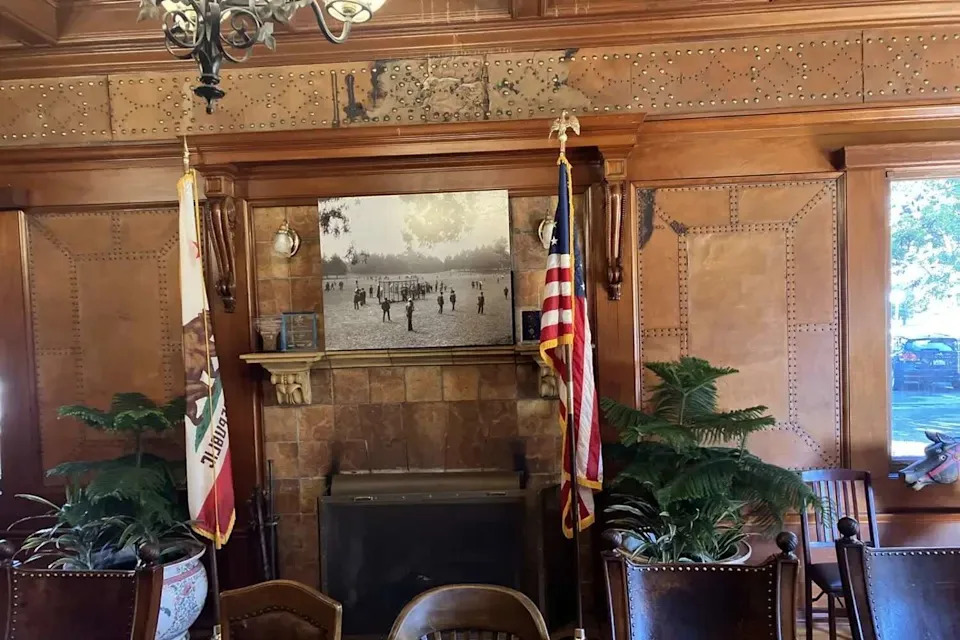
Water damage above the fireplace in the historic meeting room at McLaren Lodge. (Sam Whiting/S.F. Chronicle)
When Summers set about to digitize the records, she found an advertisement for a Golden Gate Park concert from the late 1800s, an indicator that there were works on paper that were too important to shred or file back away.
“We’ve been having concerts and music here for 130 years,” she said. “It’s really inspiring.”
Summers consulted Christopher Pollock, historian in residence for Rec and Park, and the two of them put together a budget for less than $10,000, which was approved by outgoing General Manager Phil Ginsburg. Summers and Pollock did all of the work except for outsourcing constructions of the cases. City painters, electricians and carpenters built shelving for the display and put up panels to warm the walls of steel. The only way to book a tour for now is through email at recpark.commission@sfgov.org.
The Commission Vault is the first museum to open in Golden Gate Park, or any city park, since the California Academy of Sciences moved from Market Street in 1916. The McLaren Lodge meeting room, which is the only way to access the museum, was earmarked last week for $49,000 in work to repair water damage.
The display Summers and Pollock created breaks the history of the parks down by decades, with a timeline going back to 1850. Each decade is marked by a listing of the parks in the system at the end of that decade, starting in 1860 when there were 14 parks. The timeline runs up through 2025 when there are 230 parks.
“The least expensive way was to use photographs to illustrate the important points on the timeline,” said Pollock, who ended up with about 125 images, all reproductions culled from the collection of the San Francisco Public Library and the Library of Congress, among other sources.
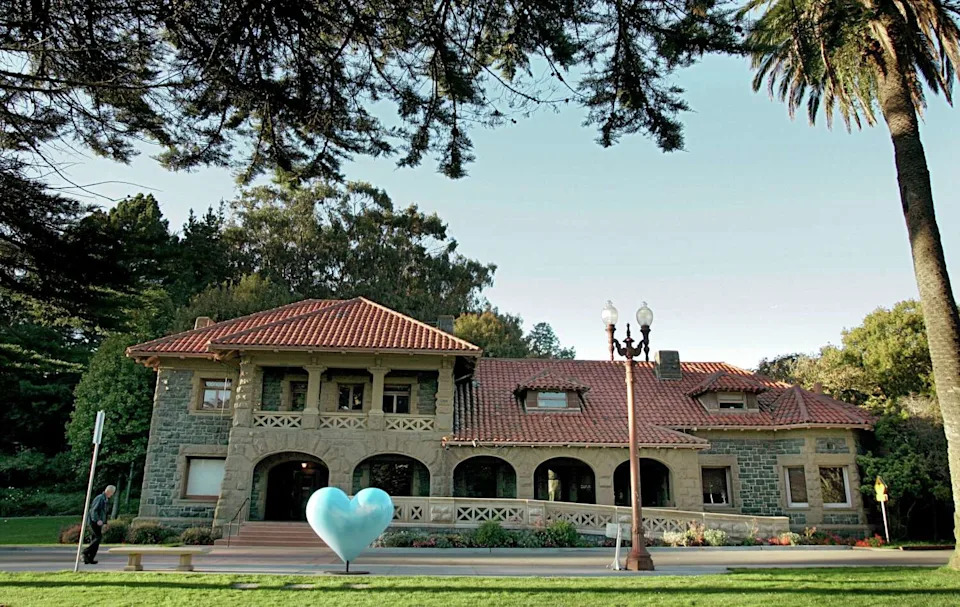
An exhibit inside the former vault at McLaren Lodge details the history of the Recreation and Park Commission as it grew to oversee 230 city parks. (Chris Hardy/S.F. Chronicle)
Among these photos are three historic pieces – a metal sign from the original San Francisco Playground Commission, estimated to be 100 years old, a new wooden sign to promote the newly opened Sunset Dunes, and a vintage photo of bison in their paddock, circa 1900.
“There is a huge variety within the overall exhibit,” Pollock said, “that illustrates administrative changes, funding changes and other important events. When I walk in I see a riot of information in front of me that tells the story of how the commission created all of these parks.”
In all, it took a year to get the display cases built and all the print work done and installed. When commission President Anderson saw it for the first time, she spent half an hour and would have stayed longer but her fellow commissioners were piling up at the door, waiting to get in.
“I was bowled over,” she said. “The museum’s timeline perfectly coincides with the city’s existence. When you step into it you are stepping into a giant time capsule and you are interacting with it.”
This article originally published at ‘Giant time capsule’: Tiny museum showcases vast history of San Francisco’s parks.