
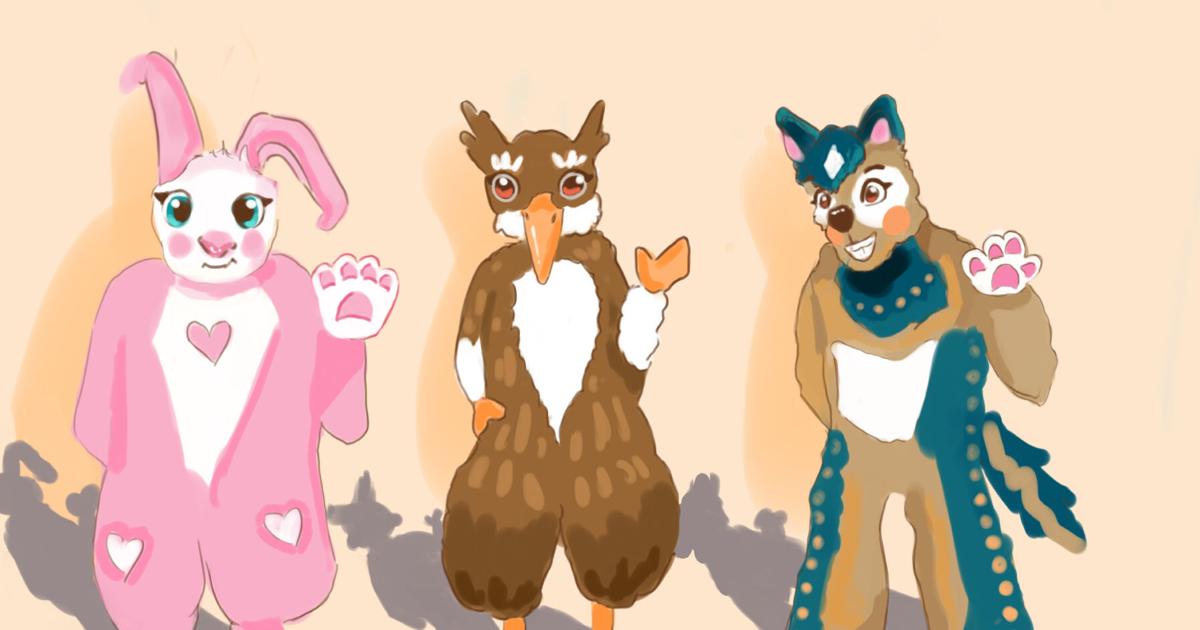
It doesn’t take long for the bustling crowds on Sproul Plaza to surround a dancing blue wolf and a purple tiger. People flock to these characters, giggling with excitement and a touch of irony, eager for a photo with the infamous UC Berkeley furries.
Furries are fans of media portraying animals with human characteristics, often wearing fursuits, crafting personalized fursonas — characters invented by a furry to represent themselves to the community — and roleplaying as those fursonas. Through online spaces and in-person conventions, the community serves as a space for judgment-free social interaction, individual expression and fun.
There is a clear, genuine interest in interacting with the anthropomorphic animals on Sproul, but beneath that joyful interaction lurks a tone of mockery reminiscent of grade school bullying. Like the distant kindness offered to “weird” kids, a joking undertone underscores every interaction, acting as a constant reminder that their strangeness deserves pity and contempt rather than acceptance. After all, it would be horrible to be accused of being a furry.
But our discomfort with furries is simply rooted in their unabashed challenge of social norms.
Furries wear extravagantly bright fursuits that attract rather than divert attention. They proudly announce their membership in the community, expressing their fursonas as loudly as they can.
In a society where we are punished for standing out, furries go against everything we are taught. Even at UC Berkeley, where we pretend to be the haven of alternative culture, furries diverge from the norms we have set for what constitutes alternative and into what is seen as “weird.” So to induce catharsis in ourselves, we cringe for them.
On the surface, people justify their discomfort about furries with accusations of bestiality that have long tainted the furry community. Despite there being a presence of furry porn and fursuit sex in the community, bestiality is not an accepted or normalized part of furrydom.
The presence of these forms of sexuality, however, can seem so bizarre to people that they attribute bestiality to all furries. Due to norms reified over centuries of sexuality needing to be presented through specific, trendy outfits and hairstyles, someone’s potential attraction to a fursuit is seen as problematic. These standards of sexual expression limit kinks and sexual practices that diverge from the norm.
Additionally, most non-furries are not familiar with the microcosm of the online furry space and may not see the ways that can alleviate social anxiety or gender dysphoria by providing a disconnect from one’s actual self or understand the creativity behind furry art. They may not understand the fun and escapism being a furry provides, especially for queer and neurodivergent people who don’t feel comfortable interacting in more normative spaces.
To understand furries, one must risk engagement with them, which marks you as “one of them.” So the only way to grapple with a lack of understanding is ridicule — to clearly mark yourself as different.
Our other option is to swallow the embarrassment and realize that it was never necessary for it to be there in the first place — to allow the strangeness of someone in a fursuit having fun infect you. To do that, though, you have to act like a little bit of a furry; you have to be the one who’s cringe. On top of that, you have to know that you’re cringe, that you’re placing yourself in a spot extremely open to ridicule.
In reality, the only “funny” thing about furries is that they’re different and proud about it. We inherently desire uniformity to fit in, and people are afraid that they will be cast out of their social circles if others sense that there’s something different about them. Social norms of conformity affect all of us, and we end up hurting ourselves and each other when we perpetuate them by considering non-normativity “cringe.”
Furries aren’t unaware of their “cringe.” The discomfort around furries mirrors what many of them have to feel in outer, non-furry society. They take their weirdness back into their own hands by proudly marking themselves as different from the rest of the crowd — but this time, they’re in control of why and how.
Now more than ever, we need to push back against a return to normative ideals if we want to maintain the freedom to express ourselves as we wish. Furries are part of that effort, and discomfort surrounding them only feeds into a larger worldview that non-normativity is something to suppress instead of celebrate. We cannot limit the extent to which we accept non-normativity, as this will only lead us to exclude more and more people from our respect.
We cannot tolerate a culture of freedom of expression and open acceptance while simultaneously rejecting certain communities that challenge the limits we set on what constitutes alternative.
We could all learn a lot from furries. We could learn to be more genuine and accepting of people, no matter how easy it is to crack a quick joke about them. We could learn to be more cringe. We could learn that just because something is different doesn’t mean it’s not worth taking seriously.
Because what’s actually all that funny about furries?