
MEXICO CITY — A top-secret special forces operation that killed the world’s most wanted drug trafficker Sunday was meant to highlight the Mexican government’s prowess in combating crime.
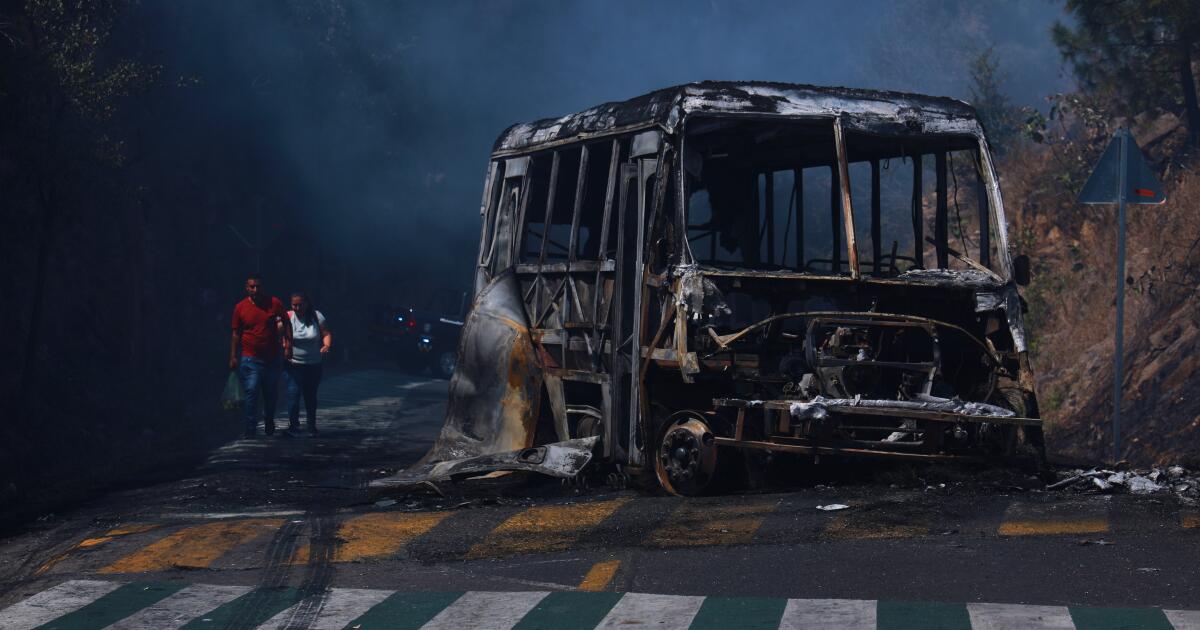
But retaliatory violence by angry cartel members who burned cars, killed dozens of soldiers, and spread mayhem in 20 of Mexico’s 32 states, instead sparked widespread fear about the vast reach of organized crime in the country.
Mexican President Claudia Sheinbaum had sought to quell fears Monday after mayhem erupted over the killing of a long-elusive cartel kingpin: Nemesio Rubén Oseguera Cervantes, known as “El Mencho.”
“The country is at peace,” Sheinbaum told reporters at her daily news conference in Mexico City on Monday. “It’s calm.”
But many Mexicans worried about continued violence.
Schools were closed Monday in some states and some flights remained suspended at the beach resort of Puerto Vallarta in the state of Jalisco, where Oseguera based his sprawling criminal enterprise. The U.S. State Department on Sunday warned Americans in Jalisco and four other states to shelter in place until further notice.
Omar García Harfuch, Mexico’s top security official, said 25 members of the National Guard had been killed in six retaliatory attacks by organized crime. He said 34 criminal suspects had been killed in the mayhem, along with a prison guard, an agent from the prosecutor’s office and one civilian.
Mexican Defense Secretary Ricardo Trevilla Trejo revealed new details of the operation targeting Oseguera, 58, a shadowy figure who founded and led the notorious Jalisco New Generation cartel, which traffics fentanyl, methamphetamine and cocaine to the United States.
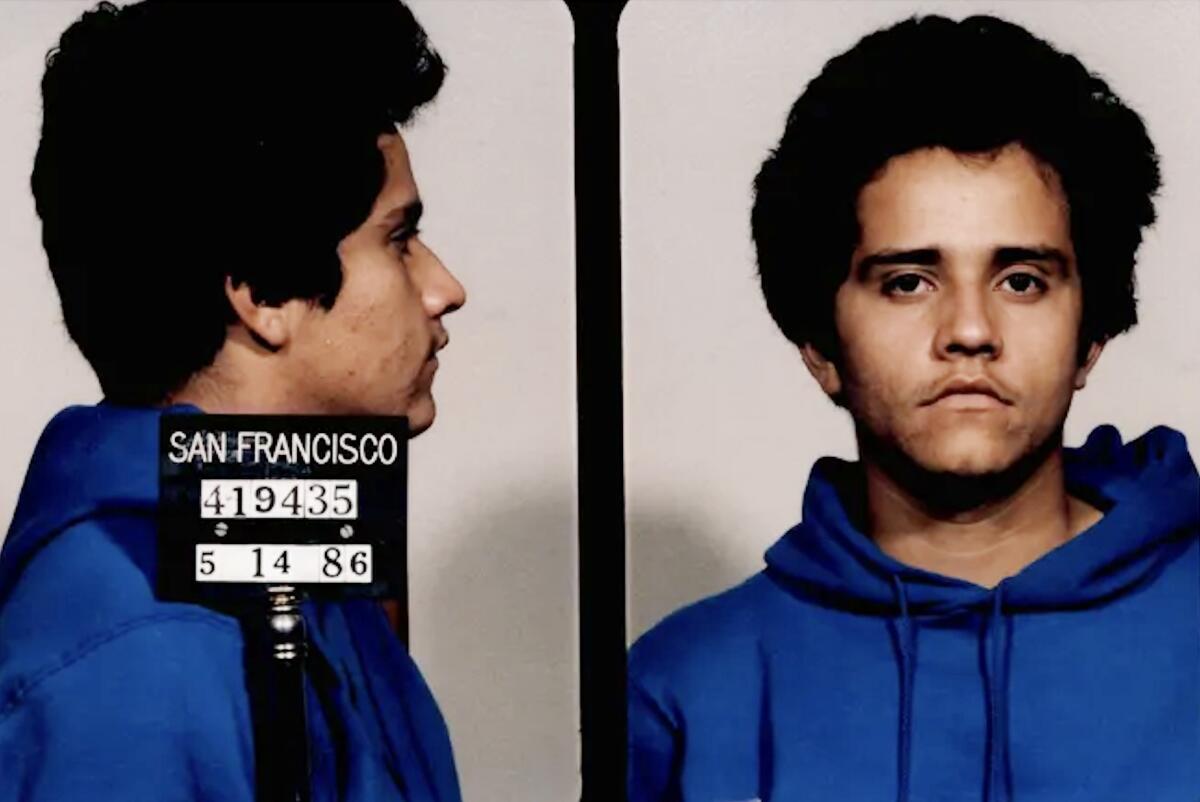
A 1986 booking photo of Nemesio Oseguera Cervantes, the cartel boss known as “El Mencho.”
(DEA)
Trevilla said that in recent days, Mexican intelligence officers had identified the mountain hideout where Oseguera had been living by tracking the movements of his “romantic partner.”
As troops approached Oseguera’s compound near the town of Tapalpa on Sunday, cartel operatives opened fire in what Trevilla described as “a very violent attack.”
A gun battle broke out between soldiers and cartel henchmen, and Oseguera escaped. Troops established a perimeter around the compound, and later discovered the drug lord hiding in nearby woods.
He and two of his bodyguards were seriously injured. The three were transported by helicopter to the nearby city of Morelia but died en route, Trevilla said.
An arsenal of guns, rocket launchers and grenades was found at Oseguera’s compound, two hours south of the city of Guadalajara.
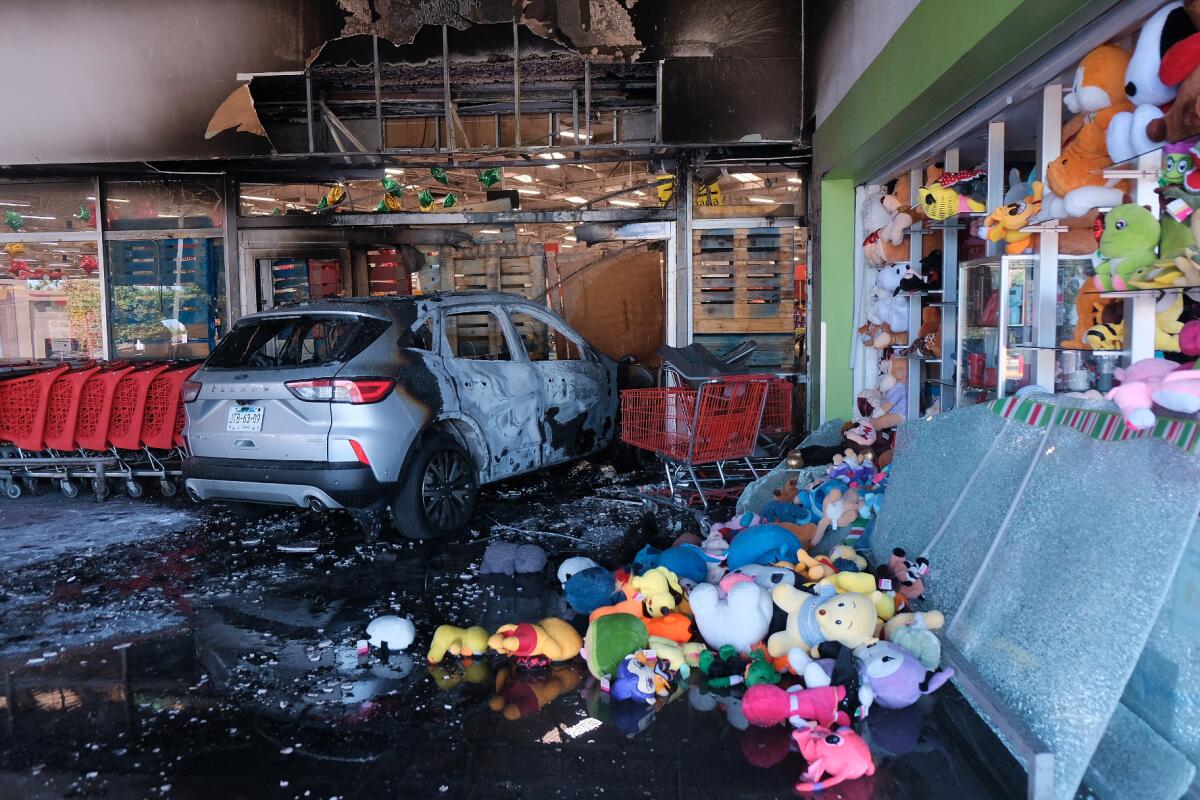
A burned-out vehicle in Guadalajara.
(Alejandra Leyva / Associated Press)
Elsewhere in Jalisco, soldiers killed another high-ranking member of the cartel whom Trevilla accused of orchestrating violence by offering hit men more than $1,000 for every soldier they killed.
The military operations triggered retaliatory attacks in Jalisco and more than a dozen other states where the cartel has a presence, with gangsters blocking roads with burning cars, torching gas stations and storefronts, and opening fire on security personnel. It has become common for cartels to try to sow chaos in an attempt to disrupt military actions.
Officials insisted the violence had eased, and Sheinbaum said she expects schools and flights to resume by Tuesday. “We awoke today with no blockades,” Sheinbaum said. “All activity has practically been reestablished.”
The government has sent thousands of soldiers to Jalisco to reinforce security there, and is ready, officials say, to combat additional violence that may arise as top remaining leaders of the cartel jockey for power. “We’re prepared for this,” Harfuch said.
Trevilla said that while U.S. intelligence played a role in the operation, it was Mexican officials who identified Oseguera’s hideout and planned and executed the attack.
“In this case there was information provided by the United States,” Sheinbauam said. “But the entire operation from its planning [stage] was the responsibility of federal forces. “
Said Trevilla: “Mexico has solid institutions. … Trust in your government.”
“What was demonstrated?” he added. “The strength of the Mexican state, of that there is no doubt.”
Oseguera’s death is the most significant takedown of a Mexican capo since the 2016 capture of Joaquín “El Chapo” Guzmán, former head of the Sinaloa cartel. El Chapo was extradited to the United States and is serving a life sentence in a U.S. prison.
The operation comes as Sheinbaum faces intense pressure from the Trump administration to crack down on U.S.-bound drug trafficking. Last year, the White House formally designated the Jalisco cartel as a foreign terrorist group. Trump has threatened to increase tariffs on Mexico — and carry out unilateral U.S. military actions in the country — if it does not do more to combat traffickers.
U.S. officials applauded Mexican authorities for Sunday’s operation. “This operation underscores a clear reality,” U.S. Ambassador to Mexico Ron Johnson said in a statement. “Criminal organizations that poison our people and threaten our nation will be held accountable.”
Johnson said that under Trump and Sheinbaum, “bilateral cooperation has reached unprecedented levels.”
Under Oseguera’s leadership, the Jalisco cartel vastly expanded its reach in Mexico, especially after the downfall of El Chapo, which weakened the once-dominant Sinaloa cartel.
Jalisco operatives have aggressively invaded the turf of other gangs, incorporated smaller criminal bands into its ranks and put legions of police officers, judges, prosecutors and politicians on its payroll.
Linthicum reported from New York and McDonnell from Mexico City.