
“We are bringing in another third party that’s focused specifically on how we can improve our restoration time estimates during large localized events, particularly when operating conditions are otherwise normal,” said Sumeet Singh, PG&E CEO, at the Feb. 12 hearing. “But in the meantime, we have already implemented a rapid escalation process for large-impact localized events.”
City leaders have called for a public utility option for years, but have struggled to push through the utility giant’s lobbying efforts and legal challenges.
Wiener’s bill aims to allow cities to break with companies like PG&E through a variety of reforms, including creating enforceable timelines to block excessive delays and limiting the California Public Utility Commission’s review process.
“In existing law, there is a 180-day deadline for the CPUC, which it has missed, and that is unacceptable,” Wiener said.
The bill, which will head to the state energy and utility committee sometime this spring, could face an uphill battle in the Legislature. Wiener previously put forward legislation that aimed to make all of PG&E a publicly-owned utility, but it failed to gather enough support.
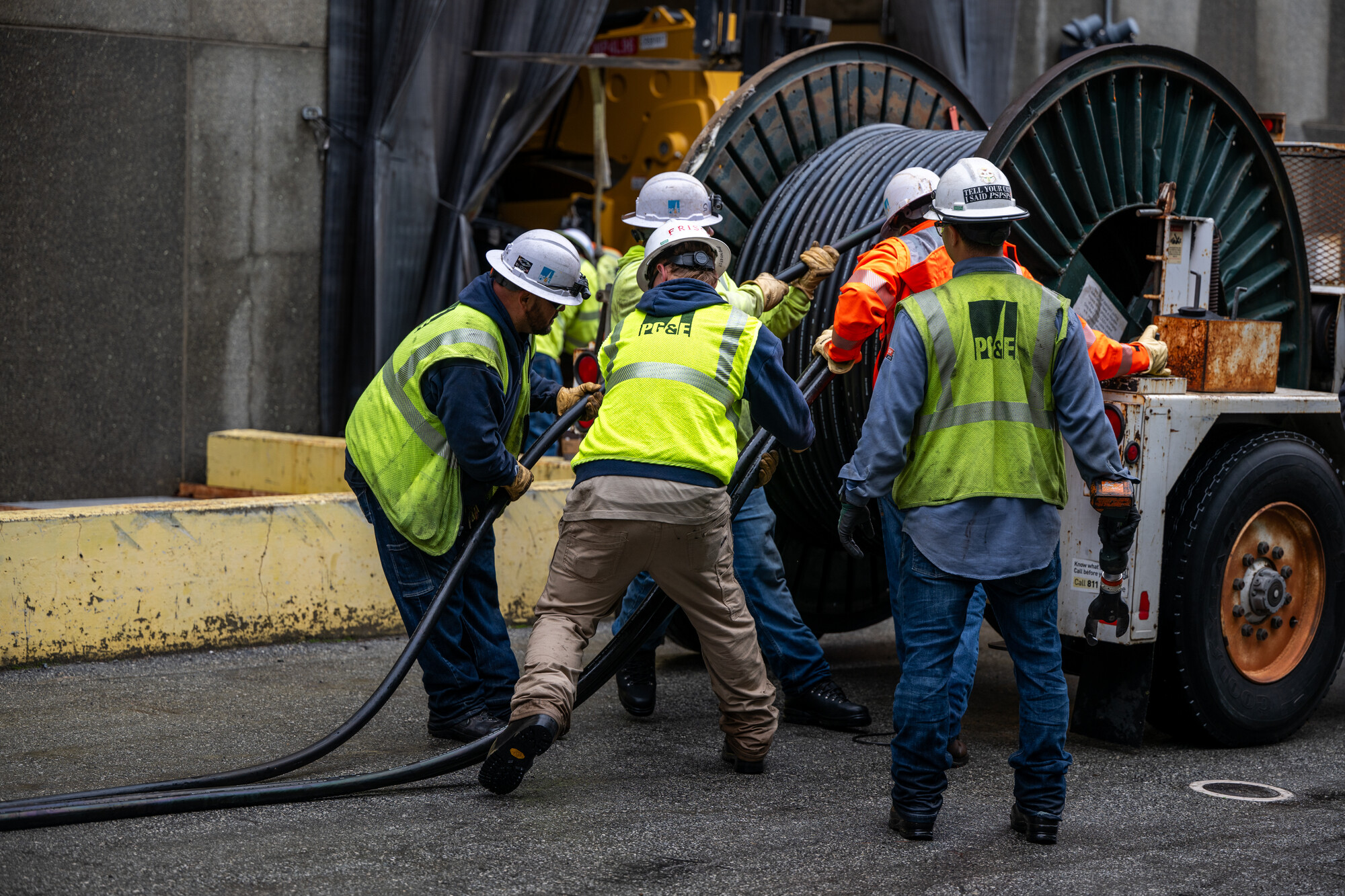 PG&E employees work to repair a substation on Mission and 8th streets in San Francisco on Dec. 22, 2025, after a fire at the site over the weekend contributed to a major citywide power outage. (Beth LaBerge/KQED)
PG&E, which serves 16 million people across Northern and Central California, has long caused controversy in the state over its safety record. Some state lawmakers, particularly after PG&E equipment sparked devastating wildfires in 2018 and other years, have expressed interest in a statewide takeover of power utilities like PG&E, which filed for bankruptcy in 2019.
Officials in San Francisco on Monday said, despite the setbacks in earlier attempts to reform the legal system around municipal power, they plan to push ahead.
Supervisor Rafael Mandelman plans to introduce a resolution at the Board of Supervisors on Tuesday in support of Wiener’s bill.
The board is also likely to pass two additional resolutions related to PG&E, one reaffirming the city’s support to acquire the power company’s infrastructure and another holding PG&E accountable for the recent outages.
“All across the Board of Supervisors, I think this is something that we are all in agreement on,” Supervisor Matt Dorsey said. “It’s time to municipalize these assets and have a public power system that delivers for rate payers rather than shareholders.”