
Whenever a new train line or extension is built in Los Angeles County, the obvious benefits include giving people an alternative option for getting around, while removing single-passengers cars from crowded freeways.
But often what gets overlooked is the economic boost from such massive projects. It’s a boost that leaders say will impact where people decide to live and where they will commute to and from.
A recently released report on the 2.3-mile A (formerly Gold) Line light-rail extension from Pomona to Claremont estimates a $1.1 billion jolt to the economy of L.A. County during seven years of construction, supporting 4,760 jobs that produce $481 million in labor income.
Local, state and federal government coffers would see a combined $154.2 million in tax revenues, including $20 million going to the county.
Also, during operation of the extended line just looking at a three-year period, the economic boom would continue. Based on trains running every eight minutes, the running line extension would add $460 million to the county’s economy and $124 million in total tax revenues. That increases to $553 million and $149 million, respectively, with five-minute headways.
The eight-minute train cycle would add 1,191 jobs — slightly more if the trains ran five-minute time frames as that requires more workers.
All these numbers — and more — are pulled from a report by the firm Kleinhenz Economics, titled: “Economic Impact of the Claremont Extension of the Metro A Line on the Los Angeles County Economy,” released by the Foothill Gold Line Construction Authority last week, the people overseeing this extension.
“This project is more than just a rail line; it is an economic catalyst for Los Angeles County,” stated Construction Authority board chair and Claremont Vice Mayor Ed Reece in a prepared statement. “Connecting Claremont to the Metro A Line represents a transformational investment that will create thousands of high-paying jobs, generate substantial tax revenues and provide lasting economic benefits for generations to come.”
The report found what’s called a multiplier effect: For every $1 million spent operating the extension to Claremont, the project would generate $7.6 million in total economic output to L.A. County. While building it, the multiplier is $1.6 million for every $1 million spent from 2026 to 2032.
And the Construction Authority is spending $798 million to build this extension, money received from LA Metro, which runs the line and would run the extended portion as well. The construction funds for the project come from the California State Transportation Agency (CalSTA), via the state’s Transit and Intercity Rail Capital Program (TIRCP).
How does this multiplier effect for economic additives work?
Take all the workers building the line who are earning more income as a result; a portion of their income is spent in the county economy, something Kleinhenz analysts call the “induced expenditure effect.” The average annual wage of these jobs across the construction period is $101,130 — higher than the median earnings for workers in LA County of $62,140.
These are jobs in construction, architecture, engineering and related professional services. Also, other parts of the economy share the wealth, such as food services, health care, retail and personal/family services, the report said. The taxes collected are significant, especially for L.A. County, hard-hit by federal and state cutbacks and inflationary pressures.
Taking a step back, the Construction Authority over the past 26 years has built 34 miles of this light-rail line: From Union Station to Pasadena in 2003; Pasadena to Azusa in 2015 and Glendora to Pomona in 2025, which opened on Sept. 19.
The station at Claremont will be the second one on the A Line that also has a Metrolink Station, the other is Pomona. This convergence may increase the transfer of Metrolink riders coming from the Inland Empire to ride the light-rail line beginning at these A-Line stations.
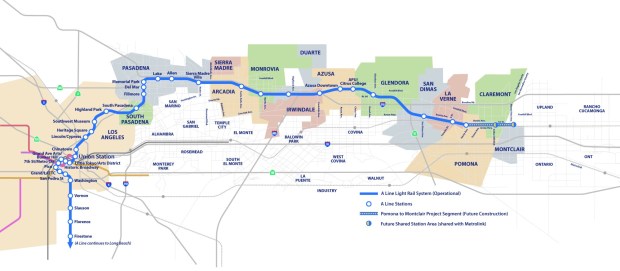 A broad look showing the long, A Line light-rail, including the future station in Claremont, on the eastern edge of Los Angeles County. (image courtesy of the Foothill Gold Line Construction Authority).
The A Line, which was connected to the former Blue Line to Long Beach and added stops from the Regional Connecter in downtown LA is currently is 57.6 miles long with 48 stations, the longest light-rail line in the nation.
It runs from Long Beach to Pomona, with stops in South L.A., downtown L.A, Chinatown, Highland Park and Pasadena, and continuing with stations in the San Gabriel Valley foothill cities.
Adding the next station at Claremont would bring the train line to nearly 60 miles long, with 49 stations.
“The study confirms what we have always seen throughout the various extensions of the Metro A Line from Los Angeles through the San Gabriel Valley – that the return on investment from the project is significant,” added Habib F. Balian, Construction Authority CEO in a prepared statement.
“The long-term economic effect of the Claremont extension will go far beyond what is included in this report; it will change where families decide to set down roots, where businesses locate and invest, and how and where jobs are created.” he added.
What is not studied in this economic report is worth noting.
For example, transit-oriented-development, where apartments and condominiums have been built alongside train stations in Northeast L.A. (in Highland Park and Chinatown, for example), and in Pasadena and Monrovia, will spread to the east as more interest arises from people who want to live near a train station to get to and from work or entertainment venues via train.
The report does not examine future transit-oriented-development or any other real estate development. It also did not look at economic activity from riders who “are likely to purchase food, retail; goods and services near Metra A Line stops,” nor increased sales at nearby businesses.The report did not monetize environmental benefits, namely less traffic on the 10 and 210 freeways and vehicles producing fewer air emissions.
It also does not measure economic impacts in San Bernardino County. The line was planned to reach into Montclair across the county boarder, but the San Bernardino County Transportation Authority voted down their portion of the project in September.
A report released in August estimated the economic input during construction in San Bernardino County would have been $112.3 million.