
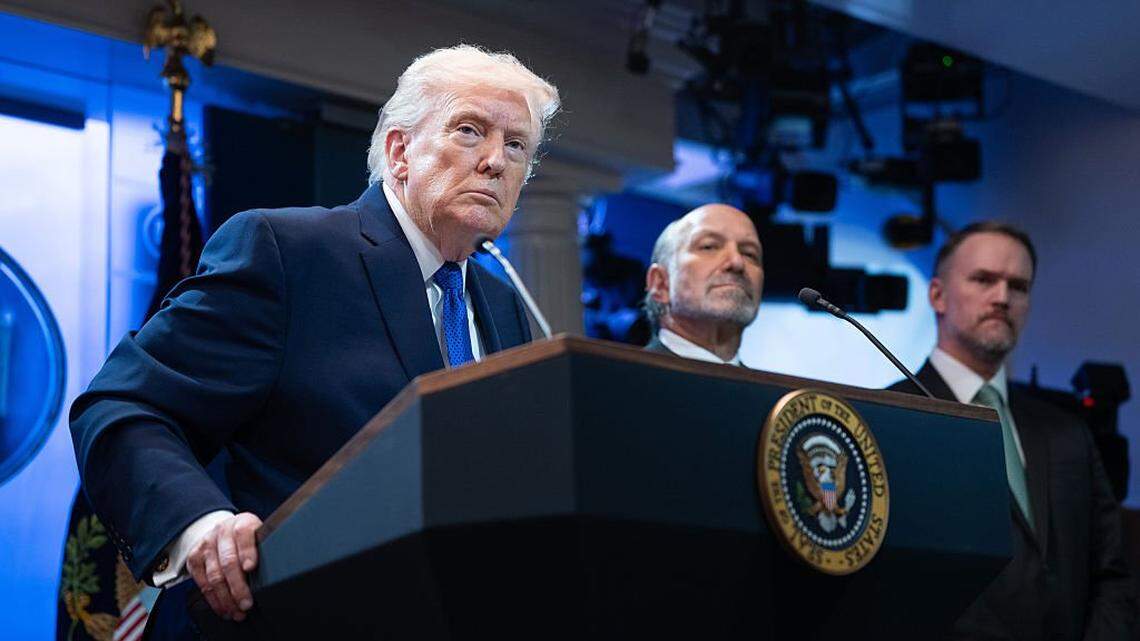
President Donald Trump answers questions during a press briefing held at the White House February 20, 2026 in Washington, D.C., after the Supreme Court ruled against his use of emergency powers to implement international trade tariffs.
Aaron Schwartz
Getty Images
On Saturday, President Donald Trump announced his plan to increase the temporary global tariff, known as Section 122 tariffs, from 10% to 15%, as he continues to push back against the Supreme Court decision that struck down his “reciprocal” duties on imports.
For California’s clean energy sector, this means largely reverting to the status quo ante — restoring a broad, blanket tariffs layer on top of the steep, targeted duties that have already been driving up the cost of solar panels, metals and other equipment, according to an expert.
“The new proposal to replace the IEEPA tariffs would just be a similar level of tariff across the board, on all products,” said Michael Davison, an associate professor in the School of Global Policy and Strategy at UC San Diego, adding “it would have the same effect as the prior tariffs.”
Under Section 122 of the Trade Act of 1974, temporary import duties are capped at 15% and can run for up to 150 days, unless Congress votes to keep them in place for another 150 days.
Last week’s Supreme Court ruling opened the door to slightly cheaper solar projects nationally and, in theory, marginally lower power bills for Californians — but only if the tariffs stay off the books for years, allowing those small savings to build up across a decade of new projects.
But with Trump’s new global tariffs announcement, that door appears to have slammed shut almost as quickly as it opened.
“The Supreme Court’s disappointing decision today will not deter the President’s effort to reshape the long-distorted global trading system that has undermined the economic and national security of our country, and contributed to fundamental international payment problems,” the White House said in a statement hours after the Supreme Court’s ruling last week.
Davidson said the most influential tariffs affecting the solar industry include Section 201 safeguard tariffs on solar imports, Section 301 tariffs on Chinese goods, Section 232 tariffs on steel, aluminum, and copper, as well as anti-dumping and countervailing duties on solar components.
Davidson’s point was echoed by Andrew Campbell, executive director of UC Berkeley’s Energy Institute at Haas, who said Friday that although the broad blanket tariffs are not the main driver behind Californians’ energy bills, they have still been a “significant factor” pushing up the cost of large‑scale clean energy projects in the state.
California’s ambitious low carbon goals, like reaching statewide carbon neutrality by 2045 and cutting greenhouse gas emissions 40% below 1990 levels by 2030, hinge on deploying large amounts of solar panels, battery storage, electric vehicles and expanded transmission, Davidson said.
Raising the costs of that equipment and infrastructure “is going to make those projects more difficult to stand up,” he continued.
Meanwhile, Gov. Gavin Newsom welcomed the court’s ruling, urging Trump to “cough up” the money “unlawfully taken” since the tariffs were imposed.
“Time to pay the piper, Donald. These tariffs were nothing more than an illegal cash grab that drove up prices and hurt working families, so you could wreck longstanding alliances and extort them,” Newsom said Friday. “Every dollar unlawfully taken must be refunded immediately — with interest. Cough up!”
Related Stories from Sacramento Bee

The Sacramento Bee
Chaewon Chung covers climate and environmental issues for The Sacramento Bee. Before joining The Bee, she worked as a climate and environment reporter for the Winston-Salem Journal in North Carolina.