
The Abridged version:
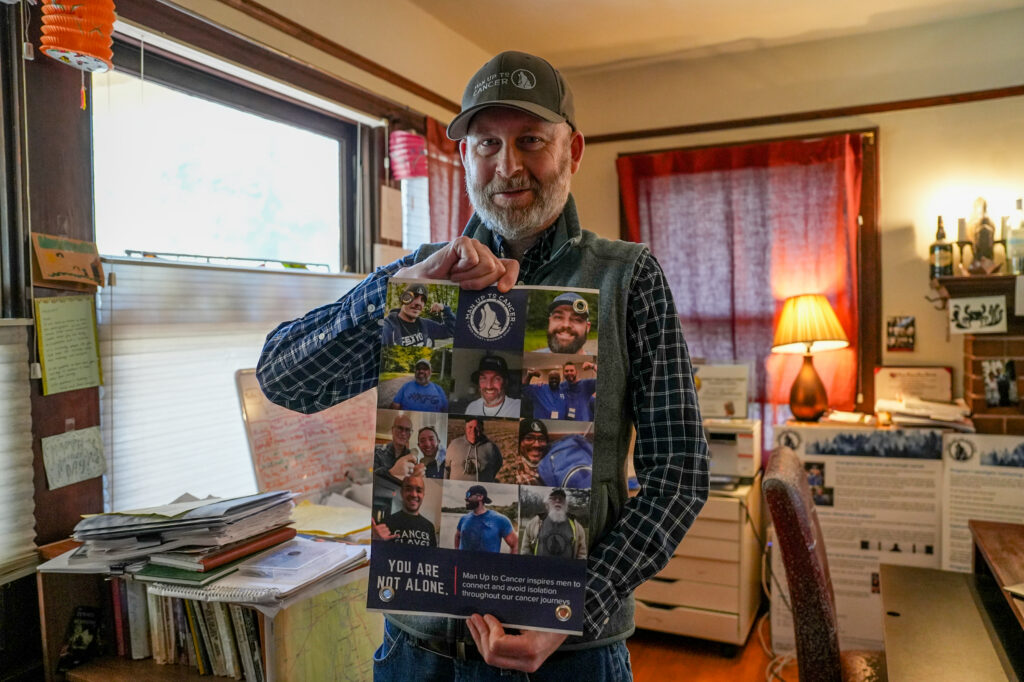
Man Up to Cancer’s Northern California chapter is led by Sacramento’s Brad Buchanan, who found his way to the organization after a near-death experience with the disease.
Other men’s support groups focus on trauma survivors, particularly veterans and first responders.
They help men face their vulnerability, accept their mortality and develop the ability to bond on an emotional level.
Brad Buchanan didn’t plan to lead a support group. He didn’t even want to be in one.
He was an English professor at Sacramento State, married, raising two young daughters. There was some work-related stress, but he had a pretty good life.
Until he was diagnosed with a rare form of cancer.
That was 10 years ago. After treatment for two different forms of cancer, a stem cell transplant, a near-death experience with graft-versus-host disease, and 18 months of blindness, Buchanan has found a new calling: leading the Northern California chapter of Man Up to Cancer.
The job doesn’t come with a salary or an office. But it’s Buchanan’s mission, carried out with Zoom, a phone and occasional trips to sports events. The most important tool of the trade is a good ear.
“The first thing I do when there’s a new member in my chapter is I give them my phone number and say, if you need to talk, I am here.”
‘I am vulnerable, and I need help.’
Members of Man Up to Cancer are neither seeking nor offering advice, Buchanan explained, just letting go of emotions they might not express at home or at work.
“It’s a safe space for guys to complain about, like, lack of support from their families, or financial trouble, which is endemic in the cancer world these days. Guys just saying, ‘I’m really sad, my life is gone, my wife has left, like, I got nothing.’ That’s code for, ‘I am vulnerable, and I need help.’”
Talking about cancer can be awkward. Talking about emotions can be downright difficult. The Man Up to Cancer website sums it up: “When faced with cancer, women tend to ‘reach out,’ and men tend to ‘check out.’”
“I’ve been reading a lot about emotions, and how men process them,” Buchanan said, “and how Western culture has socialized men to mistrust every other emotion besides anger, that anger’s really the only, quote, manly emotion.”
Male relationships ‘side-by-side’
Jason Jurado, meanwhile, views emotions from a non-cancer perspective. He coaches people who have experienced trauma, including military veterans and first responders with PTSD. Jurado served with the Marines in the Persian Gulf for Desert Shield/Desert Storm. Vulnerability, he says, is discouraged early in life.
“Men are taught that relationships are side-by-side, not face-to-face,” he said. “And that means we’re on a team, we’re together, we’re doing this mission, we’re facing the same direction. But when you go face-to-face, and it’s that one-on-one, we get scared.”
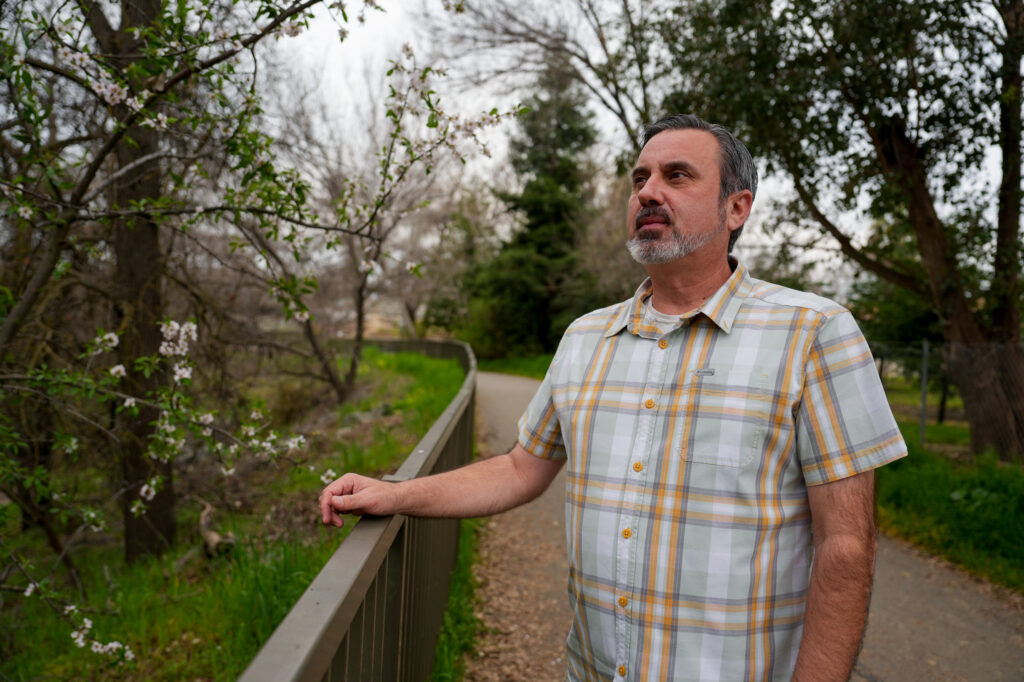 Jason Jurado at Putah Creek in Winters. (Denis Akbari)
Being afraid of hope
Buchanan felt a mix of emotions in his first experience with a cancer support group.
“I was overwhelmed and simply burst into tears. So, my wife had to fill people in. When she finished, I didn’t say much that was memorable or coherent, except ‘It’s the hope that kills you.’
“I think a lot of men feel overcome, even silenced, by helplessness coupled with shame.”
During treatment, Buchannan said, he felt “more positive emotions such as acceptance, gratitude, and even hope. What I said at that first meeting was wrong: Hope doesn’t kill you, but being afraid of feeling it certainly felt like a kind of death at the time.”
Masculinity at risk
Side effects of cancer and treatment, including erectile dysfunction, colostomies and ileostomies are part of the discussion.
“The treatments can really mess with your sexual health, plain and simple,” Buchanan pointed out. “So, whenever I’m onboarding a guy, I always talk about my experience with that. Because that is shorthand for, yes, cancer really does, or can, strike at the heart of how you conceive of your own masculinity.
“But as soon as you just say the word masculinity, you realize there’s a lot of ways of thinking about that. You realize, okay, just because I’m not at peak performance level, let’s say, in the bedroom, that doesn’t mean I’ve lost all masculinity.”
Some of the definition of masculinity goes back to the mythopoetic men’s movement of the 1970s and 80s, in which poet Robert Bly’s character Iron John inspired men to move beyond aggressive behavior and toxic masculinity, and instead connect with their inner strength. While women of the era were feeling “liberated,” men focused on nature and ancient myths.
“We’re reviving the mythopoetic men’s movement,” Buchanan said, “but we are actually addressing a serious problem — that a lot of men don’t deal well with bad medical news because that challenges our sense of who we ought to be within Western culture. And cancer blows all that stuff out of the water.”
Making peace with mortality
There is one hard truth in the discussion of cancer. Survival is not always the outcome. Buchanan, who came close to death, encourages that conversation.
“Yeah, that’s where I relate most to all this. I’m very frank about it. I say, get your s— together, get your house in order, you know? Write letters to your children, which I certainly did.
“Making peace with the fact of your mortality, because we’re gonna die at some point anyway.”
Groups create safe space for men
Rob Scronce is a member of Man Up to Cancer. He understands hesitation to join a group.
“I’m someone who struggles with informal friendship. It’s not always easy to find my way in or to feel welcome. I’m honestly not sure what we are doing with our time that we don’t participate in these kinds of groups so much.”
But when men do participate, Buchanan said, the energy shifts.
“Yeah, it’s funny. When the group creates a safe space for men to express their friendship with each other, guys will hug each other and say, ‘I love you, buddy,’ all the time. We have an obligation to respond to each other’s cancer talk.”
Illness reshapes identity
Paul Apodaca, a member of Man Up to Cancer who also coaches other patients, said illness has changed his perspective of friendship.
“It reshapes how you are,” he said, “both with existing friendships and with new ones. You prune people out of your life that aren’t creating the right space for you to battle this disease.”
Even as head of the regional chapter, with 30 members, Buchanan admits he is learning new ways to express himself.
“I’m not actually very good at this, because I’m more reserved, being a Canadian. I’m still trying to catch up to them.”
More than talking or listening, vulnerability contributes to the group dynamic.
“We’ve made ourselves a space where it’s safe to be vulnerable,” Buchanan said, “even if no one actually says, ‘Oh, here, I’m feeling vulnerable.’”
There are times when the guys are quiet. Silence is more than not talking. It’s the beginning of a deeper friendship.
In Jurado’s experience, group members who are vulnerable are the quiet ones.
“The new people showed up to the group, they were talking, and they were chatting, and they were animated, and the ones that have been in the group for years show up, and it’s hugs, handshakes. And just, ‘What’s up?’ And just kind of calm. That’s really how it shows up.”
Apodaca put it simply. “When you’re talking with someone who’s got that shared experience, there’s a lot that doesn’t need to be said.”
He offered his unique definition of vulnerability.
“If you were to talk to my wife — we joke about it all the time — I now watch Hallmark movies. Like, I will go out of my way to watch them. And I’ll get teary-eyed during them.”
Vulnerability is not binary. Man Up to Cancer is open to patients, survivors and care providers who are male or identify as male. Jason Jurado acknowledges that some career paths, such as law enforcement and the military, include women who hold back on vulnerability.
Vulnerability is the turning point
There is irony in this subject of vulnerability. Each of the men in this story talked about hesitation, but none of them hesitated in describing their fears and emotions.
Buchanan and Jurado both find it useful to express themselves through writing, and they encourage others to do the same. Buchanan has published several collections of poetry and a novel, Spy’s Mate (2025). He leads writing workshops for Man Up to Cancer and other organizations. In 2021, Buchanan’s then-wife, Kate Washington, published Already Toast: Caregiving and Burnout in America, based on their experience as a couple.
Jurado is a poet. He is also currently working on a book about alternative medicine. He reminds his clients that vulnerability is the product of inner strength.
“It just takes that one moment of strength – ‘Hey guys, I’m having a tough time’ – and starting there.”
Buchanan identifies vulnerability as a turning point.
“That’s why I like to tell people that Man Up to Cancer is actually redefining both masculinity and what it means to, quote, ‘man up.’ The original version of ‘man up’ is basically, shut up, don’t complain, get on with it. Well, manning up to cancer looks completely different. It’s actually the opposite of all of that messaging. So, that’s where I see a lot of hope.”
Brad Buchanan invites inquiries about Man Up to Cancer — buchanan@csus.edu
Donna Apidone is a regular contributor, writing Coming of Age for Abridged.